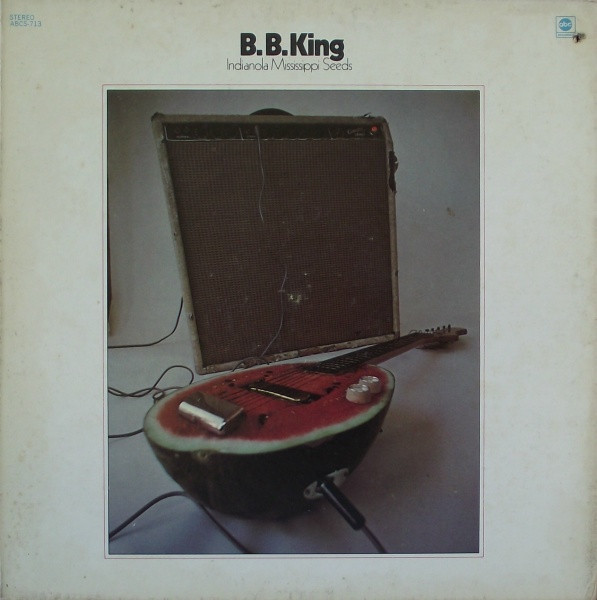
Released in October 1970 on ABC Records (catalog no. ABCS-713), Indianola Mississippi Seeds is B.B. King's eighteenth studio album and the ambitious follow-up to his breakthrough LP Completely Well (1969). Where Completely Well had introduced orchestral strings to the blues via the Grammy-winning smash "The Thrill Is Gone," Indianola Mississippi Seeds pushed further into crossover territory, matching King with a superstar cast of rock and pop luminaries. The result was one of King's most commercially successful and artistically daring albums—reaching #26 on the Billboard Pop Albums chart, #7 on the Jazz Albums chart, and #8 on the Black Albums chart—and an LP that King himself considered his finest artistic achievement.
Recording Sessions & Production
The album was recorded in May 1970 at The Record Plant in Los Angeles, with the exception of "Go Underground," which was cut at The Hit Factory in New York City.
Bill Szymczyk produced and engineered the album. Then in his late twenties, Szymczyk had already shepherded King through Live & Well (1969) and Completely Well, and it was his idea to surround the 44-year-old bluesman with young musicians rather than King's touring band. Szymczyk had moved to Los Angeles from New York earlier that year, and Indianola Mississippi Seeds was the first B.B. King record he cut on the West Coast.
The album's title and concept originated during the sessions when Szymczyk asked King where he was born. King replied "Indianola, Mississippi," and on a whim, Szymczyk asked if he had his birth certificate. King did, and it was reproduced inside the gatefold sleeve. The cover photograph—featuring a watermelon carved into the shape of a guitar, plugged into a battered amplifier—was shot by Ivan Nagy and designed by Robert Lockart, who together won the 1971 Grammy Award for Best Album Package.
Jimmie Haskell arranged the strings and horns, reprising the role he had played on "The Thrill Is Gone."
The engineering team included Szymczyk and Gary Kellgren at The Record Plant, with assistant engineers Lillianne Douma, Mike Stone, and John Henning. Joe Zagarino engineered the New York session for "Go Underground."
The Musicians
Szymczyk deliberately assembled a racially mixed band of young session players, half black and half white, drawn from the burgeoning Los Angeles studio scene.
-
B.B. King — Lead guitar, vocals, piano (track 1)
-
Carole King — Piano (tracks 2, 4), Fender Rhodes electric piano (tracks 6, 7). Then still relatively unknown (her solo breakthrough Tapestry would arrive the following year), Carole King had known Szymczyk since 1964 in New York.
-
Leon Russell — Piano (tracks 3, 5, 9), conductor (track 9). The Oklahoma singer-songwriter-pianist brought his earthy, blues-based keyboard style and provided the album's closing track, "Hummingbird."
-
Joe Walsh — Rhythm guitar (tracks 3, 5, 9). Then with the James Gang and on the cusp of joining the Eagles, Walsh added rock crunch and riffing fervor to the up-tempo tracks.
-
Hugh McCracken — Rhythm guitar (track 8). A veteran of the Completely Well sessions.
-
Paul Harris — Piano (track 8). Also from the Completely Well band.
-
Bryan Garofalo — Bass (tracks 2–7, 9). Szymczyk's go-to Los Angeles bassist.
-
Jerry Jemmott — Bass (track 8). Aretha Franklin's bassist and a holdover from the Completely Well/Live & Well sessions.
-
Russ Kunkel — Drums (tracks 2–7, 9). Szymczyk's regular L.A. rhythm partner, later famous for his work with Jackson Browne and countless others.
-
Herbie Lovelle — Drums (track 8). Another Completely Well veteran.
-
The "Angelic Chorus" — Background vocals on "Hummingbird": Sherlie Matthews, Merry Clayton (famous for her work on the Rolling Stones' "Gimme Shelter"), Clydie King, and Venetta Fields. Matthews, King, and Fields performed together as The Blackberries.
Track-by-Track Breakdown
Side One
1. "Nobody Loves Me But My Mother" (1:26)
Songwriter: B.B. King
Musicians: B.B. King (piano, vocals)
The album opens with a stark, solo blues piano piece—no guitar, no band, just King alone at the keyboard. The lyric is classic B.B. sardonic humor: "Nobody loves me but my mother / And she could be jivin' too."
At barely ninety seconds, it functions as an intimate overture, establishing that this will not be a conventional blues album. It is the only track on which King plays piano.
Songwriter: B.B. King
Musicians: B.B. King (piano, vocals)
The album opens with a stark, solo blues piano piece—no guitar, no band, just King alone at the keyboard. The lyric is classic B.B. sardonic humor: "Nobody loves me but my mother / And she could be jivin' too."
2. "You're Still My Woman" (6:04)
Songwriters: B.B. King & Dave Clark
Musicians: B.B. King (guitar, vocals), Carole King (piano), Bryan Garofalo (bass), Russ Kunkel (drums)
A brooding, mid-tempo blues ballad and the first of three collaborations with Tennessee songwriter Dave Clark.
Carole King's piano weaves beneath King's vocal and guitar with blues-bar sensitivity, while Jimmie Haskell's string arrangement adds cinematic depth without overwhelming the performance.
King's guitar solo is a masterclass in sustained, singing string bends.
Songwriters: B.B. King & Dave Clark
Musicians: B.B. King (guitar, vocals), Carole King (piano), Bryan Garofalo (bass), Russ Kunkel (drums)
A brooding, mid-tempo blues ballad and the first of three collaborations with Tennessee songwriter Dave Clark.
3. "Ask Me No Questions" (3:08)
Songwriter: B.B. King
Musicians: B.B. King (guitar, vocals), Leon Russell (piano), Joe Walsh (rhythm guitar), Bryan Garofalo (bass), Russ Kunkel (drums)
An up-tempo shuffle that became a hit single in early 1971, reaching #18 on the Billboard Black Singles chart and #40 on the Pop Singles chart.
Leon Russell's percussive, blues-drenched piano and Joe Walsh's rhythm guitar create a driving, rock-inflected groove. King's vocal is assertive and playful, his guitar cutting through the mix with trademark vibrato.
Songwriter: B.B. King
Musicians: B.B. King (guitar, vocals), Leon Russell (piano), Joe Walsh (rhythm guitar), Bryan Garofalo (bass), Russ Kunkel (drums)
An up-tempo shuffle that became a hit single in early 1971, reaching #18 on the Billboard Black Singles chart and #40 on the Pop Singles chart.
4. "Until I'm Dead and Cold" (4:45)
Songwriter: B.B. King
Musicians: B.B. King (guitar, vocals), Carole King (piano), Bryan Garofalo (bass), Russ Kunkel (drums)
A slow, reflective ballad that finds King in a monologue-style vocal delivery, paced with spasms of single-note guitar work.
The lyric is a pledge of romantic fidelity delivered with King's characteristic mix of tenderness and grit. Carole King's piano is subtle and empathetic, providing harmonic color without intruding.
Songwriter: B.B. King
Musicians: B.B. King (guitar, vocals), Carole King (piano), Bryan Garofalo (bass), Russ Kunkel (drums)
A slow, reflective ballad that finds King in a monologue-style vocal delivery, paced with spasms of single-note guitar work.
5. "King's Special" (5:10)
Songwriter: B.B. King
Musicians: B.B. King (lead guitar), Leon Russell (piano), Joe Walsh (rhythm guitar), Bryan Garofalo (bass), Russ Kunkel (drums)
The album's centerpiece instrumental. In a spoken introduction, King explains: "I got the idea from a train, but I wanted a beat so people could dance to it."
The track is built around a lively, funky groove with Garofalo and Kunkel locking in tight, Walsh adding rhythmic guitar texture, and Russell churning out bluesy riffs with melodic flair. King's lead guitar is in spectacular form, trading phrases with Russell in a brilliant guitar-piano duel.
Songwriter: B.B. King
Musicians: B.B. King (lead guitar), Leon Russell (piano), Joe Walsh (rhythm guitar), Bryan Garofalo (bass), Russ Kunkel (drums)
The album's centerpiece instrumental. In a spoken introduction, King explains: "I got the idea from a train, but I wanted a beat so people could dance to it."
Side Two
6. "Ain't Gonna Worry My Life Anymore" (5:18)
Songwriter: B.B. King
Musicians: B.B. King (guitar, vocals), Carole King (piano, Fender Rhodes electric piano), Bryan Garofalo (bass), Russ Kunkel (drums)
A swinging, defiant declaration of independence. Carole King's Fender Rhodes electric piano—an instrument rarely heard on blues records of this era—gives the track a warm, funky sheen.
King's vocal has the live-wire spirit of his classic concert recordings, and the track opens with a brief, playful bit of studio fooling around that adds to the relaxed atmosphere.
Songwriter: B.B. King
Musicians: B.B. King (guitar, vocals), Carole King (piano, Fender Rhodes electric piano), Bryan Garofalo (bass), Russ Kunkel (drums)
A swinging, defiant declaration of independence. Carole King's Fender Rhodes electric piano—an instrument rarely heard on blues records of this era—gives the track a warm, funky sheen.
7. "Chains and Things" (4:53)
Songwriters: B.B. King & Dave Clark
Musicians: B.B. King (guitar, vocals), Carole King (Fender Rhodes electric piano), Bryan Garofalo (bass), Russ Kunkel (drums)
The album's most celebrated track and its biggest hit, reaching #6 on the Billboard Black Singles chart and #45 on the Pop Singles chart in late 1970.
A brooding minor-key workout that functions as the Seeds equivalent of "The Thrill Is Gone," the song features a moody, atmospheric vamp from Carole King's electric piano and a soaring, soul-baring guitar solo from King.
Jimmie Haskell's string overdub adds cinematic tension. The lyrics—"Cold-hearted wrongdoing woman and a slave-driving boss / I just can't lose these chains and things"—carry a resonance that extends beyond personal romantic troubles into broader social territory, written in the shadow of the civil rights movement and Dr. King's assassination.
Songwriters: B.B. King & Dave Clark
Musicians: B.B. King (guitar, vocals), Carole King (Fender Rhodes electric piano), Bryan Garofalo (bass), Russ Kunkel (drums)
The album's most celebrated track and its biggest hit, reaching #6 on the Billboard Black Singles chart and #45 on the Pop Singles chart in late 1970.
8. "Go Underground" (4:00)
Songwriters: B.B. King & Dave Clark
Musicians: B.B. King (lead guitar, vocals), Paul Harris (piano), Hugh McCracken (rhythm guitar), Jerry Jemmott (bass), Herbie Lovelle (drums)
The only track not recorded in Los Angeles, "Go Underground" was cut at The Hit Factory in New York with the rhythm section from Completely Well: Jemmott, Lovelle, Harris, and McCracken.
The track has a slightly different feel from the L.A. cuts—a harder, more urban edge with McCracken's rhythm guitar and Harris's keyboard work creating a denser texture. It is the third and final Dave Clark collaboration.
Songwriters: B.B. King & Dave Clark
Musicians: B.B. King (lead guitar, vocals), Paul Harris (piano), Hugh McCracken (rhythm guitar), Jerry Jemmott (bass), Herbie Lovelle (drums)
The only track not recorded in Los Angeles, "Go Underground" was cut at The Hit Factory in New York with the rhythm section from Completely Well: Jemmott, Lovelle, Harris, and McCracken.
9. "Hummingbird" (4:36)
Songwriter: Leon Russell
Musicians: B.B. King (guitar, vocals), Leon Russell (piano, conductor), Joe Walsh (rhythm guitar), Bryan Garofalo (bass), Russ Kunkel (drums), Sherlie Matthews, Merry Clayton, Clydie King, Venetta Fields (background vocals)
The album closes with the only cover—a Leon Russell composition that Russell had recently recorded for his own self-titled debut album. Szymczyk brought it to King believing it had hit potential, and he was right: the single reached #25 on the Billboard Black Singles chart and #48 on the Pop Singles chart.
Russell conducts the session and plays piano, while the "Angelic Chorus" of Matthews, Clayton, Clydie King, and Fields transforms the song from darkly romantic blues ballad to gospel-tinged anthem.
It is the only track on which King does not take a guitar solo, letting the vocal and ensemble arrangement carry the weight.
Songwriter: Leon Russell
Musicians: B.B. King (guitar, vocals), Leon Russell (piano, conductor), Joe Walsh (rhythm guitar), Bryan Garofalo (bass), Russ Kunkel (drums), Sherlie Matthews, Merry Clayton, Clydie King, Venetta Fields (background vocals)
The album closes with the only cover—a Leon Russell composition that Russell had recently recorded for his own self-titled debut album. Szymczyk brought it to King believing it had hit potential, and he was right: the single reached #25 on the Billboard Black Singles chart and #48 on the Pop Singles chart.
Buy This Album
Critical Assessment & Legacy
Rolling Stone critic Gary Von Tersch, in a December 1970 review, captured the album's essence: "Nothing is overdone on this album, from the choice of material to the arrangements and production. B.B. is surrounded with people sensitive to his genius at work. The album displays the vital and ever-developing nature of this man King, who has been playing and wailing the blues for more than twenty of his forty-five years."
The album's success cemented Szymczyk's approach as the template for King's early-1970s studio work. The producer and artist would collaborate one more time on the highly regarded Live in Cook County Jail (1971) before Szymczyk moved on to his legendary work with the Eagles and Joe Walsh.
In the five decades since its release, Indianola Mississippi Seeds has come to be regarded as a gold standard for blues-rock crossover collaborations. The chemistry between B.B. King, Carole King, and Leon Russell set a template that countless subsequent blues-rock fusion projects have attempted to replicate.
Though it will always live in the shadow of Completely Well and Live at the Regal, Indianola Mississippi Seeds remains a pivotal document in B.B. King's career—the moment when the "King of the Blues" proved that his music could not only survive but thrive in the company of rock's brightest young stars, without ever sacrificing the emotional truth that made him great.