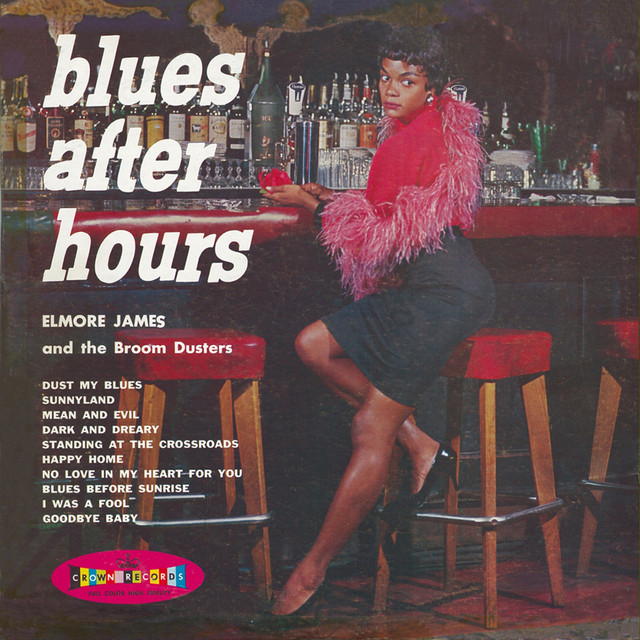
Released in 1960 on Crown Records (catalog no. CLP 5168), Blues After Hours occupies a singular place in blues history: it was the only album issued during Elmore James's lifetime, assembled from singles recorded between 1953 and 1955 for the Bihari brothers' Flair label.
What the Biharis packaged as a budget-priced compilation—complete with a lurid cover photograph of a woman at a bar—turned out to be one of the most consequential blues LPs ever issued, capturing the "King of the Slide Guitar" at the height of his early powers.
Recording Sessions & Production
The album was not recorded as a cohesive studio project but rather compiled from three distinct sessions spanning 1953 to 1955. All tracks were produced by the Bihari brothers—Jules, Saul, and Joe Bihari—the owners of Modern, Flair, Meteor, and Crown Records, who oversaw James's recordings after luring him away from Trumpet Records through their scout Ike Turner.
The Biharis operated Crown as a budget subsidiary, recycling previously released Flair singles into low-cost LPs with eye-catching covers. Yet despite its budget origins, the album presents a remarkably coherent portrait of James's art. As one contemporary reviewer noted, "when you get this sucker back home and pop it on the Dansette, you immediately realise that you are in the presence of genius."
The recordings span three cities and three distinct band configurations:
-
Chicago, August 1953 — James with his Chicago-based "Broomdusters"
-
Culver City, California, August/September 1954 — James with the Maxwell Davis Band
-
New Orleans, Summer 1955 — James with a New Orleans rhythm section
The Musicians
James's backing musicians were billed as "The Broomdusters"—a name derived from his signature hit "Dust My Broom." The personnel rotated across sessions:
-
Elmore James — Vocals, lead guitar (slide guitar on open D tuning), all tracks
-
Boyd Atkins — Alto sax, tenor sax (Chicago session)
-
J. T. Brown — Tenor sax (Chicago session)
-
Little Johnny Jones — Piano (Chicago session)
-
Ransom Knowling — Bass (Chicago session)
-
Odie Payne Jr. — Drums (Chicago session)
-
James Parr — Trumpet (Los Angeles session)
-
Maxwell Davis — Tenor sax (Los Angeles session)
-
Jewell Grant — Baritone sax (Los Angeles session)
-
Willard McDaniel — Piano (Los Angeles session)
-
Ralph "Chuck" Hamilton — Bass (Los Angeles session)
-
Jesse Sailes — Drums (Los Angeles session)
-
Edward Frank — Piano (New Orleans session)
-
Frank Fields — Bass (New Orleans session)
-
Earl Palmer — Drums (New Orleans session)
-
Unknown backing vocalists — The Don Ralke Singers (dubbed onto "Goodbye Baby" in Los Angeles)
Track-by-Track Breakdown
Side One
1. "Dust My Blues" (3:11)
Songwriter: Adapted by Elmore James from Robert Johnson's "I Believe I'll Dust My Broom" (1936)
Recorded: New Orleans, Summer 1955
Musicians: Elmore James (vocals, slide guitar), Edward Frank (piano), Frank Fields (bass), Earl Palmer (drums)
The album opens with James's signature tune and the most famous blues guitar riff in history. Originally recorded for Trumpet Records in 1951 as "Dust My Broom," this 1955 Flair re-recording—retitled "Dust My Blues"—captures the same electrifying slide guitar figure that James adapted from Robert Johnson's acoustic original.
Where Johnson played the triplet figure fretted, James used a slide in open D tuning, transforming it into a "machine-gun triplet beat" that would define electric blues.
The New Orleans session gives the track a slightly different feel from the 1951 original, with Earl Palmer's drumming adding a subtle Crescent City swing.
Songwriter: Adapted by Elmore James from Robert Johnson's "I Believe I'll Dust My Broom" (1936)
Recorded: New Orleans, Summer 1955
Musicians: Elmore James (vocals, slide guitar), Edward Frank (piano), Frank Fields (bass), Earl Palmer (drums)
The album opens with James's signature tune and the most famous blues guitar riff in history. Originally recorded for Trumpet Records in 1951 as "Dust My Broom," this 1955 Flair re-recording—retitled "Dust My Blues"—captures the same electrifying slide guitar figure that James adapted from Robert Johnson's acoustic original.
2. "Sunnyland" (3:19)
Songwriter: Elmore James
Recorded: Culver City, California, August/September 1954
Musicians: Elmore James (vocals, guitar), James Parr (trumpet), Maxwell Davis (tenor sax), Jewell Grant (baritone sax), Willard McDaniel (piano), Ralph "Chuck" Hamilton (bass), Jesse Sailes (drums)
A driving shuffle named after the famous Mississippi-to-Chicago train, "Sunnyland" showcases the full Maxwell Davis horn section. The track was originally released as the B-side to "Standing at the Crossroads" on Flair 1057 in October 1954. James's vocal is urgent and impassioned, while his guitar weaves through the horn lines with characteristic precision.
3. "Mean and Evil" (2:16)
Songwriter: Elmore James
Recorded: Culver City, California, August/September 1954
Musicians: Elmore James (vocals, guitar), James Parr (trumpet), Maxwell Davis (tenor sax), Jewell Grant (baritone sax), Willard McDaniel (piano), Ralph "Chuck" Hamilton (bass), Jesse Sailes (drums)
Also known as "The Way You Treat Me" (its original A-side title on Flair 1062), this is a compact, two-minute blast of fury. The track demonstrates James's ability to convey menace without raising his voice—his delivery is cool, almost detached, while the lyrics paint a portrait of a dangerous woman. The horn section punches in short, staccato bursts, adding to the track's air of barely contained violence.
4. "Dark and Dreary" (2:48)
Songwriter: Elmore James
Recorded: Chicago, August 1953
Musicians: Elmore James (vocals, guitar), Boyd Atkins (baritone sax, alto sax), J. T. Brown (tenor sax), Little Johnny Jones (piano), Ransom Knowling (bass), Odie Payne Jr. (drums)
The earliest recording on the album, cut during James's first sessions for the Bihari brothers. Originally released as the A-side of Flair 1048 in 1954 (with "Rock My Baby Right" as the B-side), the track features a rawer, more stripped-down Chicago sound compared to the later Los Angeles and New Orleans sessions. J. T. Brown's tenor sax wails behind James's vocal, while Little Johnny Jones's piano adds sparse, atmospheric fills. The mood is appropriately dark and brooding.
5. "Standing at the Crossroads" (2:47)
Songwriter: Adapted by Elmore James from Robert Johnson's "Cross Road Blues" (1936)
Recorded: Culver City, California, August/September 1954
Musicians: Elmore James (vocals, guitar), James Parr (trumpet), Maxwell Davis (tenor sax), Jewell Grant (baritone sax), Willard McDaniel (piano), Ralph "Chuck" Hamilton (bass), Jesse Sailes (drums)
James's electrified reworking of Robert Johnson's "Cross Road Blues" became a staple for British blues-rock bands of the 1960s, including Cream.
Where Johnson's original was a solo acoustic performance filled with Delta mystery, James's version is a full-band declaration, with the Maxwell Davis horns providing a brassy urgency. The slide guitar is less prominent here than on "Dust My Blues," allowing James's vocal—world-weary yet defiant—to take center stage. Originally released as Flair 1057 in October 1954.
Songwriter: Adapted by Elmore James from Robert Johnson's "Cross Road Blues" (1936)
Recorded: Culver City, California, August/September 1954
Musicians: Elmore James (vocals, guitar), James Parr (trumpet), Maxwell Davis (tenor sax), Jewell Grant (baritone sax), Willard McDaniel (piano), Ralph "Chuck" Hamilton (bass), Jesse Sailes (drums)
James's electrified reworking of Robert Johnson's "Cross Road Blues" became a staple for British blues-rock bands of the 1960s, including Cream.
Side Two
6. "Happy Home" (2:46)
Songwriter: Elmore James
Recorded: Culver City, California, August/September 1954
Musicians: Elmore James (vocals, guitar), James Parr (trumpet), Maxwell Davis (tenor sax), Jewell Grant (baritone sax), Willard McDaniel (piano), Ralph "Chuck" Hamilton (bass), Jesse Sailes (drums)
A mid-tempo shuffle that became the A-side of Flair 1069 in May 1955. James's vocal is unusually tender here, singing of domestic contentment with a hint of underlying tension. The Maxwell Davis band provides a smooth, almost jazz-tinged backdrop, with Willard McDaniel's piano offering particularly tasteful fills. The track demonstrates that James was capable of subtlety as well as raw power.
7. "No Love in My Heart" (2:35)
Songwriter: Elmore James
Recorded: Culver City, California, August/September 1954
Musicians: Elmore James (vocals, guitar), James Parr (trumpet), Maxwell Davis (tenor sax), Jewell Grant (baritone sax), Willard McDaniel (piano), Ralph "Chuck" Hamilton (bass), Jesse Sailes (drums)
The B-side to "Happy Home" (Flair 1069). A classic blues lament that finds James in a more traditional 12-bar structure. His guitar tone is biting and trebly, cutting through the horn section with a sound that would influence generations of British guitarists, from Peter Green to Eric Clapton.
8. "Blues Before Sunrise" (2:50)
Songwriter: Leroy Carr
Recorded: New Orleans, Summer 1955
Musicians: Elmore James (vocals, guitar), Edward Frank (piano), Frank Fields (bass), Earl Palmer (drums)
The only cover on the album not derived from Robert Johnson. Originally recorded by Leroy Carr and Scrapper Blackwell in 1934, this song became a blues standard that found renewed favor during the 1960s blues boom.
James transforms the piano-based original into a guitar showcase, his slide work adding a layer of Mississippi Delta grit to Carr's urbane classic. The New Orleans rhythm section—particularly Earl Palmer's drumming—gives the track a relaxed, almost lazy groove that contrasts with James's urgent vocal.
Songwriter: Leroy Carr
Recorded: New Orleans, Summer 1955
Musicians: Elmore James (vocals, guitar), Edward Frank (piano), Frank Fields (bass), Earl Palmer (drums)
The only cover on the album not derived from Robert Johnson. Originally recorded by Leroy Carr and Scrapper Blackwell in 1934, this song became a blues standard that found renewed favor during the 1960s blues boom.
9. "I Was a Fool" (2:40)
Songwriter: Elmore James
Recorded: New Orleans, Summer 1955
Musicians: Elmore James (vocals, guitar), Edward Frank (piano), Frank Fields (bass), Earl Palmer (drums)
The B-side to "Dust My Blues" (Flair 1074, August 1955). A straightforward blues shuffle that finds James in a reflective mood, looking back on a failed relationship with the kind of stoic acceptance that characterizes his best work. Edward Frank's piano is more prominent here than on "Dust My Blues," providing a rolling counterpoint to James's stinging guitar phrases.
10. "Goodbye Baby" (2:55)
Songwriter: Elmore James
Recorded: New Orleans, Summer 1955; vocal overdub: Los Angeles
Musicians: Elmore James (vocals, guitar), Edward Frank (piano), Frank Fields (bass), Earl Palmer (drums), plus The Don Ralke Singers (backing vocals, dubbed in Los Angeles)
Originally released as the B-side to "Blues Before Sunrise" (Flair 1079, November 1955). The track is notable for the addition of The Don Ralke Singers, a vocal group dubbed onto the New Orleans recording in a Los Angeles studio—one of the few instances of production sweetening on any Elmore James recording.
The backing vocals add a slightly pop-oriented sheen that was unusual for James, though his raw guitar and impassioned vocal remain firmly in the blues idiom. The track closes the album on a note of romantic resignation.
Songwriter: Elmore James
Recorded: New Orleans, Summer 1955; vocal overdub: Los Angeles
Musicians: Elmore James (vocals, guitar), Edward Frank (piano), Frank Fields (bass), Earl Palmer (drums), plus The Don Ralke Singers (backing vocals, dubbed in Los Angeles)
Originally released as the B-side to "Blues Before Sunrise" (Flair 1079, November 1955). The track is notable for the addition of The Don Ralke Singers, a vocal group dubbed onto the New Orleans recording in a Los Angeles studio—one of the few instances of production sweetening on any Elmore James recording.
Buy This Album
Critical Assessment & Legacy
Blues After Hours was not conceived as a major artistic statement. It was a budget-label compilation designed to capitalize on James's singles catalog. Yet the album's ten tracks represent such a consistently high level of quality that it has come to be regarded as one of the essential blues LPs of the era. As one reviewer observed, "every one is a winner. And then some, for the final two tracks are gobsmackingly brilliant."
The album's influence extends far beyond its modest origins. The British blues-rock explosion of the 1960s—Fleetwood Mac, Eric Clapton, the Rolling Stones—drew heavily from the songs collected here.
The Beatles even referenced James in their song "For You Blue," with George Harrison declaring, "Elmore James got nothin' on this, baby."
Tragically, James died of a heart attack in 1963 at age 45, just before he was scheduled to tour Europe with the American Folk Blues Festival.
He never saw the full extent of his influence. Blues After Hours remains his only album released during his lifetime, and as such, it stands as the definitive document of his early genius—a raw, powerful, and utterly essential collection that captures the moment when Mississippi Delta blues was electrified and transformed into something that would change popular music forever.