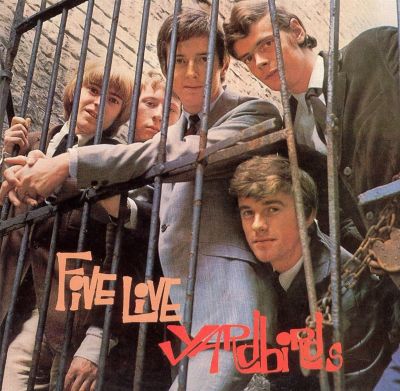
Released on December 4, 1964 by the Columbia Graphophone Company in the United Kingdom, Five Live Yardbirds is the live debut album by the English rock band the Yardbirds and one of the most consequential live recordings to emerge from the 1960s British R&B boom. Capturing the group at London's legendary Marquee Club during their Eric Clapton era, the album is widely regarded as the first essential live document of the British blues explosion and a blueprint for the extended jam-based rock that would soon follow.
Recording Sessions & Production
The album was recorded on March 20, 1964 at the Marquee Club on Wardour Street in London. The exact date was long disputed—previously listed as March 10—but Yardbirds biographer Gregg Russo established that March 20 was far more likely, since the club was still at its Oxford Street location on the 10th, and the Yardbirds played Fridays at the Wardour Street venue.
The recording conditions and equipment at the Marquee were described as "less than ideal," yet the band capitalized on their growing popularity and the electric atmosphere of the club.
Giorgio Gomelsky served as both producer and author of the liner notes. The Swiss-born filmmaker, club owner, and impresario had managed the Yardbirds since October 1963, when they took over the Rolling Stones' residency at his Crawdaddy Club in Richmond. Gomelsky was instrumental in shaping the band's early career and successfully persuaded Columbia to release a live album as their debut LP after their first two singles—"I Wish You Would" and "Good Morning Little Schoolgirl"—had achieved only limited success.
Phillip Wood engineered the recording and handled sound effects. The album was not issued in the United States at the time; however, four tracks were later included on the Yardbirds' second American album, Having a Rave Up with the Yardbirds (November 1965). A planned standalone U.S. release in 1966 with different cover art was prepared but never followed through.
The Musicians
The album captures the classic early Yardbirds lineup that had formed in late 1963 after original lead guitarist Top Topham left for art school and was replaced by Eric Clapton.
-
Eric "Slowhand" Clapton — Lead guitar, co-lead vocals on "Good Morning Little Schoolgirl." Then just 18 years old, Clapton had already developed a fluid, authoritative blues guitar style that set a new standard for British players. It was during these Marquee performances that Clapton frequently broke guitar strings while changing them, prompting the audience to engage in slow handclapping—leading Gomelsky to coin his famous nickname, "Slowhand."
-
Keith Relf — Lead vocals (except on "Good Morning Little Schoolgirl"), harmonica, maracas. The band's frontman and a capable blues harp player, though critics have noted his vocal style leaned more toward reverent emulation than raw ferocity.
-
Chris Dreja — Rhythm guitar. Dreja's role was strictly rhythmic, leaving him without the solo voice that rhythm guitarists in other bands sometimes enjoyed.
-
Paul "Sam" Samwell-Smith — Bass guitar, co-lead vocals on "Good Morning Little Schoolgirl." Samwell-Smith is credited by Clapton with inventing the Yardbirds' signature "rave up" technique—extended instrumental interludes that built to a climactic peak.
-
Jim McCarty — Drums. McCarty's drumming on the album is notably energetic and propulsive, particularly on the extended rave-up numbers where he drives the band into frenzied territory.
Track-by-Track Breakdown
All songs on the original album are covers of American blues and R&B material. The album contains no original compositions, reflecting the repertoire-based nature of the early British R&B scene.
Side One
1. "Too Much Monkey Business" (3:51)
Songwriter: Chuck Berry
The album opens with a Chuck Berry rocker that sets an immediate high-energy tone. Clapton biographer David Bowling described it as "the most rock-oriented song on the album."
Clapton's lead guitar is sharp and aggressive, transforming Berry's playful original into a rallying cry with what one reviewer called "an almost military-like order and elegance to that onslaught without sacrificing the rage and fury."
Relf's vocal is earnest if somewhat polite compared to the guitar fire underneath.
Songwriter: Chuck Berry
The album opens with a Chuck Berry rocker that sets an immediate high-energy tone. Clapton biographer David Bowling described it as "the most rock-oriented song on the album."
2. "Got Love If You Want It" (2:40)
Songwriter: Slim Harpo (James Moore)
A cover of the Louisiana swamp bluesman's 1957 Excello single. The Yardbirds deliver it as a tight, grooving R&B shuffle. Relf takes a harmonica solo, and the track demonstrates the band's ability to lock into a relaxed but insistent dance groove. At under three minutes, it is one of the more compact performances on the album.
3. "Smokestack Lightning" (5:35)
Songwriter: Howlin' Wolf (Chester Burnett)
The Yardbirds' most popular live number and the album's centerpiece. What had been a creepy, voodoo-laden solo showpiece for Howlin' Wolf is transformed into a collective bombastic ritual.
Relf and Clapton trade riffs in one of the album's highlights, while Jim McCarty summons what has been described as "Keith Moon-like powers" behind the drum kit.
Live performances of the song could reportedly stretch to 30 minutes; the album version captures a mere fraction of that potential but still packs enormous proto-psychedelic power. Howlin' Wolf himself reportedly referred to the Yardbirds' version as "the definitive version of his song."
Songwriter: Howlin' Wolf (Chester Burnett)
The Yardbirds' most popular live number and the album's centerpiece. What had been a creepy, voodoo-laden solo showpiece for Howlin' Wolf is transformed into a collective bombastic ritual.
4. "Good Morning Little Schoolgirl" (2:42)
Songwriter: H. G. Demarais
Based on the version by the American R&B duo Don and Bob, this track features Clapton and Samwell-Smith sharing lead vocals—a rare instance of Clapton singing during his Yardbirds tenure.
The studio version of this song (recorded earlier as a single) featured a fine Clapton guitar solo, but the live version spotlights Relf's harmonica instead.
Songwriter: H. G. Demarais
Based on the version by the American R&B duo Don and Bob, this track features Clapton and Samwell-Smith sharing lead vocals—a rare instance of Clapton singing during his Yardbirds tenure.
5. "Respectable" (5:35)
Songwriters: O'Kelly Isley, Ronald Isley, Rudolph Isley
A high-energy Isley Brothers cover that showcases the "rave up" technique in full force. The band uses the double-time feature for the entire song, creating a frenzied dance groove.
The track is primarily about crowd energy rather than solo virtuosity, with the entire band kicking into overdrive.
Songwriters: O'Kelly Isley, Ronald Isley, Rudolph Isley
A high-energy Isley Brothers cover that showcases the "rave up" technique in full force. The band uses the double-time feature for the entire song, creating a frenzied dance groove.
Side Two
6. "Five Long Years" (5:18)
Songwriter: Eddie Boyd
The slow blues standard gives Clapton his most extended solo spotlight on the album. His playing here anticipates the style he would further develop with John Mayall & the Bluesbreakers the following year.
The recording quality makes it somewhat difficult to discern every nuance of his Telecaster tone through the dense rhythm section, but the emotional authority and fluidity of his phrasing are already apparent.
Songwriter: Eddie Boyd
The slow blues standard gives Clapton his most extended solo spotlight on the album. His playing here anticipates the style he would further develop with John Mayall & the Bluesbreakers the following year.
7. "Pretty Girl" (3:04)
Songwriter: Bo Diddley (Ellas McDaniel)
A Bo Diddley rave-up designed primarily for dancing crowds. The track is energetic but less expansive than "Smokestack Lightning" or "Here 'Tis," serving as a compact burst of rhythmic swagger before the album's final stretch.
Songwriter: Bo Diddley (Ellas McDaniel)
A Bo Diddley rave-up designed primarily for dancing crowds. The track is energetic but less expansive than "Smokestack Lightning" or "Here 'Tis," serving as a compact burst of rhythmic swagger before the album's final stretch.
8. "Louise" (3:43)
Songwriter: John Lee Hooker
One of the three tracks on which Clapton gets a proper solo spot, alongside "Too Much Monkey Business" and "Five Long Years."
The John Lee Hooker boogie is adapted into a more structured band arrangement, with Clapton's guitar weaving around Relf's vocal and harp.
Songwriter: John Lee Hooker
One of the three tracks on which Clapton gets a proper solo spot, alongside "Too Much Monkey Business" and "Five Long Years."
9. "I'm a Man" (4:33)
Songwriter: Bo Diddley (Ellas McDaniel)
The Bo Diddley classic that the Yardbirds would later record with Jeff Beck and turn into a major hit. The Clapton-era version is rawer and more faithful to the Chicago blues template, with a steady, menacing groove. Samwell-Smith's bass is prominent, laying the groundwork for the rave-up dynamic.
10. "Here 'Tis" (5:10)
Songwriter: Bo Diddley (Ellas McDaniel)
The album closer and perhaps its most explosive moment. AllMusic critic Matthew Greenwald described it as "driven by a furious 'Bo Diddley' beat and rhythm... Clapton's interplay with bassist Paul Samwell-Smith is one of the great moments in the band's recorded history."
The rhythm section generates what one reviewer called a "mammoth groove," with McCarty's drumming reaching a level of "spirited bombast" rarely heard from British players of the era.
Songwriter: Bo Diddley (Ellas McDaniel)
The album closer and perhaps its most explosive moment. AllMusic critic Matthew Greenwald described it as "driven by a furious 'Bo Diddley' beat and rhythm... Clapton's interplay with bassist Paul Samwell-Smith is one of the great moments in the band's recorded history."
Buy This Album
Critical Reception & Legacy
Upon its release in December 1964, Five Live Yardbirds received generally favorable reviews—one contemporary notice praised its "raucous interplay... great guitar... feral energy of the ensemble"—but it failed to chart in the UK.
Retrospective assessment has been far more generous. AllMusic's Bruce Eder awarded it four and a half out of five stars, calling it "the first important—indeed, essential—live album to come out of the 1960s British rock & roll boom" and noting that "in terms of the performance captured and the recording quality, it was also the best such live record of the entire middle of the decade."
Rick Clark of AllMusic observed that the open-ended improvisations on "Smokestack Lightning" and other tracks "helped lay the groundwork for groups like Cream and the Jimi Hendrix Experience."
Ultimate Classic Rock included the album in its list of "Top 100 Live Albums," describing it as "an explosive document of a British blues band fueling a decidedly American music with power, fireworks and amped-up resourcefulness."
The album's significance extends beyond its musical content. It is the only official document of the Eric Clapton-era Yardbirds playing in their natural habitat—the cramped, sweaty London R&B clubs where the British blues revolution was actually happening, rather than in the sterile confines of a television studio or recording booth. As one critic noted, Five Live Yardbirds "lets you hear what a genuine club-based 'rave-up' sounded like at the time" and "penetrates those 'wild and innocent days' like nothing else—before egos and drugs took over."
Though Clapton would depart the band within months of the album's release (frustrated by the pop direction of "For Your Love"), Five Live Yardbirds remains the definitive portrait of the Yardbirds as a raw, hungry R&B unit—and one of the most important live albums in rock history.