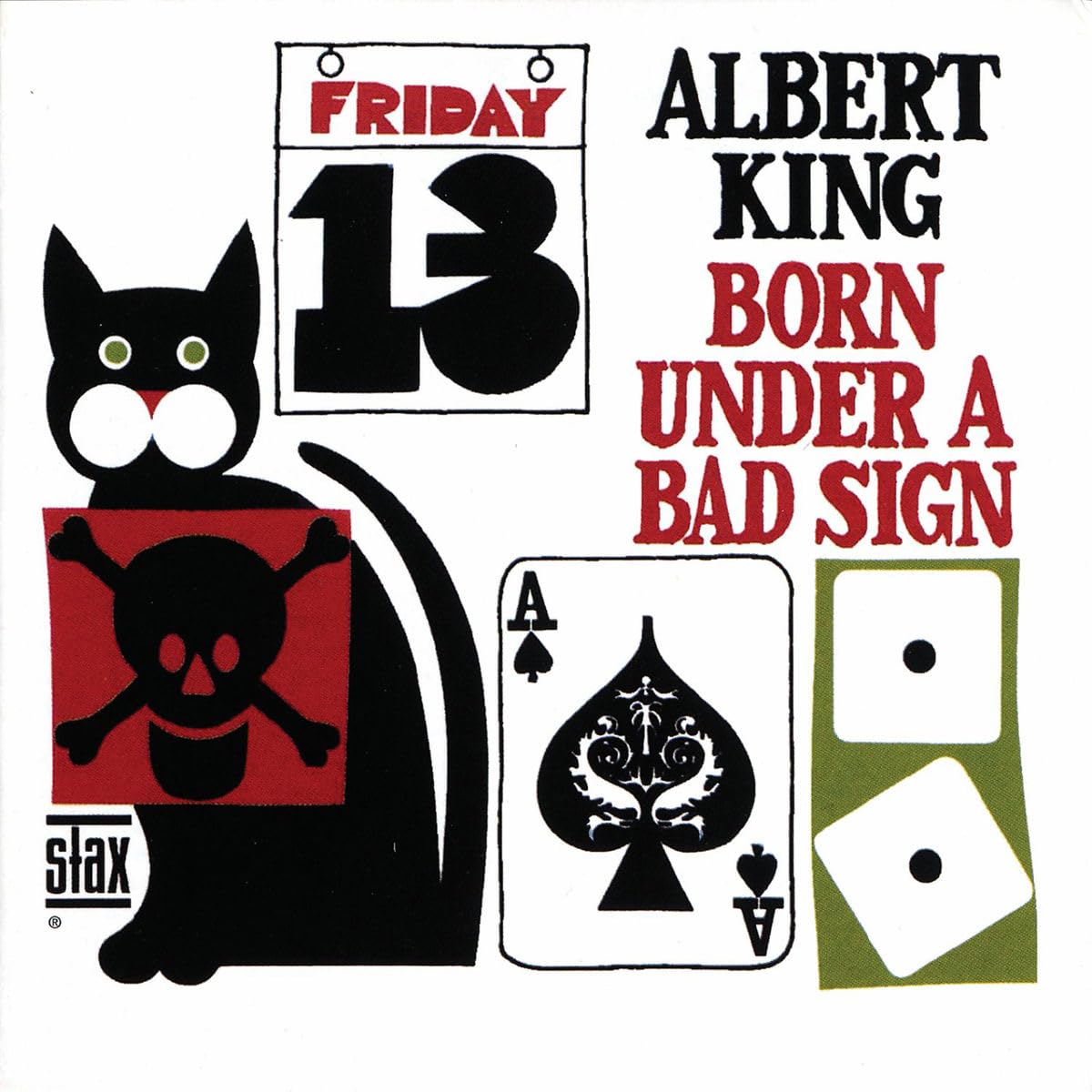
Released in August 1967 on Stax Records, Born Under a Bad Sign is Albert King's second studio album and his debut for the Memphis label that would define the final, most influential phase of his career. Though it failed to reach any album chart upon release, it has since been recognized as one of the greatest blues albums ever recorded—inducted into the Blues Foundation Hall of Fame, the Grammy Hall of Fame, and the National Recording Registry.
In 2012, Rolling Stone ranked it at #491 on its list of the 500 Greatest Albums of All Time.
Recording Sessions & Production
The album was compiled from five sessions recorded between March 3, 1966 and June 9, 1967 at Stax Recording Studio in Memphis, Tennessee.
Jim Stewart is credited as producer, though trumpeter Wayne Jackson later stated that Steve Cropper and Al Jackson Jr. effectively ran the recording sessions.
The sessions were notably informal. As Al Jackson Jr. later admitted: "We didn't know how to play it any better!"
King came to Stax through Al Bell, a Little Rock native who had met King while he played shows in the area.
At age 43, King had already recorded for labels like Vee-Jay, Parrot, and Bobbin without finding sustained commercial success. Stax changed everything.
King's guitar sound on the album is utterly distinctive. A left-handed player, he chose to play a right-handed Gibson Flying V without restringing it, pulling strings from above instead of pushing from below—the standard bending technique.
As Wayne Jackson memorably put it: "Albert's guitar was always out of tune with everything else, but he was such a strong man he would just bend the notes back in!"
The Musicians
-
Albert King — Lead guitar, vocals
-
Booker T. Jones — Keyboards, organ, piano
-
Steve Cropper — Rhythm guitar
-
Donald "Duck" Dunn — Bass guitar
-
Al Jackson Jr. — Drums
-
Wayne Jackson — Trumpet (Memphis Horns)
-
Andrew Love — Tenor saxophone (Memphis Horns)
-
Joe Arnold — Baritone saxophone, flute
-
Raymond Hill — Tenor saxophone
-
Isaac Hayes — Piano (on select tracks, including "Laundromat Blues" and "As the Years Go Passing By")
Track-by-Track Breakdown
Side One
1. "Born Under a Bad Sign" (2:47)
Songwriters: William Bell & Booker T. Jones
Musicians: Albert King (guitar, vocals), Booker T. Jones (organ/piano), Steve Cropper (rhythm guitar), Duck Dunn (bass), Al Jackson Jr. (drums), Memphis Horns
The title track and one of the most iconic blues songs of the modern era. The song originated when William Bell came to Booker T. Jones's house with a deadline: they needed a song for Albert King's session the next day. Jones came up with the thundering bass riff, and Bell supplied the immortal lyric: "If it wasn't for bad luck, I wouldn't have no luck at all."
The song reached #49 on the Billboard R&B chart and was immediately covered by Cream on their 1968 album Wheels of Fire.
Music historian Rob Bowman called it "one of the most smokingly intense blues recordings of the modern era."
Songwriters: William Bell & Booker T. Jones
Musicians: Albert King (guitar, vocals), Booker T. Jones (organ/piano), Steve Cropper (rhythm guitar), Duck Dunn (bass), Al Jackson Jr. (drums), Memphis Horns
The title track and one of the most iconic blues songs of the modern era. The song originated when William Bell came to Booker T. Jones's house with a deadline: they needed a song for Albert King's session the next day. Jones came up with the thundering bass riff, and Bell supplied the immortal lyric: "If it wasn't for bad luck, I wouldn't have no luck at all."
2. "Crosscut Saw" (2:35)
Songwriter: R.G. Ford
Musicians: Same core band
A song that dates back to 1941, when Delta bluesman Tommy McClennan recorded it for Bluebird.
A.C. "Moohah" Williams, a veteran DJ at Memphis R&B station WDIA-AM, brought it to King's attention.
Al Jackson Jr.'s drum pattern is the secret weapon—a clickety-clack, loping calypso-inflected beat that transforms the blues into something almost Latin.
King's vocal is oddly muted, letting the guitar and horns do the talking.
Songwriter: R.G. Ford
Musicians: Same core band
A song that dates back to 1941, when Delta bluesman Tommy McClennan recorded it for Bluebird.
3. "Kansas City" (2:33)
Songwriters: Jerry Leiber & Mike Stoller
Musicians: Same core band
King's urban blues treatment of the Leiber/Stoller R&B standard, originally a hit for Wilbert Harrison. The arrangement is light and swinging, with lovely drum kicks and horn lifts from the Memphis Horns.
King's almost-spoken vocal sits atop Duck Dunn's gorgeous walking bass line.
Songwriters: Jerry Leiber & Mike Stoller
Musicians: Same core band
King's urban blues treatment of the Leiber/Stoller R&B standard, originally a hit for Wilbert Harrison. The arrangement is light and swinging, with lovely drum kicks and horn lifts from the Memphis Horns.
4. "Oh, Pretty Woman" (2:48)
Songwriter: A.C. Williams
Musicians: Same core band
Written by A.C. "Moohah" Williams, the same WDIA DJ who brought "Crosscut Saw" to King's attention.
A swaggering, muscular blues that Eric Clapton later copied almost note-for-note for Cream's "Strange Brew."
Cropper's rhythm guitar is essential here, providing the steady bed over which King's lead licks dance.
Songwriter: A.C. Williams
Musicians: Same core band
Written by A.C. "Moohah" Williams, the same WDIA DJ who brought "Crosscut Saw" to King's attention.
5. "Down Don't Bother Me" (2:10)
Songwriter: Albert King
Musicians: Same core band
One of only two King originals on the album. A compact, hard-luck blues built around a familiar pattern, with King's voice and single-note guitar licks alternating in a call-and-response that strongly recalls B.B. King.
At barely two minutes, it is the shortest track on the album and one of the most concentrated bursts of blues power.
Songwriter: Albert King
Musicians: Same core band
One of only two King originals on the album. A compact, hard-luck blues built around a familiar pattern, with King's voice and single-note guitar licks alternating in a call-and-response that strongly recalls B.B. King.
6. "The Hunter" (2:45)
Songwriters: Booker T. Jones, Carl Wells, Steve Cropper, Donald Dunn, Al Jackson Jr.
Recorded: June 9, 1967
Musicians: Same core band
A song that fell into the band's lap. Carl Wells, an older songwriter who hung around the studio, brought in lyrics that Cropper found "pretty cool." The band started a groove, King began singing, and a classic was born.
The track is as trademark Booker T. & the M.G.'s as "Green Onions"—a pulsating stew of a track on high flame.
Ike & Tina Turner later covered it in 1969, taking it to #37 on the R&B chart.
Songwriters: Booker T. Jones, Carl Wells, Steve Cropper, Donald Dunn, Al Jackson Jr.
Recorded: June 9, 1967
Musicians: Same core band
A song that fell into the band's lap. Carl Wells, an older songwriter who hung around the studio, brought in lyrics that Cropper found "pretty cool." The band started a groove, King began singing, and a classic was born.
Side Two
7. "I Almost Lost My Mind" (3:30)
Songwriter: Ivory Joe Hunter
Musicians: Same core band, with Joe Arnold on flute
A rare King ballad—a countrypolitan weeper with jazz flute from Joe Arnold, an unlikely showcase for King's rich baritone.
The track demonstrates King's range, moving from the hard blues of Side One to something closer to Nat King Cole territory.
Songwriter: Ivory Joe Hunter
Musicians: Same core band, with Joe Arnold on flute
A rare King ballad—a countrypolitan weeper with jazz flute from Joe Arnold, an unlikely showcase for King's rich baritone.
8. "Personal Manager" (4:31)
Songwriters: Albert King & David Porter
Musicians: Same core band, with Isaac Hayes on piano
The album's longest track and one of its funkiest. King received songwriting help from David Porter, on leave from his usual collaboration with Isaac Hayes.
The song is a come-on in the proud tradition, and features one of the few extended guitar solos on the album. When King tears into it, the Memphis Horns initially engage in call-and-response but eventually give up; the indomitable King wins the round.
Songwriters: Albert King & David Porter
Musicians: Same core band, with Isaac Hayes on piano
The album's longest track and one of its funkiest. King received songwriting help from David Porter, on leave from his usual collaboration with Isaac Hayes.
9. "Laundromat Blues" (3:21)
Songwriter: Sandy Jones
Musicians: Albert King (guitar, vocals), Booker T. Jones (piano), Duck Dunn (bass), Al Jackson Jr. (drums), Memphis Horns, Raymond Hill (tenor sax)
King's first Stax recording and the song that got him signed. King had wandered into Estelle Axton's Satellite Records shop with a demo of this song, composed by Sandy Jones, a songwriter from Indiana.
Axton believed it could be a hit, and she was right—the single became King's second charting single ever, reaching #29 on the R&B chart.
Isaac Hayes reportedly tickles the keys behind King on this slow, smoldering blues.
Songwriter: Sandy Jones
Musicians: Albert King (guitar, vocals), Booker T. Jones (piano), Duck Dunn (bass), Al Jackson Jr. (drums), Memphis Horns, Raymond Hill (tenor sax)
King's first Stax recording and the song that got him signed. King had wandered into Estelle Axton's Satellite Records shop with a demo of this song, composed by Sandy Jones, a songwriter from Indiana.
10. "As the Years Go Passing By" (3:48)
Songwriter: Deadric Malone (aka Don Robey)
Musicians: Same core band, with Isaac Hayes on piano
A Fenton Robinson composition (first recorded by Robinson in 1959) that King makes entirely his own.
A slow, soulful blues ballad that allows the Memphis Horns to stretch out. Hayes's piano is particularly tasteful here, and the stereo separation plays off the dialogue between King and the horns.
Songwriter: Deadric Malone (aka Don Robey)
Musicians: Same core band, with Isaac Hayes on piano
A Fenton Robinson composition (first recorded by Robinson in 1959) that King makes entirely his own.
11. "The Very Thought of You" (3:46)
Songwriter: Ray Noble
Musicians: Same core band
The album closes with the 1934 pop standard, the closest King comes to playing in "standards" tender crooner mode.
When the Memphis Horns take their instrumental break, King implores them to "play it pretty," and they oblige. It is a surprisingly gentle conclusion to an album that has otherwise been a masterclass in blues intensity.
Songwriter: Ray Noble
Musicians: Same core band
The album closes with the 1934 pop standard, the closest King comes to playing in "standards" tender crooner mode.
Buy This Album
 Buy from Amazon Born Under A Bad Sign
Critical Assessment & Legacy
Born Under a Bad Sign was not a strong seller upon its initial release—it did not even dent the album charts.
Yet its influence was immediate and profound. Eric Clapton, Jimi Hendrix, Mike Bloomfield, and Stevie Ray Vaughan all studied its every subtlety and nuance.
Reissue annotator Michael Point called the album "the great divide of modern blues, the point at which the music was rescued from slipping into derivative obscurity."
It catapulted King from the Chitlin' Circuit to rock arenas like the Fillmore and Fillmore East, attracting both black and white audiences, including a large following of hippie fans.
As Bill Dahl wrote in the Stax Remasters liner notes: "Thanks to Born Under a Bad Sign, Albert King became a full-fledged blues luminary, masterfully bridging the gap between the Chitlin' Circuit and the rock arena. He would make more great Stax albums, but he'd never top this one."
More than five decades later, Born Under a Bad Sign remains the template for modern blues recordings—a perfect fusion of Delta intensity, Memphis soul groove, and rock power that continues to influence every guitarist who picks up the instrument with serious intent.