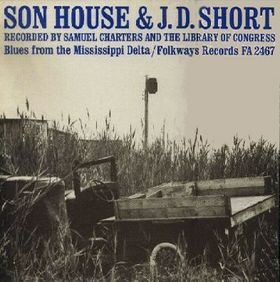
Released in 1963 on Folkways Records, Blues from the Mississippi Delta is a landmark split-LP that presents two distinct but deeply intertwined portraits of the Delta blues tradition. Side A features the final recordings of J.D. Short, a shadowy figure of the prewar era who had recorded sparingly for Paramount and Vocalion in the early 1930s before vanishing into obscurity. Side B draws from the legendary Library of Congress field recordings of Son House, made by Alan Lomax in 1941 and 1942, during the same Coahoma County study that first captured Muddy Waters on tape. The album is an early and essential endeavor at celebrating the Delta blues as a genre, a history, and a chronicle of Black experience in the American South.
Recording Sessions & Production
The album is a tale of two sessions, separated by two decades and united by the Folkways label's documentary mission.
J.D. Short's tracks were recorded on July 3, 1962, at Short's home on Cole Street in St. Louis, Missouri.
The session was produced by Samuel B. Charters, the poet, musicologist, and field recordist whose 1959 book The Country Blues had helped ignite the folk-blues revival. Charters had visited St. Louis on recording trips in 1961 and 1962, and the Short session was undertaken while Charters was also filming Short for his documentary film The Blues.
The recordings were made mostly in Short's kitchen to escape street noise.
Tragically, Short died just a few weeks later, at age 60, from a serious circulatory ailment that had afflicted him since an injury during army service.
Son House's tracks were drawn from the Library of Congress/Fisk University field recordings made by Alan Lomax (with John W. Work III and Lewis Jones of Fisk University) in Coahoma County, Mississippi. The first session took place in August 1941 at Klack's Store in Lake Cormorant, chosen because it had electricity; the second was in Robinsonville, Mississippi, on July 17, 1942.
Lomax had located House through Muddy Waters, who told the researchers that while he admired Robert Johnson, his major inspiration was Son House.
The album was compiled and issued by Folkways with Charters writing the liner notes. In addition to the music, the collection includes each artist's voice: Short contributes his memories about Charlie Patton, and House presents a description of "the key of minor."
The Musicians
J.D. Short's side:
-
J.D. Short — Vocals, guitar, harmonica (rack harp). Short performed as a one-man band, playing guitar and rack harmonica simultaneously, a technique he had developed in Clarksdale in the 1910s.
Son House's side:
-
Son House — Vocals, guitar (all tracks)
-
Willie Brown — Guitar, vocals (August 1941 session). The legendary guitarist immortalized in Robert Johnson's "Cross Road Blues."
-
Fiddlin' Joe Martin — Mandolin, vocals (August 1941 session)
-
Leroy Williams — Harmonica (August 1941 session)
The July 1942 Robinsonville session was House alone—just voice and guitar, with no accompaniment.
Track-by-Track Breakdown
Side A — J.D. Short
1. "So Much Wine" (4:13)
Songwriter: Traditional / Adapted by J.D. Short
Recorded: July 3, 1962, St. Louis, Missouri
Musicians: J.D. Short (vocals, guitar, harmonica)
A slow, mournful blues that opens the album with Short's keening voice and delicate fingerpicking. The lyric addresses the consolations and devastations of alcohol, a theme that runs through Delta blues. Short's rack harmonica adds a ghostly, wavering texture beneath his vocal.
2. "Train, Bring My Baby Back" (3:49)
Songwriter: Traditional / Adapted by J.D. Short
Recorded: July 3, 1962, St. Louis, Missouri
Musicians: J.D. Short (vocals, guitar, harmonica)
A train blues in the grand Delta tradition, with Short's guitar mimicking the rhythm of the rails. The train as a symbol of departure and possible return is one of the oldest tropes in blues, and Short delivers it with the weary resignation of a man who has watched too many loved ones leave.
3. "You Been Cheating Me" (3:00)
Songwriter: Traditional / Adapted by J.D. Short
Recorded: July 3, 1962, St. Louis, Missouri
Musicians: J.D. Short (vocals, guitar, harmonica)
A compact, bitter blues of romantic betrayal. Short's vocal is clipped and angry, his guitar stabbing out percussive chords. The track demonstrates his ability to compress a world of hurt into under three minutes.
4. "Charlie Patton" (1:15)
Songwriter: Spoken word / J.D. Short
Recorded: July 3, 1962, St. Louis, Missouri
Musicians: J.D. Short (spoken voice)
Not a song but a brief spoken recollection. Short recounts seeing Charley Patton as a child around 1910, when Patton visited his father's cabin at "Little Mirthy Dow" (near Murphy, Mississippi) and played bottleneck guitar, making the instrument "say, 'Lord have mercy, save poor me.'"
It is a priceless firsthand account of the "Father of the Delta Blues" from a man who was there.
Songwriter: Spoken word / J.D. Short
Recorded: July 3, 1962, St. Louis, Missouri
Musicians: J.D. Short (spoken voice)
Not a song but a brief spoken recollection. Short recounts seeing Charley Patton as a child around 1910, when Patton visited his father's cabin at "Little Mirthy Dow" (near Murphy, Mississippi) and played bottleneck guitar, making the instrument "say, 'Lord have mercy, save poor me.'"
5. "Fighting for Dear Old Uncle Sam" (5:23)
Songwriter: Traditional / Adapted by J.D. Short
Recorded: July 3, 1962, St. Louis, Missouri
Musicians: J.D. Short (vocals, guitar, harmonica)
The longest track on Short's side, a blues about military service and its aftermath. Given Short's own injury during army service—which ultimately contributed to his death— the song carries autobiographical weight. His guitar work is more elaborate here, with intricate fingerpicking that suggests the influence of Texas bluesmen like Funny Papa Smith, whose repertoire Short had absorbed.
Side B — Son House
6. "My Black Woman" (3:01)
Songwriter: Son House (adapted from his 1930 Paramount recording "My Black Mama")
Recorded: August 1941, Klack's Store, Lake Cormorant, Mississippi
Musicians: Son House (vocals, guitar); possibly Willie Brown (guitar), Fiddlin' Joe Martin (mandolin), and/or Leroy Williams (harmonica)
A reworking of House's 1930 Paramount side "My Black Mama," which Robert Johnson later adapted into "Death Letter Blues."
The 1941 version is rawer and more immediate than the studio original, with House's slide guitar and preaching-derived vocal creating an atmosphere of barely controlled intensity.
Songwriter: Son House (adapted from his 1930 Paramount recording "My Black Mama")
Recorded: August 1941, Klack's Store, Lake Cormorant, Mississippi
Musicians: Son House (vocals, guitar); possibly Willie Brown (guitar), Fiddlin' Joe Martin (mandolin), and/or Leroy Williams (harmonica)
A reworking of House's 1930 Paramount side "My Black Mama," which Robert Johnson later adapted into "Death Letter Blues."
7. "Sun Goin' Down" (5:00)
Songwriter: Traditional / Adapted by Son House
Recorded: August 1941 or July 1942, Mississippi
Musicians: Son House (vocals, guitar)
A blues standard also known in variants as "Sun Gonna Shine in My Back Door Someday." House's version is taken at a deliberate, meditative pace, his guitar generating a dark, droning undertone while his vocal slides between declamation and cry. The track exemplifies the "Bentonia" style's minor-key gloom.
8. "I Ain't Goin' to Cry No More" (3:30)
Songwriter: Traditional / Adapted by Son House
Recorded: August 1941 or July 1942, Mississippi
Musicians: Son House (vocals, guitar)
A mid-tempo blues of stoic resolve. House's vocal is firm and declarative, his guitar providing a steady, rolling accompaniment. The track demonstrates his ability to convey emotional complexity without histrionics—a lesson he would pass on to Muddy Waters and Robert Johnson.
9. "The Key of Minor" (2:15)
Songwriter: Spoken word / Son House
Recorded: July 17, 1942, Robinsonville, Mississippi
Musicians: Son House (spoken voice, guitar demonstration); Alan Lomax (interviewer)
A brief spoken interlude in which House explains his guitar tuning to Lomax. The "key of minor" refers to House's use of open D-minor and other minor tunings that gave his music its haunting, church-like quality. This track is invaluable for understanding the technical and spiritual foundations of Delta blues guitar.
10. "This War Will Last You for Years" (3:45)
Songwriter: Son House
Recorded: July 17, 1942, Robinsonville, Mississippi
Musicians: Son House (vocals, guitar)
Originally titled "American Defense" in the Lomax field notes, this is House's commentary on World War II.
The lyric expresses both pessimism about the conflict's duration and confidence in eventual victory. It is one of the few topical political blues in House's repertoire, delivered with the same intensity he brought to spirituals.
Songwriter: Son House
Recorded: July 17, 1942, Robinsonville, Mississippi
Musicians: Son House (vocals, guitar)
Originally titled "American Defense" in the Lomax field notes, this is House's commentary on World War II.
11. "Was I Right or Wrong?" (3:20)
Songwriter: Son House
Recorded: July 17, 1942, Robinsonville, Mississippi
Musicians: Son House (vocals, guitar)
A rag-influenced, non-blues piece that explores the experience of being a Black man in the Jim Crow South.
The track ends abruptly because House forgot the ending—a moment of unvarnished realism that field recordings capture better than any studio session could.
Songwriter: Son House
Recorded: July 17, 1942, Robinsonville, Mississippi
Musicians: Son House (vocals, guitar)
A rag-influenced, non-blues piece that explores the experience of being a Black man in the Jim Crow South.
12. "County Farm Blues" (3:50)
Songwriter: Son House
Recorded: July 17, 1942, Robinsonville, Mississippi
Musicians: Son House (vocals, guitar)
A reworking of material from House's 1930 Paramount session, now stripped to solo voice and guitar. The "county farm" refers to the Mississippi State Penitentiary at Parchman, where House had served time in the late 1920s.
The 1942 version is harder and more direct than the 1930 original, with House's slide guitar evoking the crushing labor and isolation of prison life.
Songwriter: Son House
Recorded: July 17, 1942, Robinsonville, Mississippi
Musicians: Son House (vocals, guitar)
A reworking of material from House's 1930 Paramount session, now stripped to solo voice and guitar. The "county farm" refers to the Mississippi State Penitentiary at Parchman, where House had served time in the late 1920s.
Buy This Album
Critical Assessment & Legacy
Blues from the Mississippi Delta occupies a unique position in blues discography. It is simultaneously a final testament (J.D. Short's last recordings), a rediscovery document (Son House's first widespread exposure to the folk revival audience, years before his 1964 "rediscovery" by Nick Perls, Dick Waterman, and Phil Spiro), and a scholarly artifact (with Charters's liner notes and the artists' own voices providing context).
The album's importance extends beyond its musical content. By placing Short's memories of Patton and House's explanation of "the key of minor" alongside the songs, Folkways created a model for how blues albums could function as oral history as well as entertainment. The raw, unaccompanied performances—Short in his kitchen, House in a country store and on a plantation—preserve a sound world that commercial studio recordings of the era rarely captured.
For listeners interested in the Delta blues tradition, Blues from the Mississippi Delta is an essential document: the sound of the music's first generation (House, who learned from Patton and Rube Lacey) and its nearly forgotten practitioners (Short, who carried the tradition to St. Louis and kept it alive in obscurity for three decades). It is, in the truest sense, a chronicle of Black experience in the American South—recorded, preserved, and presented with the documentary seriousness it deserves.