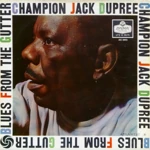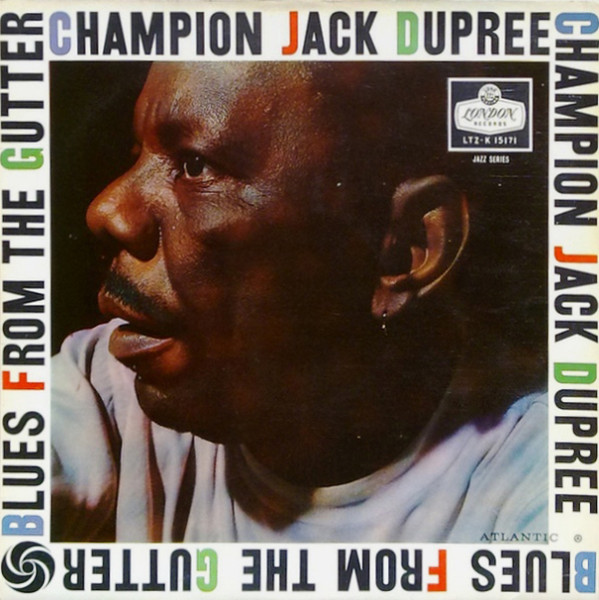
Blues from the Gutter is the landmark 1959 debut album by New Orleans-born barrelhouse pianist and vocalist Champion Jack Dupree (William Thomas Dupree), recorded for Atlantic Records. It stands as one of the most powerful and unflinching portraits of urban blues life ever committed to tape — a raw, autobiographical document of addiction, poverty, and survival that captured the imagination of the beat generation and established Dupree as a major voice in American blues.
Recording Session & Production
Date: February 4, 1958
Location: New York City (exact studio not specified in available sources)
Label: Atlantic Records — released in April 1959 (catalog number Atlantic 8019, with some pressings as SD-8019)
Producer: Jerry Wexler — the legendary Atlantic Records producer who had previously worked with Ray Charles, Ruth Brown, and Big Joe Turner, and would go on to produce Aretha Franklin and Dusty Springfield. Wexler's production approach for this album was hands-off and respectful — he assembled a crack band and let Dupree's personality dominate the proceedings.
Recording Engineer: Tom Dowd — Atlantic's brilliant engineer who was revolutionizing recording technology with his innovative approaches to capturing live sound. Dowd's work on this album ensured that Dupree's piano and vocals were captured with remarkable clarity and presence.
Cover Design: Marvin Israel — created the distinctive album artwork
Photography: Lee Friedlander — the renowned photographer whose stark, documentary-style images graced the original LP cover
Liner Notes: Gary Kramer — provided the original album notes
Recording Context: The album was recorded during a pivotal moment in Dupree's life. He had been gigging at the Celebrity Club in Freeport, New York for nearly a year when he accepted an offer to tour England — a trip that would prove fateful, as he never again resided in the United States. Like many African-American veterans, Dupree was disillusioned with his treatment upon returning from World War II. In England, he found social acceptance and appreciation for his music that led him to settle permanently in Europe. Blues from the Gutter was his last American studio album before this permanent relocation, making it a crucial document of his pre-expatriate artistry.
The Musicians
The band assembled for this session was a powerhouse of New York blues talent:
-
Champion Jack Dupree — vocals, piano
-
Ennis Lowery (aka Larry Dale) — guitar
-
Pete Brown — alto saxophone (on selected tracks)
-
Wendell Marshall — double bass
-
Willie Jones — drums
Larry Dale (born Ennis Lowery, January 7, 1923, Wharton, Texas) was a key figure in postwar New York City blues. He had moved to New York by the early 1950s and joined Paul "Hucklebuck" Williams' band before establishing himself as a session guitarist and vocalist. His work on this album — credited under his birth name Ennis Lowery — is particularly impressive; as blues writer Jim O'Neal noted, "Guitarist Larry Dale (Ennis Lowery), a key figure in postwar New York City blues, adds a level of electric intensity to Dupree's already remarkable blues with his powerful guitar solos." Dale's playing on this album reportedly inspired Brian Jones of the Rolling Stones.
Pete Brown was a versatile alto saxophonist who brought a jazz-blues sensibility to the tracks he appeared on. His saxophone added a layer of urban sophistication to Dupree's raw barrelhouse style.
Wendell Marshall on bass and Willie Jones on drums formed a rock-solid rhythm section that propelled Dupree's piano with unwavering groove. Jones was a respected New York drummer who had worked with numerous blues and R&B artists.
The Sound & Approach
Blues from the Gutter is a concept album in the truest sense — a song cycle about life on the streets, in the gutter, at the bottom of society. As Jim O'Neal wrote: "As a portrait of the down-and-out, street-level life of a junkie in 1958, Blues from the Gutter must have had quite an appeal to the album-buying public of the beat poets' era. Dupree's moods actually range from grim to upbeat, but the emphasis is on drugs, illness, and impending death."
The album's sound combines New Orleans barrelhouse piano — with its rolling bass figures and stabbing right-hand chords — with the tougher, more urban sound of 1950s New York blues. Dupree's vocals are conversational and direct, delivered with a sly wit that leavens the often-dark subject matter. The production is clean and present, allowing every nuance of Dupree's piano and voice to come through.
Track-by-Track Breakdown
Side A
1. "Strollin'" (4:31)
-
Songwriter: Champion Jack Dupree
-
Recording: February 4, 1958, New York City
-
Musicians: Champion Jack Dupree (vocals, piano), Ennis Lowery (guitar), Wendell Marshall (bass), Willie Jones (drums)
-
Notes: The album opens with a medium-tempo blues that establishes Dupree's relaxed, conversational vocal style. "Strollin'" is a portrait of urban wandering — the narrator moving through the city streets, observing and commenting. The track features Dupree's signature piano style: rolling left-hand bass figures anchoring the rhythm while his right hand delivers staccato chords and melodic fills. Larry Dale's guitar provides subtle counterpoint. This track was released as the B-side of the "Frankie and Johnny" single (Atlantic 2032). On later pressings of the album (beginning with the 1970 Atlantic SD-8255), "Strollin'" was replaced by the earlier King recording "Walking the Blues."
2. "T.B. Blues" (2:57)
-
Songwriter: Champion Jack Dupree
-
Recording: February 4, 1958, New York City
-
Musicians: Champion Jack Dupree (vocals, piano), Ennis Lowery (guitar), Wendell Marshall (bass), Willie Jones (drums), Pete Brown (alto saxophone)
-
Notes: A harrowing blues about tuberculosis — the "T.B." of the title. Dupree had witnessed the devastating effects of the disease in his community, and this song is both a personal testimony and a social document. Pete Brown's alto saxophone adds a mournful, hospital-ward atmosphere to the track. The lyrics are unsparing in their depiction of the disease's symptoms and social stigma. This track was included on the Atlantic EP 80.011 and the French Atlantic PD 7-8639 single.
3. "Can't Kick the Habit" (3:28)
-
Songwriter: Champion Jack Dupree
-
Recording: February 4, 1958, New York City
-
Musicians: Champion Jack Dupree (vocals, piano), Ennis Lowery (guitar), Wendell Marshall (bass), Willie Jones (drums)
-
Notes: One of the most explicit songs about drug addiction recorded in the 1950s. Dupree's lyrics pull no punches in describing the grip of addiction — the cravings, the desperation, the inability to quit. The "habit" of the title is heroin, and Dupree's matter-of-fact delivery makes the song even more chilling. The track is a slow blues with a heavy, dragging tempo that mirrors the weight of addiction. This was included on the Atlantic EP 80.011.
4. "Evil Woman" (2:47)
-
Songwriter: Champion Jack Dupree
-
Recording: February 4, 1958, New York City
-
Musicians: Champion Jack Dupree (vocals, piano), Ennis Lowery (guitar), Wendell Marshall (bass), Willie Jones (drums), Pete Brown (alto saxophone)
-
Notes: A classic blues theme given Dupree's distinctive treatment. The "evil woman" is a staple of blues mythology, but Dupree's version feels personal and specific — this is not a generic archetype but a real woman who has done him wrong. Pete Brown's alto sax wails behind Dupree's vocal, adding emotional intensity. The track was later released as a single (Atlantic 2095, backed with "My Mother-in-Law" in 1961).
5. "Nasty Boogie" (2:40)
-
Songwriter: Champion Jack Dupree
-
Recording: February 4, 1958, New York City
-
Musicians: Champion Jack Dupree (vocals, piano), Ennis Lowery (guitar), Wendell Marshall (bass), Willie Jones (drums), Pete Brown (alto saxophone)
-
Notes: An uptempo boogie-woogie that provides a moment of levity on an otherwise heavy album. The "nasty boogie" is a dance, and Dupree's lyrics are filled with sexual innuendo and good-time humor. Pete Brown's saxophone drives the track with a honking, R&B-flavored solo. This track demonstrates Dupree's range — he could play grim street blues and party music with equal conviction. Included on Atlantic EP 80.011.
Side B
6. "Junker's Blues" (3:15)
-
Songwriter: Champion Jack Dupree (original 1941 composition)
-
Recording: February 4, 1958, New York City
-
Musicians: Champion Jack Dupree (vocals, piano), Ennis Lowery (guitar), Wendell Marshall (bass), Willie Jones (drums), Pete Brown (alto saxophone)
-
Notes: The centerpiece of the album and Dupree's most famous composition. Originally recorded in 1941 for OKeh Records, "Junker's Blues" is a seminal piece of New Orleans music history. The song is a first-person narrative of a drug addict ("junker") and his life on the streets. What makes this song historically significant is that it directly inspired Fats Domino's first hit, "The Fat Man" (1949) — Domino and producer Dave Bartholomew adapted Dupree's piano riff and vocal melody into the foundation of New Orleans rock and roll. This 1958 remake updates the original with fuller production and superior fidelity while retaining the raw power of Dupree's performance. Pete Brown's saxophone adds a modern R&B flavor. The track was released on the French Atlantic PD 7-8639 single.
7. "Bad Blood" (2:47)
-
Songwriter: Champion Jack Dupree
-
Recording: February 4, 1958, New York City
-
Musicians: Champion Jack Dupree (vocals, piano), Ennis Lowery (guitar), Wendell Marshall (bass), Willie Jones (drums), Pete Brown (alto saxophone)
-
Notes: A blues about illness and physical decline — "bad blood" being a colloquial term for syphilis and other blood-borne diseases. The song continues the album's medical themes (T.B., addiction, now venereal disease), creating a song cycle about the health crises facing poor urban communities. The tempo is medium-slow, with Pete Brown's saxophone providing a mournful counterpoint to Dupree's vocal. Included on Atlantic EP 80.011.
8. "Goin' Down Slow" (3:28)
-
Songwriter: St. Louis Jimmy Oden (James Burke Oden)
-
Recording: February 4, 1958, New York City
-
Musicians: Champion Jack Dupree (vocals, piano), Ennis Lowery (guitar), Wendell Marshall (bass), Willie Jones (drums)
-
Notes: Dupree's interpretation of the classic blues standard written by St. Louis Jimmy Oden and first recorded by Oden in 1941. The song is a death-bed confession — the narrator knows he is dying and asks his mother to send a prayer. Dupree's version is stark and emotional, with his piano providing the primary accompaniment. The absence of Pete Brown's sax on this track creates a more intimate, funereal atmosphere. This is one of the most frequently covered blues songs in history, with versions by Howlin' Wolf, B.B. King, and countless others.
9. "Frankie and Johnny" (3:15)
-
Songwriter: Traditional (public domain)
-
Recording: February 4, 1958, New York City
-
Musicians: Champion Jack Dupree (vocals, piano), Ennis Lowery (guitar), Wendell Marshall (bass), Willie Jones (drums), Pete Brown (alto saxophone)
-
Notes: Dupree's take on the classic American murder ballad about Frankie Baker, who shot her lover Johnny Allen in St. Louis in 1899. The song had been recorded by countless artists — from Mississippi John Hurt to Elvis Presley — but Dupree's version brings a street-level grit that makes the ancient story feel immediate. Pete Brown's saxophone adds a noir-ish, cinematic quality. This track was released as a single (Atlantic 2032, backed with "Strollin'").
10. "Stack-O-Lee" (3:28)
-
Songwriter: Traditional (public domain), based on the legend of Stagger Lee
-
Recording: February 4, 1958, New York City
-
Musicians: Champion Jack Dupree (vocals, piano), Ennis Lowery (guitar), Wendell Marshall (bass), Willie Jones (drums)
-
Notes: Dupree's version of the "Stagger Lee" legend — the story of Lee Shelton, a St. Louis pimp who murdered Billy Lyons on Christmas night, 1895, over a Stetson hat. The song is one of the most enduring narratives in African American music, recorded by everyone from Mississippi John Hurt to Lloyd Price. Dupree's piano-driven version emphasizes the story's tragic dimensions, with his barrelhouse style giving the tale a New Orleans flavor. The absence of saxophone on this track puts the focus squarely on Dupree's piano and vocal storytelling.
Critical Reception & Legacy
Blues from the Gutter was immediately recognized as a masterpiece. The album's unflinching portrayal of urban poverty, addiction, and disease resonated with the beat generation and the emerging folk revival audience. As one reviewer noted, the album "made him a star in Britain and Europe." Dupree himself often called it his "all-purpose hit," because it appealed to everyone.
The album's influence extends across multiple generations:
-
The Rolling Stones' Brian Jones was reportedly inspired by Larry Dale's guitar work on this album
-
Eric Clapton and Mick Jagger would later jam with Dupree during his European years
-
The beat poets embraced the album as authentic documentation of street life
-
The British blues boom of the 1960s discovered Dupree through this and subsequent Atlantic releases
The Penguin Guide to Blues Recordings praised the album for its "depth of feeling" and noted that Pete Brown's alto sax and Ennis Lowery's "understated, but distinct lead guitar work" added crucial dimensions to Dupree's piano and vocals.
Dupree recorded two more albums for Atlantic after relocating to Europe: Champion Jack's Natural & Soulful Blues (1959, recorded in London with Alexis Korner on guitar) and Champion of the Blues (1961, a solo piano album recorded in Copenhagen). But Blues from the Gutter remains his definitive statement — the album that captured him at the peak of his American career, just before he became an expatriate blues ambassador.
Champion Jack Dupree passed away in January 1992 at age 82, still active and playing his barrelhouse piano. His final words to the blues world could serve as an epitaph for the album that made him famous: "I'm a bluesman and I'm gonna die that way."