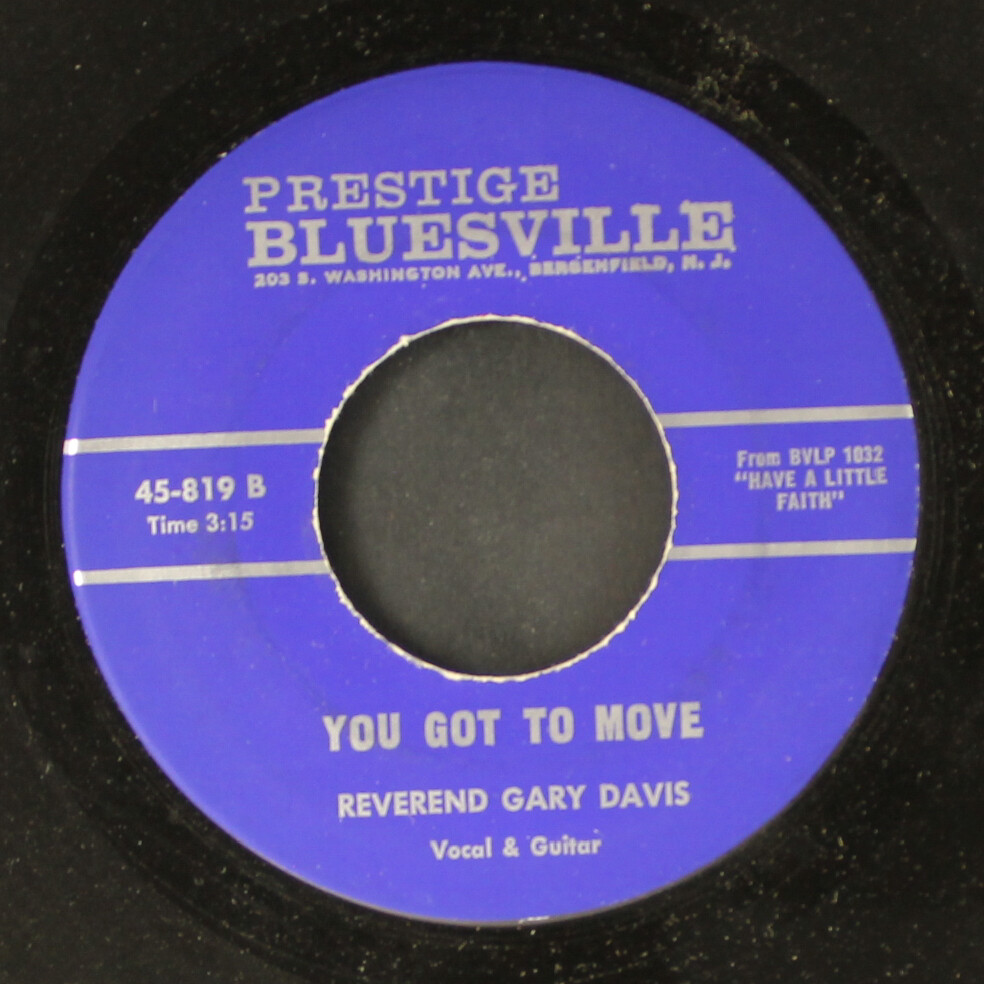
"You Got to Move" (also known as "You've Got to Move") is a powerful traditional African-American spiritual adapted and popularized by Reverend Gary Davis (1896–1972), the blind Piedmont blues guitarist, singer, and ordained minister known for his virtuosic fingerpicking and ragtime-influenced style. Davis's version transforms the song into a compelling gospel-blues performance that has influenced generations of artists.
Recording Sessions
Davis recorded the song multiple times, with notable versions in the early 1960s during the folk-blues revival. A key studio recording appeared around 1962 for Prestige or related labels, capturing his mature style. He also performed it live frequently, including at the Newport Folk Festival and in informal sessions. His recordings often feature a raw, intimate quality typical of revival-era folk-blues productions.
Producer: Varies by release, but many of Davis's 1960s recordings were produced or engineered in the context of folk labels like Prestige/Bluesville, with oversight from figures interested in documenting traditional performers.
Songwriters
The song is traditional (public domain roots in African-American spirituals and gospel), with Davis providing a distinctive arrangement and lyrics. Earlier recordings exist by gospel groups like Sister Rosetta Tharpe and the Five Blind Boys of Alabama. Davis and later Mississippi Fred McDowell popularized secular-leaning blues adaptations, leading to shared or contested credits in some releases. Davis's version emphasizes personal conviction and movement toward salvation or change.
Musicians
Davis typically performed solo or with minimal accompaniment, showcasing his extraordinary fingerpicking:
- Reverend Gary Davis – vocals, guitar (his complex, ragtime-based fingerstyle—alternating bass, melody, and rhythm simultaneously—is the defining element)
- Occasional light support in group settings (e.g., harmonica or second guitar in live recordings), but the power comes from his solo prowess.
His guitar technique combines Piedmont ragtime complexity with blues expressiveness, using thumb for bass lines and fingers for intricate melodies and chords.
Musical Style and Analysis
"You Got to Move" is a driving, rhythmic gospel-blues piece that perfectly showcases Reverend Gary Davis’s unparalleled fingerpicking technique and his ability to blend sacred and secular traditions. The song is built on a strong, repetitive rhythmic foundation—typically in a medium-tempo groove with a pronounced pulse that encourages foot-stomping or hand-clapping participation, evoking church "shout" music or work songs.
Davis’s guitar playing is the centerpiece and a masterclass in Piedmont-style fingerstyle. He uses a complex alternating-thumb bass pattern combined with melodic lines played by his index and middle fingers, creating the illusion of multiple instruments. His right-hand technique is precise and powerful, with syncopated accents, hammer-ons, pull-offs, and chordal punches that add percussive drive. The left hand employs slides, vibrato, and position shifts for expressive "crying" notes, while maintaining rock-solid rhythm. This multi-layered approach—bass, melody, and rhythm simultaneously—gives the song a full, orchestral texture on a single acoustic guitar.
Vocals: Davis delivers the lyrics in a raspy, authoritative, sermon-like style with call-and-response phrasing ("You got to move... You got to move..."). His voice carries the weight of experience and spiritual conviction, rising in intensity during the choruses. The repetition of the title phrase creates a hypnotic, mantra-like effect that builds emotional and spiritual urgency.
Structure and feel: The song follows a simple, repetitive verse-chorus form rooted in traditional spirituals. There is no complex chord progression; it relies on a modal framework with strong I and IV chords, allowing the rhythm and vocal to dominate. Davis’s arrangement adds ragtime flourishes and blues inflections, elevating it beyond straight gospel. The overall mood is insistent and empowering—encouraging movement (physical, spiritual, or social) with a sense of inevitability ("When the Lord gets ready, you got to move").
In his 1960s recordings, the sound is intimate and live-feeling, with natural room resonance that highlights the guitar’s percussive attack and vocal projection. This style influenced the folk-blues revival and, indirectly, rock guitarists seeking authentic roots techniques. Davis’s version stands as a bridge between old-time gospel, Piedmont blues, and the emerging folk scene—sophisticated yet accessible, technically dazzling yet deeply emotional.
Other Versions
- Mississippi Fred McDowell (1965 and later recordings): His raw, bottleneck slide version is gritty and earthy, emphasizing Delta blues feel. Often credited alongside Davis, McDowell’s rendition directly inspired many rock covers and became highly influential in its own right.
- The Rolling Stones (recorded 1969–1970, released on Sticky Fingers, 1971): A slinky, groove-oriented take with Mick Taylor’s expressive slide guitar. It became a live staple during their 1969 tour and a fan favorite, introducing the song to mainstream rock audiences. The Stones’ arrangement owes more to McDowell’s feel but retains the spiritual core.
- Other notable covers: Warren Haynes has performed powerful interpretations; various gospel groups (e.g., Sister Rosetta Tharpe influences or the Five Blind Boys of Alabama) emphasize the sacred roots. It has been recorded by blues revivalists, folk artists, and in live settings by players like Jorma Kaukonen (who studied with Davis). The song’s adaptability—acoustic solo, full band, slide-heavy, or gospel choir—makes it a staple in jam sessions, blues festivals, and spiritual performances.
Legacy
"You Got to Move" exemplifies the sacred-secular crossover in African-American music. Davis's recordings during the folk revival introduced it to new audiences, while McDowell's and the Stones' versions amplified its reach. The song symbolizes movement—spiritual, social, or personal—and has been performed at civil rights events and beyond. Davis's virtuosic guitar style influenced Bob Dylan, Jorma Kaukonen, Ry Cooder, and many others, cementing his place as a pivotal figure in American roots music. The track continues to be covered and studied as a bridge between gospel, blues, and rock.
Suggested Listening
 Buy from Amazon Harlem Street Singer