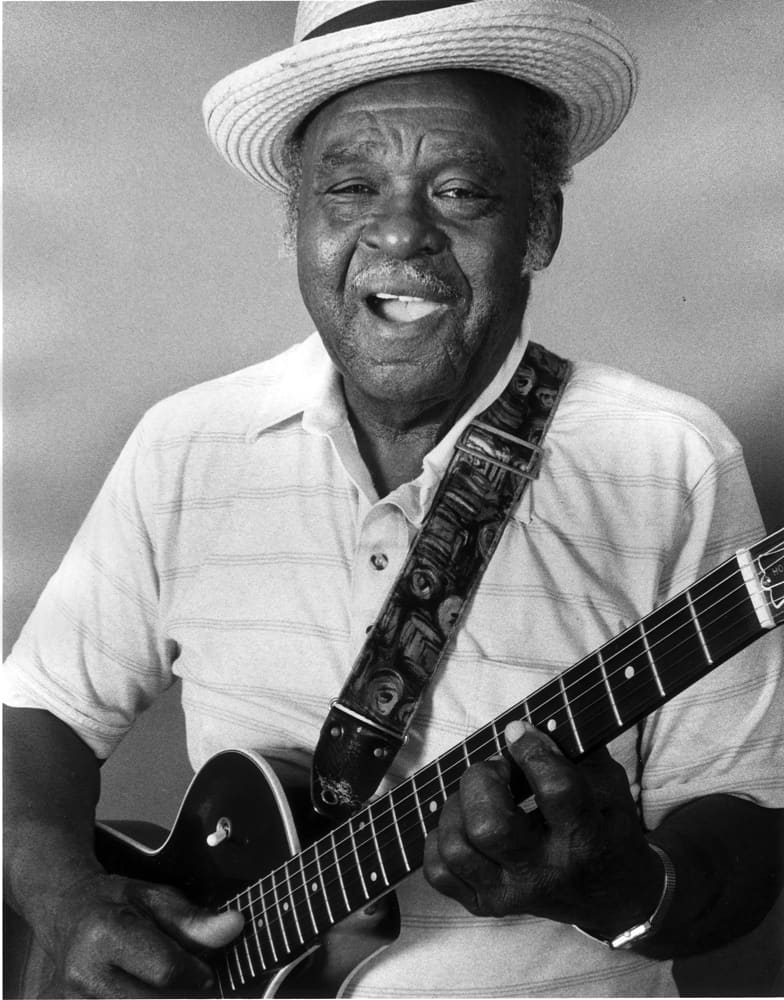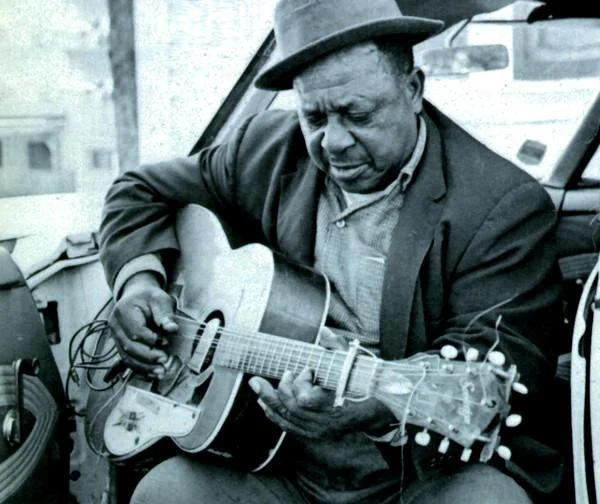
Joseph Lee “Big Joe” Williams (October 16, 1903 – December 17, 1982) was a towering figure in Delta blues—a rugged, itinerant musician whose distinctive nine-string guitar, powerful voice, and raw, rhythmic style embodied the wandering bluesman archetype. Over more than five decades, he recorded for numerous labels, mentored future legends, influenced folk and rock artists, and bridged traditional country blues with the folk-blues revival of the 1960s. His signature song “Baby, Please Don’t Go” became a blues standard covered by artists across genres.
Early Life and Musical Roots
Born in Oktibbeha County, Mississippi, near Crawford on the edge of the Noxubee Swamp, Williams came from a musical family. His grandfather Bert Logan and uncles Bert and Russ Logan were blues performers. Sources vary slightly on his birth year (some documents suggest 1899), but 1903 is widely accepted. As a child in a large family (one of 16 children in some accounts), he crafted his first instrument—a one-string guitar—and began playing early.
By his teens, Williams left home to escape field work, busking and performing in railway, turpentine, levee, and logging camps, as well as with minstrel troupes and medicine shows. In the early 1920s, he worked with the Rabbit Foot Minstrels revue, sharing the stage with talents like a young Ethel Waters. He came under the influence of Charley Patton in the Mississippi Delta and traveled with young musicians including Honeyboy Edwards and Muddy Waters (whom he reportedly “picked up” in Rolling Fork when Waters was about 15, playing harmonica behind him).
Williams was a natural rover, traveling across the United States and later the world, never fully settling despite roots in Mississippi and stints in St. Louis and Chicago.
Career Breakthrough and 1930s–1940s Recordings
In 1930, Williams recorded with the Birmingham Jug Band for Okeh Records. His major break came in 1934–1935 in St. Louis, where he met producer Lester Melrose and signed with Bluebird Records. He stayed with Bluebird for about a decade, producing some of his most enduring work.
Key early recordings include:
- “Baby, Please Don’t Go” (1935): His signature hit, a driving blues number based partly on traditional work songs like “Another Man Done Gone.” Williams sometimes credited his wife, St. Louis blues singer Bessie Mae Smith, with the song. It was later covered by Muddy Waters, Them (with Van Morrison), Bob Dylan, and many others.
- “Crawlin’ King Snake” (1941): Another classic that influenced subsequent blues and rock artists.
- Other notable tracks from this era: “Peach Orchard Mama,” “49 Highway Blues,” and collaborations with harmonica great Sonny Boy Williamson I, Robert Nighthawk, and Peetie Wheatstraw.
His 1930s and 1940s sessions for Bluebird, Vocalion, and other labels captured the raw energy of Delta blues, often featuring harmonica accompaniment and his increasingly modified guitar. Post-WWII, as electric blues and R&B rose, Williams continued recording singles for labels like Trumpet (e.g., versions of “Whistling Pines”), Bullet, and Vee-Jay, adapting while staying rooted in tradition.
The Nine-String Guitar and Musical Style
Big Joe Williams’ nine-string guitar was not just a novelty—it was a central element of his raw, powerful Delta blues sound. He modified standard acoustic guitars (often Harmony, Kay, or later a Gibson archtop) over decades, creating an instrument that produced a buzzing, percussive, almost African-influenced tone while enabling him to deliver driving rhythm, virtuosic leads, and vocals simultaneously.
Instrument Setup and Modifications
Williams began modifying guitars in the 1920s–1930s, reportedly to deter others from borrowing and playing his instrument. He added three extra tuning pegs across the headstock and doubled strings:
- Standard base tuning: Open G (D G D G B D, low to high).
- Doubled strings (unison pairs): Typically the 1st (high D), 2nd (B), and 4th (middle D) strings. This resulted in a common configuration like: D | G | D D | G | B B | D D. The middle G usually remained single (often a plain string).
- Capo usage: He almost always played with a capo on the 2nd fret, shifting open G to open A. This suited his voice and helped stabilize the homemade setup.
- Additional modifications:
- Rudimentary electric pickup (wires often coiled visibly across the top).
- Homemade attachments: kazoo holder (wire hanger), tape, metal plates, pie plates on amps, or dangling objects (e.g., beer can) that rattled for extra percussion and buzz.
- In later years, he occasionally used a 12-string in open G or a modified 6-string for slide (replacing the low D with a thin .008-gauge string tuned to high G4 for melody).
The unison doubles (unlike octave pairs on a 12-string) created sympathetic vibrations, chorusing, and a thicker, more resonant tone without excessive clash.
Playing Technique and Right-Hand Approach
Williams used thumb and index finger picks (metal or plastic), a common choice for Delta blues players needing volume and attack in noisy environments.
- Hybrid rhythm-lead style: He excelled at simultaneous bass rhythm (thumb) and melodic lines or fills (index finger). This “one-man band” approach filled out the sound, ideal for solo or sparse accompaniment performances.
- Thumb techniques: Strong, driving bass patterns, including “double thumping” (which influenced a young Bob Dylan). He percussed the guitar body for rhythmic punctuation.
- Fingerstyle elements: Index finger for leads, with the extra strings allowing “side licks” and richer chord voicings. The doubled strings responded well to strumming and picking, adding shimmer and sustain.
- Slide playing: He incorporated raggedy, expressive slide work, especially effective with the buzzing setup and open tuning.
His style featured unpredictable tempo shifts, jerky rhythms, and hypnotic grooves—hallmarks of Delta and Hill Country blues traditions.
Sound Characteristics
The nine-string setup produced a distinctive buzzing, sizzling, percussive tone often described as “African-sounding.”
- Sympathetic resonance: Unison doubles created natural chorus and overtones, giving a hollow, rattling quality when amplified roughly.
- Percussion and rattle: Attachments and the amplified acoustic body added layers of noise and vibration, enhancing the raw, lo-fi aesthetic.
- Dynamic range: From whisper-quiet to loud shouts, with effective use of the volume knob on his pickup for swells and control.
- Projection: The instrument cut through in juke joints and later folk clubs/festivals without needing a full band.
This sound bridged traditional country blues with the electrified edge emerging in the mid-20th century.
Musical Application and Influence
In open A (via capo), common Delta progressions (I-IV-V in A) became straightforward, with open strings ringing for drones and rich chords. Songs like “Baby, Please Don’t Go” showcased his driving rhythm, vocal power, and integrated leads.
His technique influenced:
- Revivalists: Bob Dylan adopted thumb-thumping and drew inspiration from Williams’ authenticity.
- Later players: Mike Bloomfield and others documented and celebrated his style. Modern builders have recreated tribute instruments.
Challenges and Mastery
The setup was unstable and temperamental—requiring constant maintenance—but Williams mastered its quirks. The extra strings demanded precise intonation and finger strength, yet enabled unique textures unavailable on standard guitars.
Big Joe Williams’ nine-string technique exemplified resourceful innovation in blues: turning limitations into signature strengths. It produced music that was deeply rhythmic, emotionally direct, and sonically unforgettable—embodying the roving, resilient spirit of Delta blues. Listening to tracks from Piney Woods Blues, Mississippi’s Big Joe Williams and His Nine-String Guitar, or live performances reveals a master fully in command of an instrument he made entirely his own.
Folk Blues Revival and Later Career
In the late 1950s and 1960s, Williams thrived during the folk-blues revival. He recorded extensively for labels like Delmark, Prestige, Arhoolie, Testament, Bluesville, and Folkways, releasing acclaimed albums such as:
 Piney Woods Blues (1958) Buy from Amazon
 Tough Times (1960) Buy from Amazon
 Blues on Highway 49 (1961) Buy from Amazon
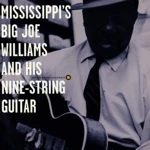 Mississippi’s Big Joe Williams and His Nine-String Guitar (1962) Buy from Amazon
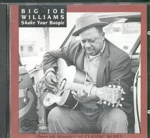 Shake Your Boogie (Arhoolie, emotionally charged 1960 session, later reissued) Buy from Amazon
He became a regular on the coffeehouse, nightclub, and festival circuit, touring Europe and Japan in the late 1960s–early 1970s and appearing at major U.S. events. He lived for a time in the basement of Chicago’s Jazz Record Mart and was known for his cantankerous personality, legendary travels, and talent-scouting (helping record artists like J.D. Short and John Wesley “Shortstuff” Macon).
A notable collaboration was with a young Bob Dylan in 1962 for Victoria Spivey’s label (including duets on Three Kings and the Queen). Williams encouraged Dylan to write original material rather than just traditional songs, and Dylan played harmonica on some of Williams’ sessions. Williams later spoke warmly of Dylan’s authenticity.
Other later recordings include Going Back to Crawford (1999 posthumous, recorded 1971 with local Mississippi musicians) and tributes/compilations highlighting his roots.
Influence and Legacy
Big Joe Williams mentored or influenced generations:
- Delta bluesmen: Muddy Waters, Honeyboy Edwards.
- Revivalists and rock: Bob Dylan, Mike Bloomfield (who wrote the memoir Me and Big Joe), and indirectly many 1960s rock acts via covers of his songs.
- His music carried the spirit of the Delta to urban audiences and overseas, helping preserve and popularize traditional blues during a time when it risked fading.
He was inducted into the Blues Hall of Fame in 1992. In 2003, a Mississippi Blues Trail marker was placed in Crawford. His grave, in a private cemetery outside Crawford (headstone funded partly by musicians and the Mount Zion Memorial Fund), bears the epitaph “King of the 9 String Guitar.” One of his guitars resides at the Delta Blues Museum.
Personal Life and Character
Williams was a larger-than-life, hard-living figure—rambunctious, independent, and dedicated to the road. He had relationships, including with Bessie Mae Smith, and took pride in his family and Mississippi roots, returning there in his later years. He died in Macon, Mississippi, on December 17, 1982, and was remembered as a fierce, authentic performer who could captivate any audience with sheer power and presence, even when initially underestimated.
Big Joe Williams’ life and music represent the enduring resilience of the blues: raw, adaptive, and deeply human. His recordings remain vital listening for anyone interested in the genre’s history, offering a direct link to the Mississippi Delta’s rich musical soil. From juke joints to folk festivals and beyond, his nine-string roar continues to echo.
Selected Discography
 The Essential Big Joe Williams Buy from Amazon