“The Thrill Is Gone” is B.B. King’s signature song and one of the most iconic blues recordings of the late 20th century. Originally written and recorded by West Coast bluesman Roy Hawkins in 1951, King’s 1969 version transformed it into a polished, string-laden soul-blues classic that crossed over to the pop charts, earned him his first Grammy, and cemented his status as the “King of the Blues.”
Recording Sessions and Producer
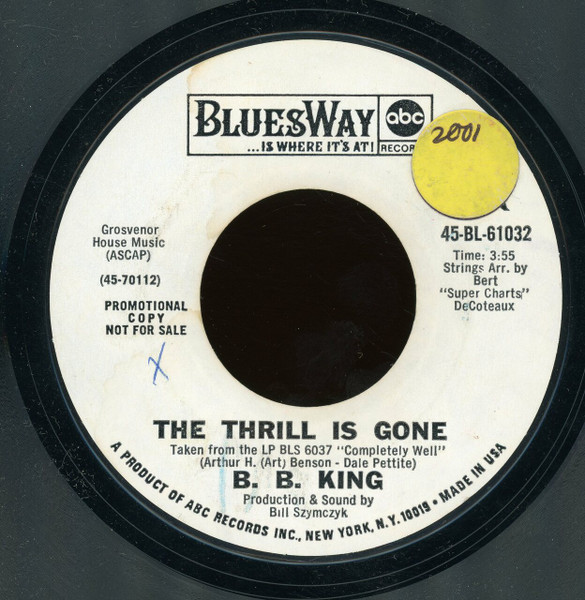
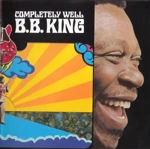
B.B. King recorded the track in 1969 (sources cite June, with detailed accounts placing the core session in September or early October) at the original Hit Factory studio at 701 Seventh Avenue in New York City for the album Completely Well (BluesWay/ABC). The single version was released in December 1969 (BluesWay 61032), backed with “You’re Mean.” The album version runs approximately 5:30; the single was edited to about 3:55.
 Buy from Amazon Completely Well
The producer was Bill Szymczyk, then a young staff producer at ABC who had previously worked with King on the half-live/half-studio album Live & Well. Szymczyk deliberately modernized King’s sound by pairing him with top New York session musicians rather than King’s regular road band. After the basic track was cut, Szymczyk decided the song needed strings. He called King in the early morning hours, secured approval, and brought in arranger Bert de Coteaux (sometimes spelled DeCoteaux or de Coteaux), who crafted a hypnotic string arrangement featuring violins balanced with stabbing cellos. The strings elevated the track without overwhelming its blues core and proved decisive to its commercial breakthrough. Szymczyk later became famous for producing the Eagles; this was his first major hit as a producer.
Songwriters
The song was written in 1951 by Roy Hawkins and Rick Darnell.
Detail on the songwriters: Roy Hawkins was a West Coast blues singer, pianist, and songwriter active in the late 1940s and early 1950s, primarily associated with the Modern/RPM label scene in California. His original 1951 recording of “The Thrill Is Gone,” produced and arranged by Maxwell Davis, reached No. 6 on the Billboard R&B chart. It was a straightforward, mid-tempo blues ballad featuring a prominent saxophone solo. Hawkins’ career faded after this hit; he died in relative obscurity in 1973.
Rick Darnell co-wrote the song with Hawkins. Early pressings of King’s single sometimes carried incorrect credits (Arthur H. Benson and Dale Pettite), but the composition is properly attributed to Hawkins and Darnell.
B.B. King had known and admired the song for years. As a young radio DJ in Memphis, he played Hawkins’ original on the air. He later described it as “a different kind of blues ballad” that “haunted” him. He carried it in his head for nearly two decades, attempting earlier versions that never satisfied him. On the night of the 1969 session, the arrangement finally clicked: King reshaped the melody and phrasing to suit his style, slowed it into a minor-key 12-bar form, and delivered it with the emotional depth that became his trademark. The song’s theme—the quiet resignation that follows the end of a romance (“The thrill is gone / The thrill is gone away”)—perfectly suited King’s mature, reflective vocal approach.
Musicians
The core 1969 session featured a tight, racially mixed group of young New York studio players:
- B.B. King – vocals, lead guitar (Lucille)
- Hugh McCracken – rhythm guitar
- Paul Harris – keyboards / Wurlitzer electric piano
- Gerald “Jerry” Jemmott (sometimes listed as Gerald Jemmott) – bass
- Herbie Lovelle – drums
- Strings arranged and conducted by Bert de Coteaux
Jemmott’s locked-in, straight-eighth bass line and Lovelle’s steady R&B groove gave the track a contemporary feel that differed from King’s usual shuffle-based live band. Harris’s electric piano immediately locked into King’s minor-key riff, helping establish the song’s hypnotic atmosphere.
Musical Style and Analysis
King’s version is a slow 12-bar blues in B minor, 4/4 time. The arrangement is deliberately spacious and atmospheric. The foundation is a locked, straight-eighth groove from Jemmott and Lovelle rather than a traditional shuffle. Paul Harris’s Wurlitzer electric piano provides a warm, sustained harmonic bed that complements King’s minor-key guitar riff.
King’s guitar work is restrained yet deeply expressive. He plays short, singing phrases with his trademark vibrato, bent notes, and vocal-like phrasing on Lucille, leaving ample space between lines. The guitar solos are melodic statements rather than displays of speed or volume. His vocal performance is equally controlled: warm, world-weary, and conversational, conveying quiet heartbreak rather than dramatic anguish.
The string arrangement by Bert de Coteaux is the element that elevated the track. The violins create a sustained, almost hypnotic pad, while the cellos add rhythmic stabs that interact with the rhythm section. The strings enhance the song’s melancholy without turning it into easy-listening pop; they frame King’s voice and guitar like a cinematic backdrop.
Overall, the recording balances blues authenticity with sophisticated production. It retains the emotional core of a classic minor blues while employing contemporary session musicians, electric piano, and orchestral colors. This combination of tradition and modernity is what allowed “The Thrill Is Gone” to reach both blues audiences and the broader pop market, securing its place as one of the great blues recordings of the era and B.B. King’s enduring signature song.
Other Versions
Roy Hawkins’ 1951 original is the primary source. King himself had recorded earlier attempts that remained unreleased or unsatisfactory.
Notable covers and later versions include:
- Aretha Franklin (1970, on Spirit in the Dark)
- Tracy Chapman (duet with B.B. King on the 1997 album Deuces Wild)
- Live versions by King on Live in Cook County Jail (1971), Bobby Bland and B.B. King Together Again… Live (1976), and Live at San Quentin (1991)
- Interpretations by Luther Allison, Little Milton, Roberta Flack, Kirk Whalum, and many others
- High-profile tributes, including performances by Eric Clapton, Bonnie Raitt, and all-star ensembles
The song has become a blues standard and a frequent vehicle for guitarists and vocalists exploring minor-key blues balladry.
Legacy
“The Thrill Is Gone” was B.B. King’s biggest commercial hit: No. 3 on the Billboard Best Selling Soul Singles chart and No. 15 on the Hot 100 in 1970. It won the Grammy Award for Best Male R&B Vocal Performance in 1970 (King’s first Grammy) and was inducted into the Grammy Hall of Fame in 1998. It has appeared on Rolling Stone’s list of the 500 Greatest Songs of All Time and is widely regarded as the recording that fully established King as a mainstream star beyond the blues circuit.
The track marked a turning point in King’s career, demonstrating that blues could be produced with contemporary polish and still retain emotional authenticity. Its success opened doors for larger venues, television appearances, and collaborations. For producer Bill Szymczyk it was a career launchpad. The song remains King’s most recognizable number and a defining statement of late-1960s soul-blues.