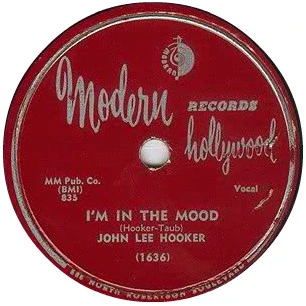
“I’m in the Mood” is one of John Lee Hooker’s most iconic and commercially successful recordings, a hypnotic electric blues track that became a major R&B hit in 1951. First released on Modern Records (catalog 835), it is widely regarded as one of the highest-selling blues singles of its era and a defining example of Hooker’s stark, atmospheric Detroit sound.
Recording Sessions and Producer
The song was recorded in mid-August 1951 (sources specify around August 7) at United Sound Systems in Detroit, Michigan. The session was produced by Bernard Besman, a key figure in Detroit’s early postwar blues scene who ran Sensation Records and frequently worked with Hooker. Sound engineer Joe Siracuse handled the technical side.
Hooker performed with second guitarist Eddie Kirkland. Besman employed an innovative (for the time) overdubbing technique: he layered two (and in some accounts additional) vocal tracks by Hooker, creating an eerie, echoing, slightly out-of-sync effect that became a signature of the recording. This was among the earliest uses of vocal overdubbing in blues records, though Les Paul had pioneered similar techniques earlier. The result is a stark, spooky, and highly atmospheric performance. As with Hooker’s earlier smash “Boogie Chillen’,” Besman leased the masters to the Bihari brothers’ Modern Records in Los Angeles for national distribution.
The single was released in October 1951 (some listings note September), with “How Can You Do It” as the B-side. It entered the Billboard R&B charts in October, reached number one on the Most Played Juke Box Rhythm & Blues chart, and held the top spot for four weeks beginning in mid-November 1951. It is reputed to have sold around a million copies.
Songwriters
The primary songwriter is John Lee Hooker. Official credits often list Hooker with Bernard Besman (or the pseudonym “Jules Taub,” used by Modern Records co-owner Jules Bihari to claim a share of publishing royalties—a common industry practice of the era). Hooker himself claimed the song was inspired by the title (and perhaps the mood) of Glenn Miller’s popular swing-era instrumental “In the Mood.”
Detail on the songwriters and composition: John Lee Hooker (1917–2001) was one of the most original and influential blues artists of the 20th century. His songwriting was deeply rooted in the Delta traditions he absorbed growing up in Mississippi, filtered through the industrial, urban environment of Detroit, where he settled during the Great Migration. Hooker’s compositions typically feature simple, repetitive structures, hypnotic guitar riffs, and lyrics that are direct, conversational, and often focused on desire, restlessness, or everyday experience. He was known for improvising lyrics and arrangements in the studio, rarely performing a song the same way twice.
“I’m in the Mood” exemplifies this approach. The lyrics are minimal and obsessive, centered on the repeated declaration of romantic and sexual longing (“I’m in the mood for love”). There is little narrative complexity; instead, the power comes from the hypnotic repetition and the intensity of Hooker’s delivery. The song’s structure is built around a slow-to-midtempo groove rather than a strict 12-bar form, allowing space for Hooker’s distinctive guitar work and the atmospheric overdubs.
Bernard Besman’s role was primarily that of producer and facilitator rather than traditional co-writer of the melody or lyrics. His contribution included shaping the session, encouraging the overdubbing experiment, and handling the business side (leasing to Modern). The “Jules Taub” credit reflects the Bihari brothers’ standard practice of inserting themselves into the publishing for financial reasons; it does not indicate substantial creative input into the song itself. In later years and reissues, credits more commonly appear as Hooker and/or Hooker–Besman.
Musicians
- John Lee Hooker – vocals, guitar (with overdubbed vocals and additional guitar layers)
- Eddie Kirkland – second guitar
The sparse instrumentation is typical of Hooker’s early Detroit recordings: electric guitar, foot stomps (often on plywood for a percussive backbeat), and minimal accompaniment. Kirkland’s second guitar provides complementary rhythm and fills without cluttering the hypnotic core of Hooker’s playing.
Musical Style and Analysis
“I’m in the Mood” is a masterclass in atmosphere and restraint. The tempo is slow to moderate, built on a hypnotic, slightly irregular groove driven by Hooker’s electric guitar and foot stomps. The guitar work features Hooker’s characteristic open or modal tuning approach, heavy amplification, and percussive attack—creating a dense, droning texture rather than conventional chord changes or flashy solos.
The vocal performance is central. Hooker’s deep, resonant voice delivers the lyrics in a half-spoken, half-sung style that is intimate and urgent. The overdubbed second (and sometimes third) vocal track creates a ghostly, echoing effect—described by critic Richie Unterberger as sounding “like that of a voice echoing around the inside of a water tower.” This technical innovation heightens the song’s eerie, almost supernatural sensuality.
Structurally, the song prioritizes mood and repetition over complex form. The title phrase functions as both chorus and mantra, reinforcing the single-minded focus on desire. There is little harmonic movement; the power derives from rhythmic insistence, dynamic control, and the interplay between the layered vocals and the sparse guitar. The result is stark, spooky, and deeply earthy—qualities that distinguish it from more polished urban blues of the period and align it with Hooker’s unique Delta-to-Detroit aesthetic.
In both its original 1951 form and later reinterpretations, “I’m in the Mood” exemplifies Hooker’s genius for transforming minimal materials into something profoundly evocative and commercially potent. It remains a cornerstone of his legacy and a high point of early 1950s electric blues.
Other Versions
Hooker re-recorded the song multiple times throughout his career. The most celebrated later version is the 1989 duet with Bonnie Raitt on the album The Healer (produced by Roy Rogers). Recorded in a dimly lit studio, it won a Grammy Award for Best Traditional Blues Recording and introduced the song to a new generation. Raitt has described the session as one of the most erotic musical experiences of her life; Hooker noted that Raitt already knew the song thoroughly from performing it herself.
Other notable covers and versions include those by John Hammond Jr. (1967), Buddy Guy and Junior Wells (1981), Jack Bruce and Gary Moore, and various live performances and reissues by Hooker himself. Bob Dylan and The Band recorded a version during the Basement Tapes sessions. The song has also appeared in numerous Hooker compilations and remains a staple of his catalog.
Suggested Listening
 Buy from Amazon I'm In The Mood 3CD Box Set
Legacy
“I’m in the Mood” stands as one of Hooker’s signature hits and a landmark of postwar electric blues. Its commercial success (a million-seller and multi-week R&B number one) confirmed Hooker’s status as a major artist after the breakthrough of “Boogie Chillen’.” The innovative vocal overdubs and the track’s stark, hypnotic atmosphere influenced generations of blues, rock, and roots musicians.
The 1989 Grammy-winning version with Bonnie Raitt revived interest in Hooker’s classic material during his late-career renaissance and helped cement The Healer as a landmark collaborative album. The song’s sensual, moody quality and minimalist structure have made it enduringly popular with both blues traditionalists and rock audiences. It remains one of the definitive examples of Hooker’s ability to create profound emotional intensity with the simplest of means.