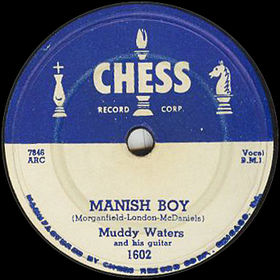
“Mannish Boy” (originally released as “Manish Boy”) is one of Muddy Waters’ most iconic and enduring recordings, a powerful assertion of Black manhood and sexual confidence that became a cornerstone of Chicago blues and a major influence on rock and roll. First cut in 1955 for Chess Records, it functions as an “answer song” to Bo Diddley’s “I’m a Man,” which itself drew from Waters’ earlier “Hoochie Coochie Man.”
Recording Sessions and Producer
The original version was recorded on May 24, 1955, in Chicago for Chess Records (catalog 1602). It was released in June 1955, with “Young Fashioned Ways” as the B-side. The session was produced by Leonard Chess and Phil Chess.
This was a rare Muddy Waters session without Little Walter on harmonica (Walter was on tour supporting his hit “My Babe”). Junior Wells filled the harmonica chair instead. The track features the classic Chess stop-time arrangement and call-and-response vocals. It reached No. 5 on the Billboard R&B chart and became one of Waters’ biggest hits of the mid-1950s.
Waters revisited the song multiple times. Notable later versions include the psychedelicized take on the 1968 album Electric Mud (produced by Marshall Chess, Gene Barge, and Charles Stepney) and the raw, high-energy 1977 remake on Hard Again, produced by Johnny Winter. The Hard Again version, featuring Winter on guitar, is often cited as one of the strongest late-career recordings by Waters and helped introduce the song to a new rock audience. A celebrated live performance with The Band and Paul Butterfield appears in the 1976 concert film and soundtrack The Last Waltz.
Songwriters
The song is credited to McKinley Morganfield (Muddy Waters), Mel London, and Ellas McDaniel (Bo Diddley).
Detail on the songwriters: Muddy Waters (McKinley Morganfield, 1913–1983) was the central figure of postwar Chicago blues. His songwriting and performing style fused Delta roots with amplified urban power. “Mannish Boy” continues the boastful, larger-than-life persona he had already established with Willie Dixon-penned hits such as “Hoochie Coochie Man.” Waters adapted and expanded the stop-time riff and manhood declaration from Bo Diddley’s “I’m a Man,” slowing the tempo, deepening the vocal authority, and making the statement more deliberate and commanding.
Bo Diddley (Ellas McDaniel, 1928–2008) had recorded “I’m a Man” earlier in 1955 at Chess. That song itself was built on the stop-time structure and braggadocio of Waters’ “Hoochie Coochie Man.” Diddley received a co-writing credit on “Mannish Boy” (under his birth name), reflecting the close creative exchange at Chess and the shared musical DNA of the two tracks. The relationship between the songs has sometimes been described as a friendly (or competitive) dialogue within the Chess roster.
Mel London (a Chicago songwriter, producer, and later label owner associated with Chief/Age/Profile Records) also received a writing credit. London’s exact contribution is less documented than those of Waters and Diddley, but he was active in the Chicago blues scene and is known for writing or co-writing other notable tracks (including “Messin’ with the Kid” for Junior Wells). His inclusion reflects the collaborative and sometimes fluid nature of song credits in the 1950s blues industry.
The lyrics center on a bold declaration of adult male identity and sexual prowess (“I’m a man / I spell M-A-N…”). In the context of the Jim Crow South and the Great Migration, the insistence on being called a “man” rather than “boy” carried clear social and political weight, turning a personal boast into a broader assertion of dignity and power.
Musicians (1955 Chess Version)
- Muddy Waters – vocals, guitar
- Junior Wells – harmonica
- Jimmy Rogers – guitar
- Willie Dixon – bass (some sources list him; others note the rhythm section more generally)
- Fred Below – drums
- Unidentified female chorus / band vocal responses
This was one of the few Muddy Waters studio recordings featuring Junior Wells rather than Little Walter. The tight stop-time riff, punctuated by the full band and call-and-response shouts, gives the track its driving, ritualistic power.
The 1977 Hard Again version featured Johnny Winter (guitar/production), James Cotton (harmonica), Bob Margolin (guitar), Pinetop Perkins (piano), Charles Calmese (bass), and Willie “Big Eyes” Smith (drums).
Musical Style and Analysis
“Mannish Boy” is built on a repeating stop-time figure—one of the most recognizable riffs in blues. The band hits a short, syncopated phrase and then drops out (or holds), allowing Waters’ voice to dominate before the riff returns. This creates a call-and-response tension between the singer and the ensemble that feels both ritualistic and conversational.
The song is essentially a one-chord (or very limited harmonic) blues, prioritizing rhythmic drive and vocal intensity over chord changes. Waters’ vocal delivery is deep, authoritative, and preacher-like, full of whoops, asides, and exaggerated phrasing that heighten the boastful character of the lyrics. The harmonica (Junior Wells on the original) and second guitar interject fills and responses, while the drums and bass lock the stop-time pattern with precision.
The overall effect is hypnotic and commanding. Where Bo Diddley’s “I’m a Man” is faster and more frantic, Waters’ version is slower, heavier, and more deliberate—an older man’s confident declaration rather than a younger man’s urgent claim. The combination of Delta-rooted vocal power, amplified Chicago instrumentation, and the stop-time structure made the record both a commercial R&B success and a template for countless later blues and rock performances.
“Mannish Boy” endures as a perfect distillation of Muddy Waters’ art: raw, proud, rhythmically irresistible, and culturally resonant.
Other Versions
Waters himself recorded multiple versions across decades. Notable covers and adaptations include performances by The Rolling Stones (live), Jimi Hendrix (a previously unreleased Band of Gypsys-era take), Koko Taylor (“I’m a Woman,” a gender-flipped answer), and many blues and rock artists. The song has appeared in films (Risky Business, Goodfellas) and commercials, further embedding it in popular culture. David Bowie’s early band The Mannish Boys took its name from the song, and the riff influenced tracks such as Bowie’s “The Jean Genie.”
Suggested Listening
 Buy from Amazon The Best of Muddy Waters
Legacy
“Mannish Boy” is a cornerstone of Chicago blues and a foundational influence on rock and roll. It was inducted into the Blues Hall of Fame (Classics of Blues Recordings) in 1986 and is included in the Rock and Roll Hall of Fame’s list of the “500 Songs that Shaped Rock and Roll.” It ranks on Rolling Stone’s list of the 500 Greatest Songs of All Time.
The song’s stop-time riff and assertive lyric have been endlessly adapted, and its themes of manhood, power, and sexual confidence continue to resonate. The 1977 Hard Again version helped spark a late-career renaissance for Waters, while the original remains a definitive statement of 1950s electric blues swagger.