"Mojo Hand" is one of the most recognizable and enduring songs in the blues canon — a rolling boogie that became Lightnin' Hopkins's signature tune and one of the most covered blues songs of the 1960s. Recorded in November 1960 at Beltone Studios in New York City for Bobby Robinson's Fire Records, the song captures Hopkins at a pivotal moment in his career, when the folk-blues revival was bringing him to new audiences and his prolific recording output was at its peak.
The Song and Its Context
Composition and Meaning
The song's title refers to a "mojo hand" — a small cloth bag filled with roots, herbs, and other secret ingredients used in African American folk magic (hoodoo) to cast spells, bring luck, or influence others. In the song, Hopkins's narrator wants to acquire a mojo hand to "fix my woman so she can't have no other man" — a classic blues theme of romantic jealousy and supernatural intervention.
The lyrics are delivered with Hopkins's characteristic conversational style, half-sung and half-spoken, with his guitar providing the rhythmic and melodic foundation. The song's structure is a rolling boogie — a 12-bar blues with a driving, danceable groove that was more uptempo and accessible than some of his earlier, more introspective work.
The Recording Session
Date and Location
"Mojo Hand" was recorded in November 1960 at Beltone Studios in New York City. This was part of an extraordinarily prolific month for Hopkins — he recorded more than 40 songs for three different companies in New York and New Jersey during this period. As the Blues Foundation noted, "Lightnin' Hopkins, who never had a problem with coming up with songs for cash on the spot, recorded more than 40 songs in the month of November 1960 for three different companies in New York and New Jersey."
The Producer
Bobby Robinson (1917–2011) was the producer of the session. Robinson was a legendary Harlem record man who had founded Fire Records in 1949 and Enjoy Records in 1962. He was known for his ability to capture raw, authentic R&B and blues performances with minimal studio polish. Robinson's approach was to set up the equipment, let the musicians play, and capture the energy of the room.
Robinson's relationship with Hopkins was typical of the independent label operator-artist dynamic of the era — he paid Hopkins for his performances, acquired the masters, and handled manufacturing and distribution. The fact that Hopkins recorded so prolifically for Robinson in a single month suggests both the producer's efficiency and the artist's remarkable creative stamina.
The Musicians
The personnel on the "Mojo Hand" session was:
-
Lightnin' Hopkins — guitar, vocals, piano
-
Unknown musician — bass
-
Delmar Donnell — drums
This was a departure from Hopkins's typical solo or duo approach. The addition of bass and drums gave the recording a fuller, more R&B-oriented sound than his earlier acoustic work. As AllMusic reviewer Tim Sheridan noted, the album "casts Hopkins in a more R&B-flavored environment. This obvious effort to get a hit makes for some excellent blues; moody and powerful performances play throughout."
The identity of the bassist remains unknown in available documentation, but Delmar Donnell on drums provided the steady, propulsive backbeat that drove the song's rolling boogie rhythm. The rhythm section's presence was "unobtrusive but very much there," as The Penguin Guide to Blues Recordings observed — they supported Hopkins without overwhelming his distinctive style.
Release and Chart Performance
"Mojo Hand" was released as a single on Fire Records in 1960 and became the title track of the album Mojo Hand, released in 1962. The album also included "Coffee for Mama," "Awful Dreams," "Black Mare Trot," "Have You Ever Loved a Woman," "Glory Be," "Sometimes She Will," "Shine On, Moon!," and "Santa."
While "Mojo Hand" did not achieve the same chart success as some of Hopkins's earlier R&B hits (like "T-Model Blues" or "Tim Moore's Farm"), it became his most recognizable standard — the song that audiences requested most often and that other artists covered most frequently. Its popularity was driven by its accessibility, its danceable groove, and its catchy, memorable hook.
The Album: Mojo Hand (1962)
The full album Mojo Hand was released in 1962 on Fire Records (FLP 104) and represented one of Hopkins's most cohesive studio efforts. All compositions were credited to Sam "Lightnin'" Hopkins, M. Robinson, and C. Lewis — suggesting that Bobby Robinson and possibly a collaborator named C. Lewis (possibly Clyde Lewis, a songwriter and musician associated with Fire Records) may have contributed to the songwriting or arrangements.
The album's track listing:
-
"Mojo Hand" — 2:55
-
"Coffee for Mama" — 3:25
-
"Awful Dreams" — 4:50
-
"Black Mare Trot" — 3:55
-
"Have You Ever Loved a Woman" — 2:38
-
"Glory Be" — 4:25
-
"Sometimes She Will" — 2:30
-
"Shine On, Moon!" — 4:17
-
"Santa" — 3:44
The album was notable for including a Christmas blues ("Santa") — a charming novelty that demonstrated Hopkins's willingness to experiment with unexpected themes. The overall mood of the album, as AllMusic noted, was "moody and powerful" — a blend of the raw Texas blues that was Hopkins's foundation and the more polished R&B sound that Fire Records was cultivating.
Cover Versions and Legacy
The Rolling Stones
The most significant cover of "Mojo Hand" came from The Rolling Stones, who recorded it for their debut album The Rolling Stones (released in the UK in 1964, in the US as England's Newest Hit Makers). The Stones' version introduced the song to a massive international audience and helped establish Hopkins as a foundational influence on the British blues-rock movement.
Other Covers
"Mojo Hand" has been recorded by numerous artists across genres, including:
-
Jimi Hendrix — who cited Hopkins as a major influence
-
Stevie Ray Vaughan — who absorbed the Texas blues tradition that Hopkins helped define
-
Albert Collins — another Texas blues guitarist influenced by Hopkins
-
Billy Gibbons of ZZ Top — who has acknowledged Hopkins's influence on his guitar style
-
The Grateful Dead — who covered Hopkins material and named a song after "Mojo Hand"
-
The Doors — who were influenced by Hopkins's raw, hypnotic approach
The "Mojo Hand" Concept
The song's title and concept have transcended the blues genre to become part of broader American popular culture. The term "mojo" has entered mainstream vocabulary, and the idea of a "mojo hand" as a talisman or lucky charm has been referenced in countless songs, films, and books. The song helped popularize hoodoo and African American folk magic as subjects for popular music, paving the way for later explorations by Dr. John, Screamin' Jay Hawkins, and others.
Blues Hall of Fame
In 2023, "Mojo Hand" was inducted into the Blues Foundation Hall of Fame as a "Classic of Blues Recording." The Blues Foundation noted that the song became Hopkins's "most recognizable standard" and that it demonstrated his ability to "come up with songs for cash on the spot" during his prolific November 1960 recording sessions.
The 2022 Reissue: Mojo Hand: The Complete Fire Sessions
In 2022, Fire Records (now a division of 43 North Broadway, LLC) reissued the album as Mojo Hand: The Complete Fire Sessions, remastered and expanded with additional session recordings. The reissue was distributed by Redeye Worldwide and made available on streaming platforms, vinyl, and CD. This comprehensive release gathered all of the material from the November 1960 Beltone Studios sessions, providing a complete document of one of Hopkins's most productive recording periods.
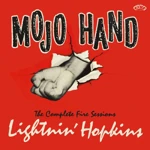 Mojo Hand: The Complete Fire Sessions Buy from Amazon
Legacy and Significance
"Mojo Hand" stands as one of the most important blues recordings of the 1960s for multiple reasons:
-
Accessibility: The song's rolling boogie groove and catchy hook made it approachable for audiences who might have found Hopkins's more introspective work too demanding.
-
R&B Crossover: The addition of bass and drums gave the recording a fuller, more contemporary sound that bridged the gap between traditional blues and the emerging R&B market.
-
British Invasion Foundation: The Rolling Stones' cover helped establish the British blues-rock movement and introduced Hopkins to a global audience.
-
Cultural Impact: The song's exploration of hoodoo and folk magic helped bring African American spiritual traditions into mainstream popular culture.
-
Prolific Documentation: The November 1960 sessions that produced "Mojo Hand" demonstrated Hopkins's extraordinary creative stamina — more than 40 songs in a single month for three different labels.
Lightnin' Hopkins died in 1982 at age 69, but "Mojo Hand" continues to resonate — in the grooves of original Fire 45s, in the reissue CDs, in the samples used by hip-hop producers, and in the DNA of every blues and rock band that ever played a rolling boogie groove. As one historian wrote, "Deep down in the blood-thickened grooves of his songs, listeners can catch glimpses, shards, and shadings of sorrow songs found on slave and sharecropper plantations, prison work fields, and infamous prison chain gang highways…. Hopkins's sorrow songs constitute a living fabric, a commanding version of history as his-story."