
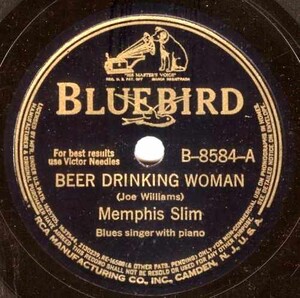
"Beer Drinking Woman" (also titled "Beer Drinkin' Woman") is one of Memphis Slim’s earliest and most enduring recordings. Cut in 1940 for Bluebird, it helped launch his professional career and remained in his repertoire for decades. The song is a classic mid-tempo piano blues that showcases Slim’s developing style as both a singer-pianist and songwriter.
Recording Session
The song was recorded on October 30, 1940, at RCA Studio A in Chicago. Matrix number BS-053590 (take 1 issued; an alternate take 2 also survives). It was released on Bluebird B-8584 (paired with “Grinder Man Blues”) around December 13, 1940. This was Slim’s second commercial session (his first under the name Memphis Slim) and one of the recordings that established him as a professional artist. He later stated that the success of “Beer Drinking Woman” and “Grinder Man Blues” from this date allowed him to play the venues he had long dreamed of.
Producer: Lester Melrose, the influential A&R man and producer for Bluebird/RCA Victor. Melrose gave Chatman the stage name “Memphis Slim” and oversaw many of the label’s blues sessions in this period. He favored a relatively polished, commercially oriented blues sound with clear piano and rhythm support.
Songwriters
Memphis Slim (born John Len Chatman; he published under the name Peter Chatman in honor of his father) is the sole credited songwriter. The song is an original composition that reflects the everyday social world of urban and Southern Black life in the late 1930s–early 1940s.
The lyrics center on a woman who loves beer drinking and the complications that follow. Slim presents the character with a mixture of humor, observation, and mild complaint rather than pure bitterness. The narrative is straightforward and conversational: the singer describes the woman’s habits, the consequences for their relationship, and his own responses. This approach—rooted in real-life observation and delivered with a touch of wry detachment—became a hallmark of Slim’s songwriting. Unlike more dramatic or fatalistic blues, “Beer Drinking Woman” has a lighter, more anecdotal quality that made it accessible and repeatable in live settings.
Slim’s early writing already shows the clarity and structural sense that would mark his later hits (including “Every Day I Have the Blues” and “Mother Earth”). He balances personal detail with universal blues themes of romance, independence, and everyday friction. The song’s staying power in his repertoire for decades indicates how well it suited both his personality and his audience.
Musicians
The original session was sparse and effective:
- Memphis Slim (Peter Chatman) – vocals and piano
- Leroy Batchelor (also spelled Bachelor) – double bass
This minimal lineup places full emphasis on Slim’s piano and voice. The bass provides steady rhythmic and harmonic support without crowding the arrangement. (Some discographical notes mention possible additional presence on related sides, but the core issued take features Slim and Batchelor.)
Musical Style and Analysis
“Beer Drinking Woman” is a mid-tempo piano blues firmly rooted in the Chicago style of the early 1940s while still carrying strong Southern influences from Slim’s Memphis upbringing.
Piano style: Slim’s playing already displays the powerful left-hand foundation and right-hand melodic freedom that would define his mature work. The left hand supplies a steady, rolling bass pattern with boogie and blues elements; the right hand delivers fills, chords, and melodic responses that interact with the vocal line. His touch is firm and authoritative rather than delicate, giving the performance a solid, propulsive feel. The piano functions as both rhythmic engine and harmonic color, creating a full sound even in the duo setting.
Vocal delivery: Slim’s deep, clear baritone is already distinctive. He sings with rhythmic precision and a slightly conversational tone that suits the anecdotal lyrics. Phrasing is natural and swinging; he leaves space for the piano fills and uses subtle dynamic shifts to emphasize key lines. The overall vocal approach is confident and engaging rather than intensely emotional or rough-edged.
Structure and arrangement: The song follows a standard 12-bar blues form with an AAB lyric pattern. The tempo is moderate—danceable yet relaxed enough for the story to register. The sparse instrumentation keeps the focus on the interplay between voice and piano. Bass notes lock with the left-hand piano patterns to create a solid groove, while the right-hand piano answers and ornaments the vocal. The result is clean, well-balanced, and commercially polished in the Melrose manner, yet still grounded in authentic blues feeling.
The track’s appeal lies in its combination of strong groove, clear storytelling, and Slim’s already-commanding presence at the piano. It sits between the more rural-sounding blues of the 1930s and the fuller small-band jump blues Slim would develop later with the House Rockers. The performance is concise (around three minutes), tightly executed, and immediately memorable—qualities that helped it become an early success and a long-term repertoire piece.
Other Versions
Memphis Slim revisited the song in later years, including live performances (for example, a 1986 version at Ronnie Scott’s with guests). An alternate take from the original 1940 session has been issued on compilations. The song appears on numerous reissues of Slim’s Bluebird material (The Bluebird Recordings 1940–1941 and various complete-works sets). Covers exist, including versions associated with Chuck Berry in some discographies, though Slim’s original remains the primary reference.
 Buy from Amazon The Bluebird Recordings 1940–1941
Legacy
“Beer Drinking Woman” was one of the two sides from Slim’s October 1940 session that established him as a recording artist and working professional. Together with “Grinder Man Blues,” it gave him the commercial foothold he needed in Chicago. The song stayed in his live and recorded repertoire for decades, illustrating its lasting appeal. It represents an important early document of Slim’s piano style and songwriting approach—clear, rhythmic, observational, and audience-friendly—before he expanded into larger band formats and more philosophical material such as “Mother Earth.” As part of the Bluebird catalog overseen by Lester Melrose, it also sits within the broader history of commercially successful Chicago blues of the early 1940s. Reissues have kept the track available, ensuring its place in the documented early career of one of the blues’ most consistent and influential pianists.









