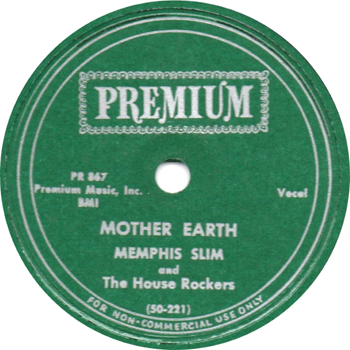
"Mother Earth" is one of Memphis Slim’s most enduring and philosophically resonant blues recordings. A slow, minor-tinged twelve-bar blues first released in 1951, it combines a memorable descending chromatic figure with a stark meditation on mortality and human equality. The song became a signature piece for Slim and later inspired covers across blues, rock, and soul.
Recording Session
The original version of “Mother Earth” was recorded during a marathon session in March 1950 in Chicago for the independent Premium Records label (formed by the owners of the recently collapsed Miracle Records). Matrix numbers from the session fall in the UB50 series (associated with United Broadcasting Studio), with “Mother Earth” linked to numbers in that sequence (commonly cited around UB50-221). The track was released as the A-side (or paired side) of Premium 867 in January 1951, backed with “Really Got the Blues,” and entered the Billboard R&B charts that same month, peaking at number 7 (or number 9 on the jukebox chart in some contemporaneous reports).
A follow-up session for Premium occurred in May 1950, but it produced no immediate commercial releases while the label was active. Slim continued recording for Premium into early 1951 (including a documented February 1951 session with lineup changes), after which the company folded; Leonard Chess later acquired many of the Premium masters. Slim returned to the song in later years, notably on the 1959 Vee-Jay album Memphis Slim at the Gate of the Horn and in various live and studio contexts thereafter.
This March 1950 dating places the original recording firmly in the early postwar Chicago independent-label period, shortly after Slim’s Miracle years and before his moves to United, Vee-Jay, and beyond.
Producer: Details for the original Premium session are sparse in surviving documentation, as was common for small independent labels of the era. Later reissues and related Chess-era material sometimes list Ralph Bass in production or supervisory roles, but the 1950 recording is primarily associated with Premium’s in-house production.
Songwriters
Memphis Slim (born Peter Chatman, also known as John Len Chatman) and Lewis (Lewin) Simpkins are the credited songwriters. Slim was the primary creative force—composer of the distinctive musical figure and the core philosophical message—while Simpkins, an A&R man and collaborator associated with Miracle and Premium, contributed to the lyrical framing.
The song is a classic blues “moralizer.” Its central refrain—“Don’t care how great you are, don’t care what you’re worth / When it all ends up you got to go back to mother earth”—is one of the most frequently quoted lines in postwar blues. The lyrics systematically dismantle status, wealth, and pride: racehorses, money, high-hatting behavior, ownership of property or airplanes all prove meaningless in the face of death. Everyone, regardless of achievement or fortune, returns to the same earth.
This theme draws on long-standing African American folk and religious traditions that emphasize the equality of all people before mortality, while remaining secular in tone. Slim’s writing here is concise, proverb-like, and universal rather than narrowly personal. The song’s power lies in its calm, almost stoic acceptance of the inevitable rather than in dramatic lament. Slim later named a 1959 album after the song, underscoring its importance in his catalog. The collaboration with Simpkins reflects the common practice of pairing performing artists with label-affiliated writers or A&R figures who helped shape commercially viable material.
Musicians
The original 1950 Premium recording features Memphis Slim with his band the House Rockers and a backing vocal group:
- Memphis Slim – piano, lead vocals
- Alex Atkins – alto saxophone
- Timothy Overton (or Ernest Cotton in some related lineups) – tenor saxophone
- Alfred Elkins – bass
- Leon Hooper – drums
- Vocal group (often identified as the Vagabonds or similar ensemble) providing harmony backgrounds
The arrangement is relatively spare for a full band recording of the period: Slim’s piano and voice remain central, the saxophones add sustained pads and occasional fills, and the rhythm section maintains a deliberate, slow pulse. The vocal group’s harmonizing behind Slim’s chanting creates the “haunting effect” noted in contemporary reviews.
Musical Style and Analysis
“Mother Earth” is a slow twelve-bar blues, typically performed in a minor or minor-inflected key (commonly associated with G minor or related tonalities in the original). Its most distinctive musical feature is a descending chromatic figure—a stepwise downward movement that often begins on the root and descends toward the flat fifth or fifth before resolving. This chromatic descent functions both as an introductory motif and as a recurring melodic and harmonic color that gives the song its somber, inevitable character.
Piano style: Memphis Slim’s left hand supplies a steady, rolling foundation rooted in boogie-woogie and Chicago blues piano traditions, while his right hand delivers the chromatic figures, tremolo, and melodic fills. The playing is restrained and atmospheric rather than flashy, matching the philosophical weight of the lyrics. The tempo is deliberately slow, allowing space for the vocal lines and the chromatic motif to register fully.
Vocal delivery: Slim’s deep, authoritative baritone delivers the lyrics with calm gravity. The phrasing is measured and almost conversational, reinforcing the song’s proverb-like quality. The backing vocal group provides sustained harmonies that thicken the texture without competing with the lead, creating a subtle choral dimension unusual for hard Chicago blues of the period.
Structure and arrangement: The song follows a standard 12-bar form with an AAB lyric pattern. The chromatic figure often appears in the turnarounds or as an introductory statement, giving the arrangement a sense of circularity—life begins and ends in the same earth. Dynamics remain controlled; the track builds intensity through repetition and the accumulation of the chromatic motif rather than through volume or tempo changes. At approximately 2:42–2:43, the original single is concise yet complete.
The overall effect is one of quiet inevitability. The descending chromatic line sonically embodies the lyric’s message of descent and return to the earth, while Slim’s piano and the sparse band arrangement keep the focus on the moral statement. Retrospective critics have praised it as “an uncommonly wise down-tempo blues” and one of the finest examples of the form.
Other Versions
Memphis Slim recorded the song multiple times in studio and live settings. Notable covers and adaptations include:
- Mother Earth (the San Francisco band named after the song), featuring Tracy Nelson on vocals and piano, on their 1968 debut Living with the Animals (extended version).
- Eric Burdon & War – incorporated into the medley “Blues for Memphis Slim” on Eric Burdon Declares “War” (1970); Jimi Hendrix sat in on a live performance of the song shortly before his death.
- Johnny Winter (1988 and live versions).
- Cyndi Lauper with Allen Toussaint (2010).
- Additional versions by Barbara Dane (with Lightnin’ Hopkins), Heart (as part of a medley), Gov’t Mule, Tab Benoit, and others.
Suggested Listening
 Buy from Amazon Mother Earth
Legacy
“Mother Earth” stands as one of Memphis Slim’s signature compositions and a postwar blues standard. Its chart success in 1951 helped solidify Slim’s reputation, and its philosophical depth has kept it relevant across generations. The song’s influence is visible in the naming of the band Mother Earth and in the wide range of covers that span traditional blues, psychedelic rock, funk, and contemporary interpretations. It remains a frequently cited example of the blues’ capacity for profound, universal reflection on mortality and equality, delivered with the elegance and authority that characterized Memphis Slim’s best work.