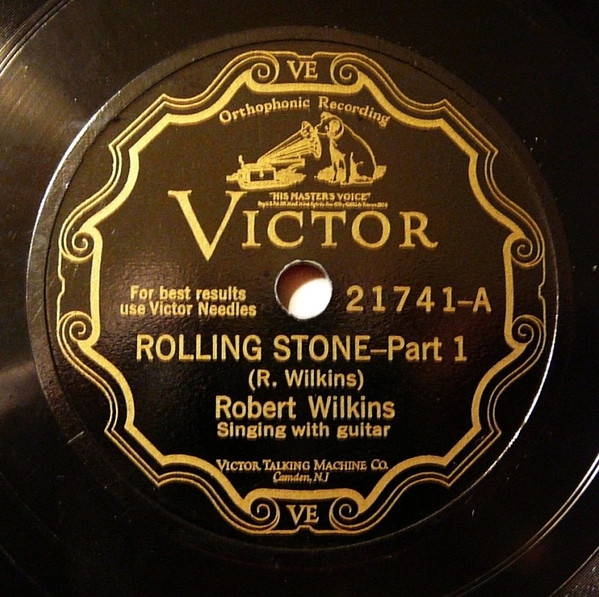
"Rolling Stone" (Parts 1 and 2), also known as "Rollin' Stone," is a pioneering two-sided country blues recording by Robert Wilkins (Robert Timothy Wilkins, 1896–1987). Recorded in 1928, it is one of the earliest uses of the phrase “rolling stone” in recorded blues and a key early example of Memphis-area country blues songwriting and guitar style.
Recording Session
The song was recorded on September 7, 1928, at the Memphis Auditorium in Memphis, Tennessee, during Wilkins’s first commercial session for the Victor label. It was released as Victor 21741 (Part 1 / Part 2) in December 1928. Matrix numbers are BVE-45496-1 (Part 1) and BVE-45497-2 (Part 2). Wilkins used a borrowed guitar with a broken neck for the session and was reportedly reluctant to have the recording released, though Victor proceeded.
Producer / Supervisor: Ralph Peer oversaw the session for Victor Records. Peer was a major figure in early commercial recording of blues, country, and folk material.
Songwriters
Robert Wilkins is the sole credited songwriter. The song stands as an original composition that helped establish him as a distinctive voice in early Memphis blues.
Wilkins’s writing on “Rolling Stone” is narrative and confessional rather than purely formulaic. The lyrics explore themes of restlessness, emotional isolation, and the burdens of a wandering life. The central image of the “rolling stone” (a person who cannot settle or find rest) is developed across the two sides of the 78, allowing for extended storytelling unusual for the era’s typical three-minute limit. Part 1 and Part 2 function as a continuous piece, giving Wilkins room to elaborate on personal hardship, failed relationships, and a sense of rootlessness.
His approach blends traditional blues imagery with a more personal, almost autobiographical tone. The song avoids heavy reliance on stock phrases in favor of a coherent emotional arc. This skill as a songwriter later carried over into his gospel career, when he reworked secular material (most famously turning “That’s No Way to Get Along” into the biblical “Prodigal Son”). “Rolling Stone” already shows the clarity of structure, melodic sense, and lyrical focus that would define his best work. The phrase itself entered the broader blues lexicon, though Wilkins’s version is distinct from the later Muddy Waters song of similar title.
Musicians
The recording is a solo performance:
- Robert Wilkins – vocals and guitar
No additional musicians appear on the sides. The performance relies entirely on Wilkins’s voice and his guitar accompaniment, which provides both rhythmic drive and melodic commentary.
Musical Style and Analysis
“Rolling Stone” is a country blues / Memphis blues performance characterized by a stark, intimate sound and a relatively unconventional structure for its time.
Guitar style: Wilkins plays with a clean, precise fingerstyle approach that combines steady bass patterns with melodic fills and chordal support. The guitar is not heavily percussive in the manner of some Delta players; instead it maintains a flowing, almost conversational relationship with the voice. Despite the borrowed, damaged instrument, the playing is controlled and articulate. The accompaniment often stays centered around a limited harmonic framework (frequently described as one-chord or near-modal in feel), enlivened by bass-note movement that implies harmonic motion without fully resolving into standard progressions. This creates a hypnotic, unsettled quality that mirrors the song’s lyrical theme of restlessness.
Vocal delivery: Wilkins sings in a clear, plaintive tenor with careful phrasing and emotional restraint. His tone is mournful yet controlled—less raw and shouting than many contemporary Delta singers, more focused on storytelling clarity. The voice sits comfortably over the guitar, with natural dynamics that rise and fall according to the narrative.
Structure: The piece is divided across two sides of a 78 rpm record, allowing for greater length and development than a single side would permit. It does not adhere strictly to a conventional 12-bar blues form throughout. Some descriptions note an 18-bar or ABAB-related pattern in places, while the overall feel remains blues-based through its melodic contour, blue notes, and emotional content. The continuous narrative across Parts 1 and 2 gives the performance a ballad-like quality within a blues framework. The guitar provides consistent rhythmic and harmonic grounding while leaving space for vocal expression.
The overall atmosphere is introspective and slightly austere. The limited harmonic movement and steady pulse reinforce the sense of a man who keeps moving yet finds no lasting rest. Wilkins’s command of dynamics, timing, and the interplay between voice and guitar marks the recording as more sophisticated than many contemporaneous solo blues sides.
Other Versions
Wilkins himself did not extensively re-record the secular “Rolling Stone” after his conversion to ministry in the 1930s, when he largely abandoned blues lyrics. The original 1928 sides remain the primary document.
The song has been reissued on key compilations, most notably The Original Rolling Stone (Yazoo / Herwin), which collects Wilkins’s pre-war recordings and takes its title from this track. Later artists and collectors have referenced or performed related material, but direct covers of the 1928 “Rolling Stone” are less common than those of his better-known “That’s No Way to Get Along” / “Prodigal Son.” The title and concept of the “rolling stone” figure, however, entered wider blues and popular-music usage.
Suggested Listening
 Buy from Amazon The Original Rolling Stone
Legacy
“Rolling Stone – Parts 1 and 2” is historically significant as one of the earliest recorded uses of the phrase “rolling stone” in blues. It helped launch Wilkins’s brief but notable pre-war recording career and demonstrated his gifts as both a songwriter and a refined guitarist-singer. The sides are now regarded as classics of pre-war Memphis and country blues.
Wilkins’s later transformation of other material into gospel (especially the Rolling Stones’ cover of “Prodigal Son”) brought renewed attention to his catalog, and the compilation The Original Rolling Stone cemented the 1928 recording’s place in the blues canon. The song stands as an early, eloquent statement of restlessness and emotional isolation, delivered with the clarity and craftsmanship that distinguish Robert Wilkins among the great under-appreciated figures of early blues.