
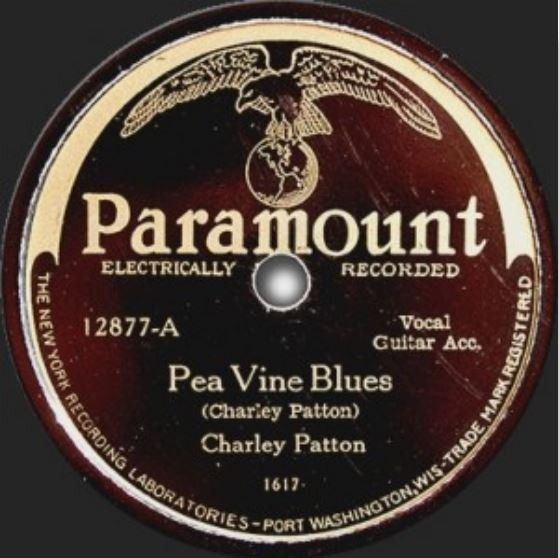
"Pea Vine Blues" is a classic early Delta blues recording by Charley Patton (c. 1891–1934), one of the foundational figures of the genre. Cut during his historic debut session in 1929, the song draws on local Mississippi railroad imagery and showcases Patton’s raw power as a singer, guitarist, and storyteller. It remains a cornerstone of pre-war blues and a key document of the Dockery Plantation musical world.
Recording Session
The song was recorded on Friday, June 14, 1929, at Gennett Studios in Richmond, Indiana, for Paramount Records. This was Patton’s first commercial session; he cut fourteen sides that day. The matrix number is G15221 (also listed as 15221). “Pea Vine Blues” was issued as the A-side of Paramount 12877, paired with “Tom Rushen Blues,” and first advertised in the Chicago Defender around February 1, 1930 (some sources note late 1929 release activity). The session was arranged with the involvement of Jackson, Mississippi, talent scout and music-store owner H. C. Speir, who recommended Patton to Paramount. Recording conditions at the Gennett facility were basic—a barn-like building near railroad tracks—and Paramount’s pressings were notoriously poor-quality, yet Patton’s powerful delivery still cuts through.
Producer / Supervisor: Paramount’s A&R and production staff oversaw the date (Arthur Laibly later handled subsequent Patton sessions). Speir’s scouting role was crucial in getting Patton into the studio.
Songwriters
Charley Patton is the sole credited songwriter. “Pea Vine Blues” belongs to the body of material he had developed and performed for years before recording; by 1929 it was already part of his basic repertoire.
The song is rooted in the landscape and daily life of the Mississippi Delta, specifically the area around Dockery Plantation. The “Pea Vine” refers to a winding branch line of the Yazoo and Mississippi Valley Railroad that ran south from Dockery toward Boyle, Mississippi. These short, twisting local lines were nicknamed “pea vines” because of their meandering routes (the name also evoked the plant itself). Patton uses the train’s whistle as a central image: “I think I heard the Pea Vine when she blowed… It blow just like my rider gittin’ on board.” The departing train becomes a metaphor for a lover leaving, a classic blues theme given concrete local detail.
Patton’s lyric style here is typical of his best work—direct, conversational, and grounded in place names and everyday observation rather than abstract poetry. He intersperses sung lines with spoken asides and shifts in vocal tone, creating a multi-layered narrative effect. The song follows a loose AAB blues structure while allowing room for his characteristic rhythmic and melodic flexibility. This combination of personal, place-specific detail and universal blues themes helped make Patton’s songs memorable and influential among both Black audiences in the Delta and later generations of musicians and collectors.
Musicians
The recording is a solo performance:
- Charley Patton – vocals and guitar
No additional musicians appear. Patton’s guitar provides the entire accompaniment, combining heavy bass thumps with forcefully picked upper-string figures that often “answer” or complete his vocal lines.
Musical Style and Analysis
“Pea Vine Blues” is a concentrated demonstration of Charley Patton’s Delta blues mastery. Recorded solo on June 14, 1929, the performance relies entirely on the interplay between his voice and guitar, creating a dense, multi-layered texture that feels larger than a single performer.
Form and Harmonic Framework
The song operates within a blues framework, most often described as a loose AAB structure. Patton does not adhere rigidly to a metronomic 12-bar grid. Phrases expand or contract according to the demands of the lyric and the emotional contour of the performance. This rhythmic elasticity is one of his signatures: the underlying pulse remains clear, yet individual lines stretch, compress, or overlap in ways that heighten drama. Harmonic movement stays centered on a primary tonal area, with the guitar supplying both the root foundation and implied chordal color through bass figures and upper-string responses rather than full, changing chords.
Guitar Technique
Patton’s guitar work is the structural and emotional engine of the track. He produces a striking contrast between registers:
- Bass register: Dark, plunging, heavily thumped notes create a somber, almost sepulchral foundation. These low tones function like a rhythmic and harmonic anchor, often described as having a drum-like or heartbeat quality.
- Upper strings: Forcefully picked figures supply melodic commentary, complete vocal phrases, and add brightness and attack. These higher lines frequently “answer” or finish the sung lines, creating a continuous dialogue between voice and instrument.
The result is a two-voiced (or multi-voiced) texture achieved by one player. Patton’s right-hand attack is percussive and physical; he treats the guitar as both melodic instrument and rhythmic driver. Timing is flexible—he will delay or rush a bass thump or upper-string fill for expressive effect while never losing the overall forward momentum. This combination of heavy low-end pulse and sharp upper-string articulation gives the performance its characteristic density and drive.
Vocal Approach and Textural Layering
Patton’s voice is raw, guttural, and extraordinarily powerful—capable of cutting through the surface noise of Paramount’s poor-quality pressings. He deploys a wide dynamic and tonal range within a single performance:
- Full-throated, projected singing carries the main narrative lines with urgency and force.
- Softer, spoken or half-spoken asides (for example, the quieter interjection about not having to cry anymore) add intimacy and a conversational or theatrical dimension.
- These shifts create a multi-planar effect: the sung voice, the spoken voice, and the guitar operate as parallel strands, giving the listener a sense of simultaneous dramatic layers.
The vocal phrasing is highly rhythmic. Patton often begins a line with strong rhythmic placement and then allows the melody to stretch or fall away, mirroring the flexible timing of his guitar. Blue notes and microtonal inflections appear naturally within the forceful delivery, locating the performance firmly in the Delta tradition while remaining uniquely personal.
Rhythmic Character and Overall Effect
The groove is urgent yet grounded. The heavy bass thumps provide a steady, almost marching undercurrent, while the upper-string attacks and vocal rhythms create syncopation and forward propulsion. The train-whistle imagery of the lyric finds a sonic parallel in the way the guitar figures rise and cut across the steady pulse—suggesting both the mechanical regularity of a railroad and the human emotion of departure.
The overall atmosphere is stark and powerful. There is little ornamental decoration; every element serves the narrative and the emotional weight of the song. The contrast between the dark bass foundation and the brighter, more agile upper strings, combined with the shifts between sung and spoken voice, produces a performance of remarkable intensity and structural sophistication for a solo 1929 recording.
In short, “Pea Vine Blues” exemplifies Patton’s ability to generate complex, multi-layered music from the simplest resources—one voice and one guitar—while remaining deeply rooted in the geography, speech, and rhythmic life of the Mississippi Delta. The track’s enduring impact lies in this combination of raw physical power, rhythmic freedom, and precise dramatic control.
Other Versions
Direct covers of “Pea Vine Blues” are less numerous than those of Patton’s better-known titles such as “Pony Blues,” but the song appears on virtually every major Patton compilation (Complete Recorded Works, Yazoo, Document, JSP, Third Man/Revenant sets, etc.). Later artists and revivalists have performed related railroad-themed or Patton-inspired material. The song’s railroad imagery and guitar approach have influenced the broader Delta tradition carried forward by Son House, Howlin’ Wolf, and others who absorbed Patton’s repertoire and style.
 Buy from Amazon The Best of Charley Patton
 Buy from Amazon The Complete Recordings 1929-34
Legacy
“Pea Vine Blues” stands as a key document from Patton’s landmark June 14, 1929, session—the date that introduced one of the most important figures in blues history to the recording world. The song’s specific reference to the Pea Vine railroad has been commemorated on the Mississippi Blues Trail, underscoring its rootedness in Delta geography and culture. Patton’s performance style—powerful voice, percussive and melodic guitar, spoken asides—helped define the Delta blues aesthetic that shaped subsequent generations, from Son House and Robert Johnson to Howlin’ Wolf, Muddy Waters, and the rock musicians who later drew on that tradition. Though Paramount’s poor pressings limited commercial reach at the time, reissues have secured “Pea Vine Blues” as an essential early blues recording and a vivid portrait of both a place and a towering musical personality.









