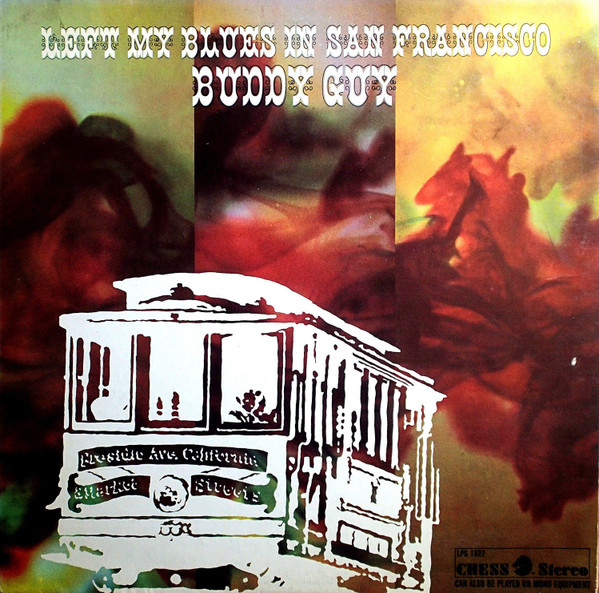
Left My Blues in San Francisco is the debut studio album by Buddy Guy, released in 1967 on Chess Records. Despite its title, the album has nothing to do with San Francisco — it was a marketing decision by Leonard Chess to capitalize on the "flower power" movement and appeal to young white audiences. In reality, it is a compilation of tracks recorded between 1962 and 1967 at Ter-Mar Studios in Chicago, making it a fascinating time capsule of Guy's early career and Chess's attempt to mold him into a soul/R&B artist rather than the raw blues guitarist he wanted to be.
Recording Sessions & Production
Dates: April 23, 1965 – 1967 (with some tracks dating back to 1962)
Location: Ter-Mar Studios, Chicago, Illinois
Label: Chess Records (catalog number LPS-1504)
Producer: Gene Barge — a saxophonist, arranger, and producer who also contributed tenor saxophone on several tracks and provided orchestration alongside Charles Stepney. Barge was a key figure in Chess's soul-oriented productions during the mid-1960s.
Orchestration: Charles Stepney — future producer and keyboardist for Rotary Connection, who provided orchestration and drums on tracks 1, 7, and 10. Stepney's arrangements gave the album its distinctive soul-pop sheen, with horn sections and string-like keyboard pads that were far removed from Guy's usual raw Chicago blues sound.
Recording Supervisor/Engineer: Ron Malo — Chess's house engineer who captured the Ter-Mar studio sound
Supervision: Max Cooperstein
Album Design/Cover Photography: Jerry Griffith
Illustration: Bill Utterback
The Leonard Chess Story: The album's soulful, polished sound was not Guy's choice. According to Guy's own account in a 2015 Rolling Stone interview, Chess founder Leonard Chess felt Guy's blues guitar playing sounded like "noise." Chess directed Guy to play R&B ballads, jazz instrumentals, and soul tunes instead. None of Guy's raw blues material was released by Chess during this period. Left My Blues in San Francisco became the only Buddy Guy record ever released on the Chess label. As Guy recalled, Chess eventually realized his mistake: "The first thing he said was, 'I want you to kick me in my ass.' And I said, 'What?' He said, 'Because you've been trying to show us this shit ever since you came here and we was too goddamn dumb to listen. So now this shit is selling and I want you to come in here — you can have your way in the studio.' But by then I was gone."
The "San Francisco" Deception: The album cover states "Recorded July, 1967 at Ter Mar Studios, Chicago," but this is only true for three tracks (A3 "I Suffer With the Blues," A5 "Buddy's Groove," and B1 "Goin' Home"). The remaining eight tracks were recorded at various dates between 1962 and 1966. The San Francisco reference and the July 1967 date were marketing ploys to make the album seem current and hip.
The Musicians
The album features a rotating cast of Chicago session musicians, with many names lost to history. The documented personnel includes:
Buddy Guy — lead guitar, lead vocals
Gene Barge — tenor saxophone (tracks 1, 2, 7, 9, 10, 11), production & orchestration
Charles Stepney — orchestration, drums (tracks 1, 7, 10)
Matt "Guitar" Murphy — guitar (tracks 2, 8, 9, 11)
Phil Upchurch — bass guitar (tracks 1, 7, 10)
Reggie Boyd — bass guitar (tracks 2, 9, 11)
Phil Thomas — drums (tracks 2, 4, 9, 11)
Lafayette Leake — Hammond organ (track 4)
Jack Meyers — bass (track 4)
Lefty Bates — rhythm guitar (track 4)
Jarrett Gibson — tenor saxophone (track 4)
Abe Locke — tenor saxophone (track 4)
Milton Bland — tenor saxophone (track 8)
A.C. Reed — tenor saxophone (track 8)
Leroy Stewart — bass guitar (track 8)
Sonny Turner — trumpet (track 4)
Murray Watson — trumpet (track 4)
Unknown musicians: The baritone saxophonist on tracks 1, 7, and 10; bassist on tracks 3, 5, and 6; drummer on tracks 3, 5, 6, and 8; rhythm guitarist on tracks 1, 5, 7, and 10; organist on tracks 3 and 8; pianist on tracks 1, 2, 5, 6, 7, 9, 10, and 11; and tenor saxophonist on tracks 1, 5, 6, 7, and 10 remain unidentified.
Matt "Guitar" Murphy was already a seasoned session player who would later gain fame as the guitarist for the Blues Brothers. His presence on several tracks adds a jazz-blues sophistication to the arrangements.
Lafayette Leake was a versatile pianist/organist who had worked with virtually every major Chess artist and would later appear on Willie Dixon's I Am the Blues (1970).
The Sound
The album's sound is a "hodgepodge of styles—soul, rhythm and blues, pop and blues" that forms "a fascinating time capsule." The production varies significantly due to the five-year span of recording dates, but the Ter-Mar studio sound is consistent: "deep, powerful bass, raw, satisfying drums and horns that cut effectively through the rhythm section's foundation." The mixes are "dense, full and strictly 'old school,'" probably recorded live to four-track tape.
What distinguishes the album from Guy's later work is the orchestration — Charles Stepney and Gene Barge's arrangements are "powerful as they have to be to not be buried by Guy's uncontainable banshee scream vocals." The horn sections, keyboard pads, and occasional string-like textures create a soul-pop atmosphere that is closer to Stax-Volt or Motown than to Muddy Waters or Howlin' Wolf. As one reviewer noted, "this whole album has a Wilson Pickett/Stax feel to it."
Despite the polished production, Guy's personality and guitar work shine through. His "stinging guitar" and "irrepressible personality" emerge from the arrangements, hinting at the artist he would become once freed from Chess's commercial constraints.
Track-by-Track Breakdown
Side A
1. "Keep It to Myself" (2:30)
-
Songwriter: Sonny Boy Williamson II (Aleck "Rice" Miller)
-
Recording: 1965–1967, Ter-Mar Studios, Chicago
-
Musicians: Buddy Guy (vocals, guitar), Gene Barge (tenor saxophone, production/orchestration), Charles Stepney (orchestration, drums), Phil Upchurch (bass), plus unidentified pianist, tenor saxophonist, baritone saxophonist, and rhythm guitarist
-
Notes: The album opens with a cover of Sonny Boy Williamson II's 1956 composition, given a soulful treatment that sets the tone for the entire record. The track features a driving rhythm, punchy horn arrangement, and Guy's vocals riding atop the ensemble. His guitar is relatively subdued — more rhythmic support than lead showcase — reflecting Chess's desire to present Guy as a soul singer rather than a guitar hero. The song was originally recorded by Williamson for Checker Records, and Guy's version transforms it from raw Delta blues into uptown R&B.
2. "Crazy Love" (2:20)
-
Songwriter: Willie Dixon
-
Recording: 1965–1966, Ter-Mar Studios, Chicago
-
Musicians: Buddy Guy (vocals, guitar), Gene Barge (tenor saxophone, production/orchestration), Matt "Guitar" Murphy (guitar), Reggie Boyd (bass), Phil Thomas (drums), plus unidentified pianist
-
Notes: Guy's recording was the first version of this Willie Dixon composition, predating the better-known covers by other artists. The song is a mid-tempo blues with a relaxed, almost lazy groove that allows Guy's vocal to take center stage. Matt Murphy's guitar provides subtle counterpoint to Guy's voice, while Barge's tenor sax adds soulful fills. The track is relatively stripped-down compared to some of the more orchestrated numbers, with just guitar, bass, drums, sax, and piano. Guy's vocal is smooth and controlled — a far cry from the raw shouting of his live performances, but effective in its own way. The song demonstrates Dixon's ability to write material that works across genres — blues, soul, and R&B.
3. "I Suffer With the Blues" (2:44)
-
Songwriter: Buddy Guy (George Guy)
-
Recording: July 1967, Ter-Mar Studios, Chicago
-
Musicians: Buddy Guy (vocals, guitar), plus unidentified bassist, drummer, organist, and pianist
-
Notes: One of three Buddy Guy originals on the album and one of the three tracks actually recorded in July 1967. This is Guy's declaration of blues identity — "I suffer with the blues" — a statement of allegiance to the tradition that Chess was trying to steer him away from. The track is a slow blues with minimal accompaniment — just Guy's voice and guitar, supported by bass, drums, and subtle organ. His guitar is more prominent here than on the opening tracks, with stinging single-note lines that hint at the fire he was capable of. The song became a fan favorite and was included in Guy's live repertoire for years. The sparse arrangement allows Guy's vocal and guitar to dominate, creating an intimate atmosphere that contrasts with the fuller productions elsewhere on the album.
4. "When My Left Eye Jumps" (3:53)
-
Songwriters: Willie Dixon, Al Perkins
-
Recording: 1965–1966, Ter-Mar Studios, Chicago
-
Musicians: Buddy Guy (vocals, guitar), Lefty Bates (rhythm guitar), Lafayette Leake (Hammond organ), Jack Meyers (bass), Phil Thomas (drums), Jarrett Gibson (tenor saxophone), Abe Locke (tenor saxophone), Sonny Turner (trumpet), Murray Watson (trumpet)
-
Notes: The most elaborately arranged track on the album, featuring a full horn section and Hammond organ. The title refers to the folk belief that a twitching left eye is an omen — typically of good luck for men, bad luck for women. Dixon's lyrics play with this superstition: "When my left eye jumps, somebody's coming with some good news." The track has a jazz-blues feel, with the horns providing sophisticated arrangements that wouldn't be out of place on a Count Basie record. Lafayette Leake's Hammond organ adds a churchy, gospel-tinged atmosphere. Guy's vocal is playful and knowing, his guitar relegated to brief, tasteful fills. This is Guy as entertainer rather than blues purist — a performer capable of working in multiple styles. The track's nearly four-minute length allows for extended instrumental passages, with the horns taking solos that showcase the quality of Chess's session players.
5. "Buddy's Groove" (3:42)
-
Songwriter: Gene Barge
-
Recording: July 1967, Ter-Mar Studios, Chicago
-
Musicians: Buddy Guy (vocals, guitar), plus unidentified bassist, drummer, organist, and pianist
-
Notes: The second of the three July 1967 recordings and the only track credited to producer Gene Barge. The song is an instrumental showcase — "Buddy's Groove" being a vehicle for Guy's guitar rather than his voice. The groove is a medium-tempo shuffle with a relaxed, after-hours feel. Guy's guitar is the star here, with extended solo passages that demonstrate his fluid technique and distinctive tone. The accompaniment is minimal — bass, drums, organ, and piano providing a subtle foundation. This track is the closest the album comes to showcasing Guy as a guitar hero, and it hints at the direction he would take in his later career. Barge's composition is a simple but effective blues framework that gives Guy room to stretch out. The track became a staple of Guy's live shows and was covered by other artists.
Side B
6. "Goin' Home" (2:39)
-
Songwriter: Willie Dixon
-
Recording: July 1967, Ter-Mar Studios, Chicago
-
Musicians: Buddy Guy (vocals, guitar), plus unidentified bassist, drummer, and pianist
-
Notes: The third and final July 1967 recording, and a Willie Dixon composition that had been recorded by numerous Chess artists. "Goin' Home" is a blues about returning to one's roots — "I'm goin' home, back to the place where I was born" — a theme that resonated with the Great Migration generation who had left the South for Chicago. Guy's vocal is heartfelt and sincere, his guitar providing sympathetic accompaniment. The arrangement is relatively sparse — just voice, guitar, bass, drums, and piano — allowing the emotional content of the lyrics to take center stage. The track is a slow blues with a stately, dignified tempo that gives Guy room to stretch out vocally. His guitar solo is particularly effective — a sustained, crying note that seems to embody the longing of the lyrics. This is Guy at his most traditional, playing pure Chicago blues despite Chess's attempts to steer him toward soul and pop.
7. "She Suits Me to a Tee" (2:14)
-
Songwriter: Buddy Guy (George Guy)
-
Recording: 1966, Ter-Mar Studios, Chicago
-
Musicians: Buddy Guy (vocals, guitar), Gene Barge (tenor saxophone, production/orchestration), Charles Stepney (orchestration, drums), Phil Upchurch (bass), plus unidentified pianist, tenor saxophonist, baritone saxophonist, and rhythm guitarist
-
Notes: One of Guy's three originals and a track that may remind listeners of Eric Clapton's "Outside Woman Blues" from Cream's 1967 album Disraeli Gears. However, Guy's track was recorded in 1966 — a full year before Cream's version — demonstrating that Guy was already influencing the British blues boom before he was widely recognized in America. The song is an uptempo blues with a driving rhythm and a catchy, repetitive chorus. The orchestration by Stepney and Barge is particularly prominent here, with horns and keyboards creating a dense, energetic backdrop for Guy's vocal. His guitar is fiery and aggressive, with rapid-fire runs that anticipate the blues-rock style he would pioneer in the 1970s. The track is a highlight of the album — a perfect synthesis of blues feeling and soul production.
8. "Leave My Girl Alone" (3:25)
-
Songwriter: Buddy Guy (George Guy)
-
Recording: 1962–1965, Ter-Mar Studios, Chicago
-
Musicians: Buddy Guy (vocals, guitar), Milton Bland (tenor saxophone), A.C. Reed (tenor saxophone), Matt "Guitar" Murphy (guitar), Leroy Stewart (bass), plus unidentified drummer and organist
-
Notes: The third of Guy's originals and one of the album's most popular tracks. "Leave My Girl Alone" is a warning to a rival — "You better leave my girl alone, before I get my gun and send you to your happy home" — delivered with Guy's characteristic blend of menace and humor. The track features a two-tenor-sax attack (Bland and Reed) that creates a dense, honking R&B sound reminiscent of King Curtis or Junior Walker. Matt Murphy's guitar adds a jazz-blues sophistication, while Guy's vocal is raw and urgent. The song became a staple of Guy's live repertoire and was later covered by Stevie Ray Vaughan. The track's extended length (over three minutes) allows for extended instrumental passages, with the saxes trading solos and Guy's guitar building to a climactic finish. This is Guy as blues shouter — the side of his personality that Chess tried to suppress but that would eventually make him famous.
9. "Too Many Ways" (2:14)
-
Songwriter: Willie Dixon
-
Recording: 1965–1966, Ter-Mar Studios, Chicago
-
Musicians: Buddy Guy (vocals, guitar), Gene Barge (tenor saxophone, production/orchestration), Matt "Guitar" Murphy (guitar), Reggie Boyd (bass), Phil Thomas (drums), plus unidentified pianist
-
Notes: A Willie Dixon composition about the many ways a woman can break a man's heart — "There's too many ways to break a man's heart, and baby you know them all." The track is a mid-tempo blues with a relaxed, conversational feel. Guy's vocal is smooth and controlled, his guitar adding subtle color rather than dominating the arrangement. Matt Murphy's guitar provides sympathetic accompaniment, while Barge's tenor sax adds soulful fills. The track is relatively short (just over two minutes), making it a compact, effective blues statement. Dixon's lyrics are typically clever and concise — the blues as distilled wisdom.
10. "Mother-in-Law Blues" (2:41)
-
Songwriter: Gene Barge
-
Recording: 1965–1966, Ter-Mar Studios, Chicago
-
Musicians: Buddy Guy (vocals, guitar), Gene Barge (tenor saxophone, production/orchestration), plus unidentified bassist, drummer, pianist, tenor saxophonist, baritone saxophonist, and rhythm guitarist
-
Notes: The second Gene Barge composition on the album and a comic blues about the universal problem of difficult mothers-in-law. The song is a novelty number — "My mother-in-law, she's a mean old thing" — delivered with Guy's characteristic humor. The arrangement is full and brassy, with horns and keyboards creating a party atmosphere. Guy's vocal is exaggerated and theatrical, playing the bluesman as comedian. The track is a reminder that the blues is not all sadness and despair — it can also be funny, irreverent, and celebratory. Barge's composition is tailor-made for Guy's personality, giving him room to mug and vamp while the band swings behind him.
11. "Every Girl I See" (3:41)
-
Songwriters: Willie Dixon, Michael M.P. Murphy
-
Recording: 1965–1966, Ter-Mar Studios, Chicago
-
Musicians: Buddy Guy (vocals, guitar), Gene Barge (tenor saxophone, production/orchestration), Matt "Guitar" Murphy (guitar), Reggie Boyd (bass), Phil Thomas (drums), plus unidentified pianist
-
Notes: The album's closer and a Willie Dixon co-write with Michael M.P. Murphy. The song is an uptempo blues about the narrator's inability to be faithful — "Every girl I see, I want her to be mine" — delivered with a wink and a smile. The track has a driving, danceable rhythm that makes it a natural closer. Guy's vocal is playful and energetic, his guitar adding stinging fills between phrases. Matt Murphy's guitar and Barge's tenor sax provide a full, rich sound that sends the album out on a high note. The song is a perfect summary of the album's approach — blues material given a soulful, polished treatment that was designed for crossover appeal. Whether this approach served Guy's artistry is debatable, but the track is undeniably catchy and well-executed.
Buy This Album
Critical Reception & Legacy
Left My Blues in San Francisco received mixed reviews at the time of its release. AllMusic's Cub Koda noted that the album "suffers from the typical Chess Records problem of the era: the label's attempt to reach a wider audience often resulted in watered-down productions that pleased no one." However, he also acknowledged that "Guy's guitar playing and vocals are always worth hearing, even when the material and arrangements are less than ideal."
The Encyclopedia of Popular Music and The New Rolling Stone Album Guide both gave the album modest ratings, recognizing its historical importance while noting its compromised nature. Reviewing a reissue, The Advocate wrote that "the album's hodgepodge of styles—soul, rhythm and blues, pop and blues—forms a fascinating time capsule from which Guy's irrepressible personality and fiery guitar do emerge."
The album's legacy is complex. On one hand, it represents a missed opportunity — Chess's failure to recognize Guy's genius as a blues guitarist and their attempt to turn him into something he was not. On the other hand, it is a valuable document of Guy's versatility and a fascinating glimpse into the commercial pressures facing black artists in the 1960s. The album's soul-pop sound influenced Guy's later work — particularly his 1990s comeback albums for Silvertone, which also blended blues with contemporary production.
The album has been reissued multiple times, including an MCA "Original Chess Masters" series release in the late 1980s digitally remastered by Greg Fulginiti, and a 2019 Vinyl Me, Please reissue cut by Kevin Gray at Cohearent Audio. The VMP reissue has been praised for restoring "original pressing clarity, with solid imaging, full dynamics and everything needed to return you to the sonic thrills of early to mid '60s tape recording greatness."
Buddy Guy would not record another studio album until A Man and the Blues (1968) for Vanguard, and it would not be until Damn Right, I've Got the Blues (1991) that he achieved the commercial success and critical recognition he deserved. But Left My Blues in San Francisco remains an essential document of his early career — the sound of a young genius struggling against the constraints of the music industry, his brilliance shining through despite the compromises. As Guy himself might say, he left his blues in San Francisco, but he never stopped being a bluesman.