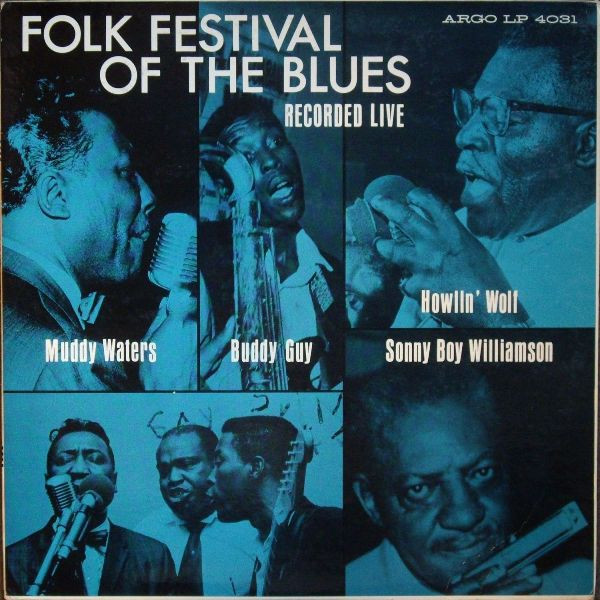
Folk Festival of the Blues is a landmark 1963 live album on Argo Records — a subsidiary of Chess Records — that captures a historic gathering of Chicago blues royalty at the intimate Copacabana Club on Chicago's West Side. Originally recorded as a WPOA live radio broadcast emceed by legendary disc jockey Big Bill Hill, the album presents Muddy Waters, Howlin' Wolf, Buddy Guy, Sonny Boy Williamson II, and Willie Dixon performing with a shared backing band at the peak of their powers. It was reissued in 1967 under the title Blues from Big Bill's Copacabana.
Recording Sessions & Production
Date: July 26, 1962 (live tracks); January 1962 (Sonny Boy Williamson studio track)
Location: Copa Cabana Club, Chicago, Illinois (West Side/Lawndale-Garfield Park area along the Roosevelt Road entertainment corridor); Sonny Boy Williamson track recorded at Chess Studios, Chicago
Label: Argo Records (catalog number LP 4031), a Chess Records subsidiary
Emcee: Big Bill Hill — the legendary Chicago blues DJ who hosted the "Red Hot & Blues Show" on WOPA-AM and ran the Copa Cabana nightclub. Born in 1914 in England, Mississippi, Hill arrived in Chicago around 1962 and became a crucial figure in the city's blues scene, championing local artists at a grassroots level through his brokered radio shows. His club was a regular stop for working blues musicians including Eddie Shaw, Little Mack Simmons, Mighty Joe Young, Lefty Dizz, and Hound Dog Taylor.
Producer: Not explicitly credited in available sources, but the album was produced under the supervision of Chess/Argo Records' A&R staff, likely including Ralph Bass or Willie Dixon himself, who was deeply involved in Chess production during this period.
Recording Context: The album captures a WPOA live radio broadcast — one of the earliest examples of blues being documented through radio transmission. The intimate club setting (described as "small" and "intimate") allowed for close interaction between performers and audience, creating an atmosphere of spontaneity and raw energy that studio recordings often lacked. The January 1962 Sonny Boy Williamson track was a studio recording with overdubbed applause added to simulate a live feel.
The Musicians
The album features two distinct band configurations:
The Copa Cabana Band (July 26, 1962):
-
Muddy Waters — vocals (tracks 1, 2, 6, 8)
-
Howlin' Wolf — vocals (tracks 5, 7, 10)
-
Buddy Guy — vocals, guitar (tracks 3, 4, 9)
-
Willie Dixon — vocals (track 1)
-
Jarrett Gibson — tenor saxophone
-
Donald Hankins — baritone saxophone
-
Otis Spann — piano
-
Jack Meyers — bass
-
Fred Below — drums
The Sonny Boy Williamson Studio Band (January 1962):
-
Sonny Boy Williamson II — vocals, harmonica (track 4)
-
Lafayette Leake — organ
-
Matt "Guitar" Murphy — guitar
-
Milton Rector — bass
-
Al Duncan — drums
Buddy Guy was only 25 years old at the time of this recording — still relatively early in his career, having released his debut single "First Time I Met the Blues" in 1960. His presence on this album alongside established legends like Waters and Wolf demonstrates Chess's confidence in his rising star.
Otis Spann was Muddy Waters' longtime pianist and one of the greatest blues keyboardists of all time. His presence on this session guaranteed a level of musical sophistication that elevated the performances beyond typical club fare.
Fred Below was the "father of modern blues drumming" — his innovative approach to backbeats and shuffle rhythms had revolutionized Chicago blues in the 1950s.
Jarrett Gibson and Donald Hankins formed a two-man horn section that added punch and color to the arrangements, giving the music a fuller, more R&B-oriented sound than the stripped-down guitar-bass-drums format.
Track-by-Track Breakdown
Side A
1. "Wee, Wee Baby" (3:06)
-
Songwriters: Pete Johnson, Big Joe Turner
-
Recording: July 26, 1962, Copa Cabana Club, Chicago
-
Musicians: Muddy Waters (vocals), Willie Dixon (vocals), Buddy Guy (guitar), Jarrett Gibson (tenor sax), Donald Hankins (baritone sax), Otis Spann (piano), Jack Meyers (bass), Fred Below (drums)
-
Notes: The album opens with a rare vocal duet between Muddy Waters and Willie Dixon — two of the most distinctive voices in blues history trading verses on this jump blues classic. Originally recorded by Pete Johnson and Big Joe Turner, "Wee, Wee Baby" is a party anthem that sets a celebratory tone for the album. The dual vocal approach is unusual for Waters, who typically dominated his recordings, but it demonstrates the collaborative spirit of the Copa Cabana sessions. Dixon's booming bass voice provides a perfect counterpoint to Waters' smoother, more refined tenor. Buddy Guy's guitar is already distinctive — stinging, aggressive, and modern. The horn section adds a jump-blues flavor that recalls the 1940s Kansas City sound.
2. "Sitting and Thinking" (3:47)
-
Songwriter: Muddy Waters (McKinley Morganfield)
-
Recording: July 26, 1962, Copa Cabana Club, Chicago
-
Musicians: Muddy Waters (vocals), Jarrett Gibson (tenor sax), Donald Hankins (baritone sax), Otis Spann (piano), Buddy Guy (guitar), Jack Meyers (bass), Fred Below (drums)
-
Notes: A Muddy Waters original that finds the blues master in a reflective mood — "sitting and thinking" about his troubles, his women, his life. The song is a medium-tempo blues with a relaxed, conversational feel. Waters' vocal is world-weary but not defeated — the sound of a man who has seen it all and survived. Otis Spann's piano is particularly prominent here, providing rolling fills between vocal phrases. Buddy Guy's guitar is restrained, adding subtle color rather than flashy solos. The track demonstrates Waters' ability to dominate a performance through presence and authority rather than volume or speed.
3. "Worried Blues" (3:05)
-
Songwriter: Buddy Guy (George Guy)
-
Recording: July 26, 1962, Copa Cabana Club, Chicago
-
Musicians: Buddy Guy (vocals, guitar), Jarrett Gibson (tenor sax), Donald Hankins (baritone sax), Otis Spann (piano), Jack Meyers (bass), Fred Below (drums)
-
Notes: The first Buddy Guy feature and one of his own compositions. At 25, Guy was already a confident bandleader and songwriter. "Worried Blues" is a slow, grinding blues that showcases Guy's vocal and guitar talents. His voice is rawer and more emotive than Waters' — less polished, more visceral. His guitar playing is already distinctive: stinging single-note lines, aggressive bends, and a tone that cuts through the ensemble like a knife. The track is a masterclass in young blues fire — Guy channeling the anxiety and ambition of a rising star. Otis Spann's piano provides sympathetic accompaniment, while the horns add dramatic accents.
4. "Bring It On Home" (2:32)
-
Songwriter: Willie Dixon
-
Recording: January 1962, Chess Studios, Chicago (studio recording with overdubbed applause)
-
Musicians: Sonny Boy Williamson II (vocals, harmonica), Lafayette Leake (organ), Matt "Guitar" Murphy (guitar), Milton Rector (bass), Al Duncan (drums)
-
Notes: The only studio recording on the album — a Sonny Boy Williamson II performance with overdubbed applause to simulate a live feel. The song is one of Dixon's most famous compositions, later recorded by Led Zeppelin (who were sued for copyright infringement and settled out of court). Williamson's harmonica is the star here — piercing, authoritative, and full of vocal-like inflections. His voice is gritty and world-weary, the sound of a man who has traveled the blues highway for decades. Lafayette Leake's organ adds a churchy, gospel-tinged atmosphere, while Matt Murphy's guitar provides solid, unobtrusive support. The track's short length (under three minutes) reflects the 78 rpm era from which Williamson emerged — concise, impactful, and unforgettable. The overdubbed applause is a minor distraction, but the performance is powerful enough to overcome the artifice.
5. "Sugar Mama" (3:47)
-
Songwriter: Howlin' Wolf (Chester Burnett)
-
Recording: July 26, 1962, Copa Cabana Club, Chicago
-
Musicians: Howlin' Wolf (vocals), Jarrett Gibson (tenor sax), Donald Hankins (baritone sax), Otis Spann (piano), Buddy Guy (guitar), Jack Meyers (bass), Fred Below (drums)
-
Notes: Howlin' Wolf's first appearance on the album, and what an entrance it is. "Sugar Mama" is a Wolf original — a raw, primal blues about desire and dependency. Wolf's voice is a force of nature: gravel-encrusted, roaring, terrifying. He doesn't sing the blues; he assaults them. The band rises to the occasion — Buddy Guy's guitar slashes and burns, Otis Spann's piano pounds with gospel fervor, and the horns provide a brassy counterpoint to Wolf's vocal tornado. Fred Below's drumming is particularly effective, driving the track with an unstoppable forward momentum. This is Chicago blues at its most ferocious — a reminder of why Wolf was considered the most intimidating figure in the blues.
Side B
6. "Clouds in My Heart" (3:56)
-
Songwriter: Muddy Waters (McKinley Morganfield)
-
Recording: July 26, 1962, Copa Cabana Club, Chicago
-
Musicians: Muddy Waters (vocals), Jarrett Gibson (tenor sax), Donald Hankins (baritone sax), Otis Spann (piano), Buddy Guy (guitar), Jack Meyers (bass), Fred Below (drums)
-
Notes: A Muddy Waters original that finds him in a melancholy mood — "clouds in my heart" suggesting emotional turmoil and romantic distress. The song is a slow blues with a stately, almost regal tempo. Waters' vocal is dignified and controlled, his pain expressed through nuance rather than volume. Otis Spann's piano is the instrumental highlight, providing elegant, jazz-influenced fills that elevate the track beyond standard blues. Buddy Guy's guitar is restrained and tasteful, adding color rather than dominating the arrangement. The horns are used sparingly, providing emotional punctuation at key moments. This is Waters as blues statesman — mature, confident, and deeply moving.
7. "May I Have a Talk with You" (3:47)
-
Songwriter: Howlin' Wolf (Chester Burnett)
-
Recording: July 26, 1962, Copa Cabana Club, Chicago
-
Musicians: Howlin' Wolf (vocals), Jarrett Gibson (tenor sax), Donald Hankins (baritone sax), Otis Spann (piano), Buddy Guy (guitar), Jack Meyers (bass), Fred Below (drums)
-
Notes: A Howlin' Wolf original that demonstrates his more conversational side — "May I have a talk with you" is a polite request that masks deeper, more primal intentions. Wolf's vocal is surprisingly restrained for him, almost gentle in its opening phrases. But as the song progresses, the familiar Wolf roar emerges — the man cannot contain his intensity for long. The track is a slow blues with a dragging, heavy groove that tests the band's stamina. Buddy Guy's guitar weeps and moans behind Wolf's vocal, while Otis Spann's piano adds church-like chords. The horns are used to dramatic effect, swelling behind Wolf's most intense vocal moments. This is Wolf as seducer rather than destroyer — a side of his personality rarely captured on record.
8. "Got My Mojo Working" (3:05)
-
Songwriter: Preston Foster (though commonly credited to Muddy Waters)
-
Recording: July 26, 1962, Copa Cabana Club, Chicago
-
Musicians: Muddy Waters (vocals), Jarrett Gibson (tenor sax), Donald Hankins (baritone sax), Otis Spann (piano), Buddy Guy (guitar), Jack Meyers (bass), Fred Below (drums)
-
Notes: The album's most famous track — Waters' signature song and one of the most recognizable blues compositions in history. Originally written by Preston Foster and first recorded by Ann Cole in 1956, Waters' version became the definitive interpretation. "Got My Mojo Working" is a hoodoo anthem — the "mojo" being a magical charm used in African American folk magic. Waters' vocal is playful and suggestive, his delivery filled with sly innuendo. The band drives the song with an irresistible shuffle rhythm — Fred Below's drumming is a masterclass in blues timekeeping, while Otis Spann's piano adds rolling, boogie-woogie figures. Buddy Guy's guitar is fiery and aggressive, pushing Waters to greater intensity. The track is a guaranteed crowd-pleaser, and this live version captures the excitement of a club audience responding to a classic. The song would become Waters' closing number for the rest of his career.
9. "Don't Know Which Way to Go" (3:47)
-
Songwriter: Buddy Guy (George Guy)
-
Recording: July 26, 1962, Copa Cabana Club, Chicago
-
Musicians: Buddy Guy (vocals, guitar), Jarrett Gibson (tenor sax), Donald Hankins (baritone sax), Otis Spann (piano), Jack Meyers (bass), Fred Below (drums)
-
Notes: The second Buddy Guy feature and another original composition. The title — "Don't Know Which Way to Go" — captures the uncertainty and ambition of a young artist navigating the Chicago blues scene. Guy's vocal is more confident here than on "Worried Blues" — he has found his voice and is ready to claim his place among the legends. His guitar playing is spectacular: long, sustained notes that bend and cry, rapid-fire runs that demonstrate technical mastery, and a tone that is instantly recognizable. Otis Spann's piano provides sympathetic support, while the horns add dramatic accents. The track is a medium-tempo blues with a driving rhythm that showcases Guy's ability to build tension and release. This is the sound of a star being born — Buddy Guy announcing his arrival as a major artist.
10. "(She's) 19 Years Old" (3:47)
-
Songwriter: Howlin' Wolf (Chester Burnett)
-
Recording: July 26, 1962, Copa Cabana Club, Chicago
-
Musicians: Howlin' Wolf (vocals), Jarrett Gibson (tenor sax), Donald Hankins (baritone sax), Otis Spann (piano), Buddy Guy (guitar), Jack Meyers (bass), Fred Below (drums)
-
Notes: The album's closer and one of Howlin' Wolf's most famous compositions. "(She's) 19 Years Old" is a blues about an older man's obsession with a young woman — "She's 19 years old, and she knows how to satisfy my soul." Wolf's vocal is a complex mixture of desire, guilt, and defiance. He knows the relationship is socially unacceptable, but he cannot help himself. The song is a slow blues with a heavy, grinding groove that builds to an almost unbearable intensity. Buddy Guy's guitar is particularly effective here — his stinging, aggressive lines mirror Wolf's emotional turmoil. Otis Spann's piano adds gospel-tinged chords that suggest the spiritual dimension of Wolf's struggle. The horns swell and recede, adding dramatic color to the arrangement. Fred Below's drumming is relentless, driving the song forward with an unstoppable pulse. This is Wolf at his most vulnerable and most powerful — a man laid bare by desire, confessing his sins to the blues. The track ends the album on a note of raw, unfiltered emotion that lingers long after the final note fades.
Buy This Album
Critical Reception & Legacy
Folk Festival of the Blues has been described as "a raw, live Argo album" that is "a far cry from folk" — a comment on the misleading title that reflected the era's tendency to market electric blues under the "folk" umbrella to appeal to the burgeoning folk revival audience. The album captures a crucial moment in Chicago blues history — the early 1960s, when the first generation of Chicago blues masters (Waters, Wolf, Williamson) were still at their peak, and the next generation (Guy) was just beginning to emerge.
The album's reissue as Blues from Big Bill's Copacabana in 1967 reflected the growing recognition of Big Bill Hill's role in documenting and promoting Chicago blues. The original Argo pressing is now a collector's item, with signed copies (featuring autographs from Waters, Wolf, Williamson, Guy, Dixon, Spann, and others) commanding high prices on the rare record market.
The album's influence extends through multiple channels:
-
Buddy Guy's career — This album documents Guy at a crucial early stage, playing alongside his idols and proving he could hold his own. His performances here helped establish him as a major talent.
-
The British blues boom — Albums like this, exported to the UK, provided the raw material that British musicians like the Rolling Stones, Eric Clapton, and John Mayall would transform into the British blues explosion of the mid-1960s.
-
Live blues recording — The album established a template for documenting Chicago blues in its natural habitat — the small club, the radio broadcast, the intimate setting where the music was played for dancers and drinkers rather than for the recording studio.
-
The Copacabana Club — The album preserves the sound of a legendary Chicago blues venue that would otherwise be lost to history.
Folk Festival of the Blues is not a perfect album — the sound quality is raw, the mixing is sometimes uneven, and the Sonny Boy Williamson studio track with overdubbed applause feels artificial compared to the genuine live recordings. But it is an invaluable document — a snapshot of Chicago blues at its peak, captured in the wild rather than in captivity. As one reviewer noted, it presents "a who's who of the Chicago blues from the 1960s... performing at the peak of their careers." For anyone interested in the golden age of electric Chicago blues, this album is essential listening.