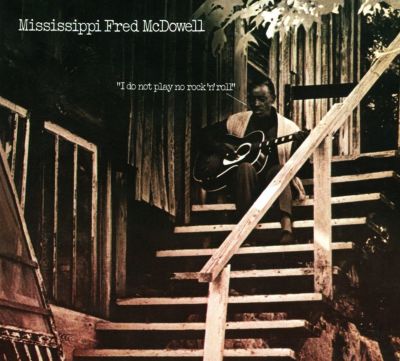
Released in 1969 on Capitol Records (catalog no. ST-409), I Do Not Play No Rock 'N' Roll is Mississippi Fred McDowell's first album to feature electric guitar and the record that introduced his North Mississippi hill country blues to a national audience. The title—taken from McDowell's own spoken introduction to "Baby Please Don't Go"—became his enduring catchphrase and a declaration of aesthetic purity.
The album earned a Grammy nomination in the "Best Ethnic or Traditional Recording (Including Traditional Blues)" category and was later reissued in 1995 as part of the Capitol Blues Collection.
Recording Sessions & Production
The album was recorded over three days—September 8, 9, and 10, 1969—at Malaco Sound Recording Studios in Jackson, Mississippi.
Tommy Couch produced the album for Malaco Productions. Couch and his Malaco partner Wolf Stephenson had first met McDowell in the mid-1960s when the bluesman played fraternity parties at the University of Mississippi.
Wayne Shuler served as album coordinator for Capitol Records, and Bob Wortham handled photography.
The sessions marked a significant departure for McDowell. Previously recorded exclusively on acoustic guitar for Alan Lomax, Chris Strachwitz, and others, this was his first album on which he played electric guitar.
Though some blues purists initially griped about the amplification, critics noted that his lines remained "so stark, spare, and jagged that the fullness and volume the instrument provides works perfectly with his hardcore Delta approach."
The Musicians
-
Mississippi Fred McDowell — Lead guitar, vocals. Playing his electric guitar with a glass bottleneck on his ring finger—a technique he had developed from a beef rib bone as a child—McDowell generated the droning, hypnotic single-chord vamps that defined the North Mississippi hill country sound.
-
Jerry Puckett — Bass guitar
-
Dulin Lancaster — Drums. (Note: Some sources list him as "Darin Lancaster.") The rhythm section was deliberately subtle—AllMusic noted that "the drummer's contributions are so subtle as to be almost inaudible," keeping the focus squarely on McDowell.
Track-by-Track Breakdown
Side One
1. "Baby Please Don't Go" (4:48)
Songwriter: Big Joe Williams
Musicians: Mississippi Fred McDowell (electric guitar, vocals), Jerry Puckett (bass), Dulin Lancaster (drums)
The album opens with the only cover song in the set—Big Joe Williams's 1935 standard—and the track from which the album's title is drawn. McDowell introduces the song with his famous declaration: "I do not play no rock and roll, y'all. I just play the straight natural blues."
The track establishes the electric template: McDowell's biting slide guitar, his moaning vocal, and the understated rhythm section creating a sound that is simultaneously primitive and powerful.
Songwriter: Big Joe Williams
Musicians: Mississippi Fred McDowell (electric guitar, vocals), Jerry Puckett (bass), Dulin Lancaster (drums)
The album opens with the only cover song in the set—Big Joe Williams's 1935 standard—and the track from which the album's title is drawn. McDowell introduces the song with his famous declaration: "I do not play no rock and roll, y'all. I just play the straight natural blues."
2. "Good Morning Little School Girl" (4:26)
Songwriter: Fred McDowell
Musicians: Same
A McDowell original that shares its title with the Don and Bob blues standard but is an entirely different composition. The track showcases McDowell's gift for conversational, intimate blues. His electric guitar generates a chugging, rhythmic undertone while his vocal addresses the schoolgirl with a mixture of tenderness and world-weariness.
3. "Kokomo Me Baby" (3:00)
Songwriter: Fred McDowell
Musicians: Same
At exactly three minutes, this is the most compact track on the album. A mid-tempo blues with a skipping rhythm, it demonstrates McDowell's ability to generate danceable grooves within the hill country's typically hypnotic framework. The title refers to the Kokomo, Mississippi area near McDowell's home in Como.
4. "That's All Right Baby" (5:04)
Songwriter: Fred McDowell
Musicians: Same
A five-minute blues that allows McDowell to stretch out on electric guitar. The track features his trademark call-and-response between vocal and slide guitar—what he described as making the guitar "say what I say, you unnerstand. If I say 'Our Father' it say 'Our Father.'"
5. "Red Cross Store" (4:04)
Songwriter: Fred McDowell
Musicians: Same
A blues of economic desperation and institutional indifference. The lyric addresses the Red Cross store—likely a relief distribution center—and the meanness of the people who run it: "Red Cross store no more / Cross people sure do treat you mean / That's the meanest store that I ever seen."
The track is a stark reminder of the poverty that shaped McDowell's world, delivered with his characteristic dignity rather than self-pity.
Songwriter: Fred McDowell
Musicians: Same
A blues of economic desperation and institutional indifference. The lyric addresses the Red Cross store—likely a relief distribution center—and the meanness of the people who run it: "Red Cross store no more / Cross people sure do treat you mean / That's the meanest store that I ever seen."
Side Two
6. "Everybody's Down On Me" (9:12)
Songwriter: Fred McDowell
Musicians: Same
The centerpiece of the album and its longest track by far, running over nine minutes. McDowell spends the first four minutes in spoken-word storytelling—spinning lively stories and setting the scene—before he begins playing guitar or singing.
When the music finally kicks in, it is a slow, grinding blues of paranoia and resilience. The extended length was virtually unprecedented for a blues album track in 1969 and demonstrates the label's willingness to let McDowell work on his own terms.
Songwriter: Fred McDowell
Musicians: Same
The centerpiece of the album and its longest track by far, running over nine minutes. McDowell spends the first four minutes in spoken-word storytelling—spinning lively stories and setting the scene—before he begins playing guitar or singing.
7. "61 Highway" (4:43)
Songwriter: Fred McDowell
Musicians: Same
A tribute to the legendary U.S. Highway 61—the "Blues Highway" that runs through the heart of the Mississippi Delta from New Orleans to Memphis and beyond.
McDowell's version features chugging chords and what one critic called "'Mystery Train' verses," connecting his hill country sound to the broader tradition of blues songs about the road.
The track exudes what AllMusic described as "frightening power" when McDowell hits his stride.
Songwriter: Fred McDowell
Musicians: Same
A tribute to the legendary U.S. Highway 61—the "Blues Highway" that runs through the heart of the Mississippi Delta from New Orleans to Memphis and beyond.
8. "Glory Hallelujah" (2:47)
Songwriter: Fred McDowell
Musicians: Same
The shortest track on the album, a gospel-tinged spiritual that reflects McDowell's deep roots in the church. Though best known as a bluesman, McDowell regularly performed at Hunter's Chapel in Como, Mississippi, and spirituals were an essential part of his repertoire.
The track provides a moment of uplift before the album's closing number.
Songwriter: Fred McDowell
Musicians: Same
The shortest track on the album, a gospel-tinged spiritual that reflects McDowell's deep roots in the church. Though best known as a bluesman, McDowell regularly performed at Hunter's Chapel in Como, Mississippi, and spirituals were an essential part of his repertoire.
9. "Jesus Is On The Mainline" (3:38)
Songwriter: Fred McDowell (traditional gospel, adapted)
Musicians: Same
The album closes with a gospel blues that McDowell had been performing for decades. The lyric—"Jesus is on the mainline, tell him what you want"—draws on the traditional African American spiritual, with the "mainline" referring to a direct telephone connection to the divine. McDowell's electric slide guitar gives the spiritual a raw, blues-drenched intensity that blurs the line between sacred and secular. The track would become one of his most celebrated performances and a staple of his live shows.
Liner Notes and Spoken Commentary
The original LP included extensive spoken commentary from McDowell printed on the back cover, in which he explained his philosophy and technique. He described how he developed his bottleneck style from a beef rib bone, how the blues evolved from the "reel" his elders played, and how he made his guitar speak his words.
Buy The Album
Critical Assessment & Legacy
I Do Not Play No Rock 'N' Roll was immediately recognized as a landmark. The Honolulu Star-Advertiser called it "pure deep South blues."
The Vineland Times Journal praised McDowell's "gripping, moaning guitar work, which sometimes becomes so texturally thick that it forms a wall of crystalline sound."
In 2001, Goldmine listed it among "25 Great Folk Revival Albums Not Limited to the 1960s," calling it "electrified and electrifying in its rustic eloquence."
The album's influence extends far beyond the blues world. Bonnie Raitt studied slide guitar with McDowell and treated him like a grandfather figure.
The Rolling Stones were reportedly flattered by his reaction to their cover of "You Gotta Move" on Sticky Fingers (1971).
Today, I Do Not Play No Rock 'N' Roll remains an essential document of North Mississippi hill country blues—the album that proved McDowell's music could thrive with electric amplification without sacrificing an ounce of its raw, hypnotic power. As McDowell himself put it on the record: "I hope y'all like it, who's never git it."