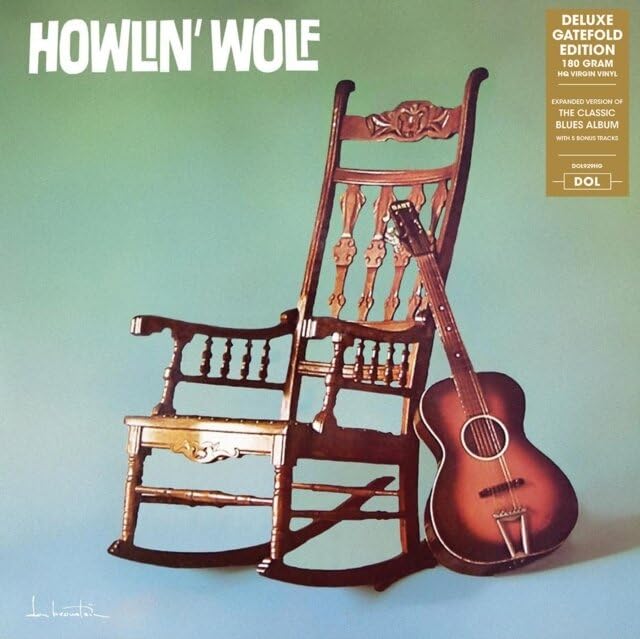
Howlin' Wolf — officially self-titled but universally known as "The Rockin' Chair Album" due to Don S. Bronstein's cover illustration of a wooden rocking chair and acoustic guitar — is the second LP by Chicago blues titan Chester Arthur Burnett, released by Chess Records in January 1962. It is not a studio album in the conventional sense but a compilation of twelve singles recorded between June 1957 and December 1961, assembled into what many consider the definitive document of electric Chicago blues at its peak. The album was ranked #238 on Rolling Stone's 500 Greatest Albums of All Time and named the third greatest guitar album ever by Mojo magazine.
Recording Sessions & Production
The album comprises material from six separate recording sessions spanning nearly four and a half years:
-
June 24, 1957
-
January 1956 (bonus track "Rockin' Daddy")
-
March 18, 1954 (bonus track "Poor Boy")
-
Late 1959
-
September 1958 (bonus track)
-
May 1961
-
June 1961
-
December 1961
Location: Universal Recording Corporation and/or Chess Studios, Chicago, Illinois
Label: Chess Records (catalog number LP-1469, released January 11, 1962)
Producer: Ralph Bass — Chess's A&R man and house producer who supervised the sessions and wrote the original liner notes. Bass was instrumental in shaping the Chess sound and had previously worked with Muddy Waters, Little Walter, and Chuck Berry.
Engineer: Ron Malo — Chess's brilliant recording engineer who captured the raw, immediate sound that defined the label's aesthetic.
Cover Art: Don S. Bronstein — the iconic illustration of a rocking chair and acoustic guitar against a green background. The cover was famously misleading — suggesting acoustic country blues when the contents were wild, electric Chicago blues. The "Rockin' Chair" nickname became so ubiquitous that later reissues added it to the cover officially.
Recording Approach: The sessions were typical of Chess's methodology — minimal takes, live in the studio, with the band playing together in real-time. As one reviewer noted, "the sound is drenched in danger and overflows with raw sexuality." The production is lean and direct, with no overdubs or studio trickery — just the sound of a great band playing great songs in a great room.
The Musicians
The album features a rotating cast of Chicago blues legends, with the core lineup consisting of:
Vocals/Harmonica/Guitar:
-
Howlin' Wolf (Chester Arthur Burnett) — lead vocals, harmonica, occasional guitar
Guitar:
-
Hubert Sumlin — Wolf's longtime protégé and the defining guitarist of his sound. Sumlin's "quirky, unpredictable" style — full of "sweeps, slides, and vocal-like bends" — is the album's instrumental voice, equally distinct from Wolf's growl.
-
Jimmy Rogers — former Muddy Waters sideman who contributed to several tracks
-
Willie Johnson — early Wolf guitarist on 1957 recordings
-
Freddy Robinson — contributed to June 1961 sessions
-
Otis "Big Smokey" Smothers — guitarist on late 1959 session
-
Jody Williams — early Chess session guitarist
-
Buddy Guy — played bass on some sessions before establishing himself as a lead guitarist
Piano:
-
Otis Spann — Muddy Waters' pianist who also recorded extensively with Wolf
-
Johnny Jones — house pianist for many Chess sessions
-
Henry Gray — Louisiana-born pianist who became Wolf's regular keyboardist
-
Hosea Lee Kennard — pianist on earlier sessions
-
Lafayette Leake — versatile pianist who played with both Waters and Wolf
Bass:
-
Willie Dixon — Chess's legendary house songwriter and bassist, who wrote or co-wrote most of the album's material. Dixon also contributes spoken recitations on "Going Down Slow."
-
Buddy Guy — played bass before switching to lead guitar
-
Alfred Elkins — bassist on some 1957 recordings
Drums:
-
Sam Lay — Wolf's regular drummer during this period, formerly with the Paul Butterfield Blues Band
-
Fred Below — the "father of modern blues drumming" who played on many Chess classics
-
S.P. Leary — drummer on late 1950s sessions
-
Earl Phillips — early Wolf drummer
-
Junior Blackman — contributed to some sessions
-
Sammy Lewis — drummer on selected tracks
Saxophones:
-
J.T. Brown — tenor saxophone
-
Donald Hankins — baritone saxophone
-
Arnold Rogers — tenor saxophone
-
Abe Locke — tenor saxophone (on late 1959 session)
The Willie Dixon Songbook
What distinguishes this album from virtually every other blues compilation is that the majority of its songs were written or co-written by Willie Dixon, Chess's house songwriter and bassist. Dixon's compositions for Wolf were darker, more menacing, and more sexually charged than those he wrote for Muddy Waters — reflecting the two artists' distinct personalities. As one reviewer noted, the album is "an outrageous set of sex songs written by Willie Dixon."
Dixon's lyrics for Wolf drew on African American folklore, Southern slang, and the blues tradition to create songs that were at once ancient and modern — rooted in the Delta past but electrically charged for the urban present. The rivalry between Wolf and Muddy Waters inspired Dixon to write some of his best material for both men, each song tailored to the specific artist's persona.
Track-by-Track Breakdown
Side One
1. "Shake for Me" (2:12)
-
Songwriter: Willie Dixon
-
Recording: June 1961, Chicago
-
Musicians: Howlin' Wolf (vocals), Hubert Sumlin (guitar), Freddy Robinson (guitar), Willie Dixon (bass), Otis Spann (piano), Fred Below (drums)
-
Notes: The album opens with a track that Guitar Player magazine called "maybe my favorite Wolf track ever." The groove is "infectious and somehow otherworldly," with lyrics that are "predominantly X-rated." Sumlin's solo is "full of quirky hooks and filled with sweeps, slides, and vocal-like bends." The song is an early precursor to the later classic "Killing Floor," reusing the same rhythm and riff but with a more melodic, "proto-Page-like" lead guitar break. Led Zeppelin would later interpolate lyrics from "Shake for Me" and "Back Door Man" into their 1969 single "Whole Lotta Love."
2. "The Red Rooster" (2:22)
-
Songwriter: Willie Dixon (based on traditional material and Charley Patton's "Banty Rooster Blues")
-
Recording: December 1961, Chicago
-
Musicians: Howlin' Wolf (vocals, slide guitar), Hubert Sumlin (guitar), Jimmy Rogers (guitar), Willie Dixon (bass), Henry Gray (piano), Sam Lay (drums)
-
Notes: Also known as "Little Red Rooster," this is one of the most influential blues songs ever recorded. The melody is traditional, with lyrics recycling old Walter Rhodes and Charley Patton material, but Dixon's arrangement and Wolf's performance made it definitive. Wolf plays slide guitar on this track — "an incredible slide lick on which the song is built" that would inspire Brian Jones's sitar-like guitar on the Rolling Stones' 1964 cover. The Stones' version became the first and only time a straightforward 12-bar blues reached #1 on the UK Singles Chart. Sam Cooke also had a major hit with his smoother, more soul-oriented version in 1963. The song's "keep everything in the farmyard upset" lyrics and lazy, strutting rhythm create a blues atmosphere unlike any other.
3. "You'll Be Mine" (2:25)
-
Songwriter: Willie Dixon
-
Recording: December 1961, Chicago
-
Musicians: Howlin' Wolf (vocals), Hubert Sumlin (guitar), Jimmy Rogers (guitar), Willie Dixon (bass), Henry Gray (piano), Sam Lay (drums)
-
Notes: An "ass-shakin' blues-rocker" released as a single around the same time as the album. Despite the gallant-sounding lyrics, Wolf chants "you'll be mine, you'll be mine" in "an evil, cartoonish chuckle that would rather make one think of Richard the Third than Romeo or Tristan." The guitar break mixes "classic blues licks with occasional Chuck Berryisms," demonstrating the cross-pollination between blues and early rock and roll. This was Wolf and Dixon's first single of 1962.
4. "Who's Been Talkin'" (2:18)
-
Songwriter: Howlin' Wolf (Chester Burnett)
-
Recording: June 24, 1957, Chicago
-
Musicians: Howlin' Wolf (vocals, guitar), Hubert Sumlin (guitar), Willie Johnson (guitar), Willie Dixon (bass), Hosea Lee Kennard (piano), Earl Phillips (drums)
-
Notes: One of only two tracks on the album written by Wolf himself (the other being "Tell Me"). This is the earliest recording on the LP, dating from 1957, and it shows a rawer, more primal Wolf than the 1961 material. The song is a classic blues accusation — the narrator suspects his woman has been talking about him behind his back. The dual-guitar attack of Sumlin and Johnson creates a dense, threatening atmosphere that matches Wolf's paranoia.
5. "Wang Dang Doodle" (2:18)
-
Songwriter: Willie Dixon
-
Recording: June 1961, Chicago
-
Musicians: Howlin' Wolf (vocals), Hubert Sumlin (guitar), Freddy Robinson (guitar), Willie Dixon (bass), Otis Spann (piano), Fred Below (drums)
-
Notes: A party song with nonsense lyrics that became a major hit for Koko Taylor in 1966 (#4 R&B, #58 Pop). Wolf's original version is "even better, dirtier, wilder and more brutal" than Taylor's more polished hit. The lyrics — "we gonna romp and tromp till midnight" — are a celebration of Saturday night hedonism. The track features the same lineup as "Shake for Me" and shares that song's driving, uptempo energy. Dixon's bass line is particularly prominent, anchoring the chaotic party atmosphere with unshakeable groove.
6. "Little Baby" (2:45)
-
Songwriter: Willie Dixon (based on Little Walter's "My Babe," which was itself derived from the spiritual "This Train")
-
Recording: May 1961, Chicago
-
Musicians: Howlin' Wolf (vocals), Hubert Sumlin (guitar), Jimmy Rogers (guitar), Willie Dixon (bass), Johnny Jones (piano), Sam Lay (drums)
-
Notes: An updated take on Little Walter's 1955 classic "My Babe," with Dixon writing new lyrics that transform the song from "a regular love serenade into a creepy stalker anthem": "You go to court and I'll come along / You go to jail and I'll throw your bond..." Despite the song's quality, "absolutely nobody ever covered 'Little Baby'" — until the Rolling Stones recorded it on their 1995 Stripped album. The track features a more relaxed groove than the uptempo openers, with Sumlin's guitar providing subtle, atmospheric fills.
Side Two
7. "Spoonful" (2:42)
-
Songwriter: Willie Dixon (based on Charley Patton's "Spoonful Blues" and other traditional material)
-
Recording: May 1961, Chicago
-
Musicians: Howlin' Wolf (vocals), Hubert Sumlin (guitar), Jimmy Rogers (guitar), Willie Dixon (bass), Johnny Jones (piano), Sam Lay (drums)
-
Notes: One of the most celebrated tracks on the album and a blues standard of the highest order. Dixon's lyrics — "Could fill spoons full of diamonds / Could fill spoons full of gold" — use the "spoonful" as a metaphor for the pleasures and temptations of life: sex, drugs, and all manner of vice. Wolf's performance is "brutal intensity" over a "lethargic rhythm" that makes the song feel simultaneously seductive and dangerous. Cream recorded the definitive rock version on their 1966 debut Fresh Cream, including a legendary 17-minute live version on Wheels of Fire (1968). The song has been covered by countless artists including Etta James, Canned Heat, and The Who.
8. "Going Down Slow" (3:18)
-
Songwriter: St. Louis Jimmy Oden (James Burke Oden)
-
Recording: December 1961, Chicago
-
Musicians: Howlin' Wolf (vocals), Hubert Sumlin (guitar), Jimmy Rogers (guitar), Willie Dixon (bass, spoken recitation), Henry Gray (piano), Sam Lay (drums)
-
Notes: The album's emotional centerpiece and longest track. Originally recorded by St. Louis Jimmy Oden and Roosevelt Sykes in 1941, this version is "absolutely owned by the Wolf." The song is a death-bed confession — "I have had my fun if I never get well no more" — and Wolf transforms it into a "tragedy of Shakespearean proportions." What makes this version unique is the dialogue between Wolf and Dixon: Wolf sings the verses while Dixon throws in "ad-libbed spoken observations" that reinforce his status as "court philosopher of the blues" — "I did not say I was a millionaire, but I said I have spent more money than a millionaire!" Hubert Sumlin's guitar "lays down series of scorching arpeggiated electric licks that have been imitated many times over, but hardly ever surpassed." The track is a masterclass in how to take a "stereotypically generic 12-bar blues and work it into a tragedy."
9. "Down in the Bottom" (2:05)
-
Songwriter: Willie Dixon
-
Recording: June 1961, Chicago
-
Musicians: Howlin' Wolf (vocals), Hubert Sumlin (guitar), Freddy Robinson (guitar), Willie Dixon (bass), Otis Spann (piano), Fred Below (drums)
-
Notes: A "rougher-hewn, choppier, punkier variation of 'Rollin' And Tumblin'" — a rewrite of the old "Meet Me In The Bottom" blues standard. At just 2:05, it's the shortest track on the album, but it packs a ferocious punch. The song was released as a single in June 1961 (backed with "The Red Rooster"). Wolf's vocal is all barely controlled rage, while Sumlin's guitar slashes and burns. This is Chicago blues at its most primal and aggressive.
10. "Back Door Man" (2:45)
-
Songwriter: Willie Dixon
-
Recording: June 1961, Chicago
-
Musicians: Howlin' Wolf (vocals), Hubert Sumlin (guitar), Freddy Robinson (guitar), Willie Dixon (bass), Otis Spann (piano), Fred Below (drums)
-
Notes: One of the most famous songs in the blues canon and the album's most overtly sexual track. The title refers to Southern slang for a man who has an affair with a married woman — he enters and exits through the back door to avoid detection. The Doors covered this on their 1967 debut album, with Jim Morrison clearly appreciating the song's transgressive sexuality. Wolf's original is rawer and more threatening than The Doors' version — a predatory blues that stalks rather than seduces. The song was originally the B-side to "Wang Dang Doodle" in January 1961.
11. "Howlin' for My Darlin'" (2:28)
-
Songwriter: Willie Dixon
-
Recording: June 24, 1957, Chicago
-
Musicians: Howlin' Wolf (vocals, guitar), Hubert Sumlin (guitar), Willie Johnson (guitar), Willie Dixon (bass), Hosea Lee Kennard (piano), Earl Phillips (drums)
-
Notes: Also known as "Howlin' for My Baby" on some releases. This is the second track from the June 1957 session (along with "Who's Been Talkin'"), and it shares that session's raw, early-Chess sound. The song is a love blues — Wolf howling for his woman with the same intensity he brings to songs of violence and betrayal. The dual-guitar interplay between Sumlin and Johnson creates a dense, swirling texture that anticipates the heavier sound of 1960s rock.
12. "Tell Me" (2:52)
-
Songwriter: Howlin' Wolf (Chester Burnett)
-
Recording: June 24, 1957, Chicago
-
Musicians: Howlin' Wolf (vocals, guitar), Hubert Sumlin (guitar), Willie Johnson (guitar), Willie Dixon (bass), Hosea Lee Kennard (piano), Earl Phillips (drums)
-
Notes: The album's closer and the second of Wolf's two original compositions on the LP. Released as a single on February 10, 1960, this is a slow blues with Wolf's guitar more prominent than on most tracks. The lyrics are a direct plea — "Tell me, tell me, what's on your mind" — but Wolf's delivery makes it sound like a threat. The 1957 recording date places this among the earliest material on the album, and it shows Wolf's style in transition — still rooted in the Delta blues of his mentor Charley Patton, but moving toward the fully electric Chicago sound he would perfect in the 1960s.
Critical Reception & Legacy
Howlin' Wolf (The Rockin' Chair Album) was immediately recognized as a masterpiece. In 1985, it won a Blues Music Award from The Blues Foundation for "Classics of Blues Recordings—Album." In 2012, Rolling Stone ranked it #238 on their list of the 500 Greatest Albums of All Time, describing it as "an outrageous set of sex songs written by Willie Dixon." Mojo magazine named it the third greatest guitar album of all time in 2004.
The album's influence on rock music is incalculable:
-
The Rolling Stones covered "Little Red Rooster" (1964, UK #1) and "Little Baby" (1995)
-
Sam Cooke covered "Little Red Rooster" (1963, R&B #7, Pop #11)
-
Cream covered "Spoonful" (1966) and "Outside Woman Blues"
-
The Doors covered "Back Door Man" (1967)
-
Led Zeppelin interpolated "Shake for Me" and "Back Door Man" into "Whole Lotta Love" (1969)
-
Koko Taylor covered "Wang Dang Doodle" (1966, R&B #4)
-
Jimi Hendrix covered "Killing Floor" (1968)
-
Jeff Beck covered "I Ain't Superstitious" (1968)
As one reviewer noted, after listening to this album too much, "most of the 'blues' albums recorded by black and white bluesmen alike in the decades that followed will feel limp and perfunctory by comparison." The album set a standard for electric blues that has rarely been equaled — a perfect storm of songwriting (Dixon), guitar (Sumlin), vocals (Wolf), and production (Chess) that created something greater than the sum of its parts.
Howlin' Wolf passed away on January 10, 1976, at age 65. He was inducted into the Blues Foundation Hall of Fame in 1980 and the Rock and Roll Hall of Fame in 1991. Smokestack Lightnin' was placed in the Grammy Hall of Fame in 1999 and the Library of Congress National Recording Registry in 2009. But Howlin' Wolf — The Rockin' Chair Album — remains his definitive statement, the collection that introduced his music to the rock generation and established the template for electric blues excellence.
Buy This Album
 Buy from Amazon Howlin' Wolf (The Rockin' Chair Album)