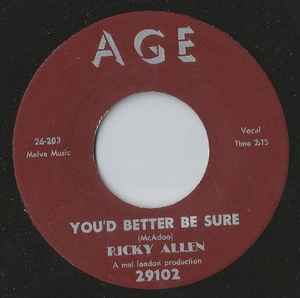
“You’d Better Be Sure” is a 1961 Chicago soul-blues single by vocalist Ricky Allen (born Richard A. Allen, January 6, 1935 – May 29, 2005), released on Mel London’s Age Records (catalog 29102) with “You Were My Teacher” as the B-side. It became a strong local hit on the Chicago market and marked Allen’s breakthrough as one of the label’s most prolific and commercially successful artists.
Recording Session and Producer
The track was recorded around May 3, 1961 (sources vary slightly on the exact date, with release following in June/October 1961 depending on the source), during leftover studio time at the end of another Mel London-produced session. According to Allen’s own recollection in interviews, the session was primarily for other artists (including material involving Junior Wells, A.C. Reed, and Earl Hooker tracks such as “Blue Guitar” and related sides). With about 15 minutes remaining, London invited Allen—who had accompanied drummer Bobby Little to the studio—to cut two of his own songs. They completed “You’d Better Be Sure” and the flip side in just two takes.
Producer: Mel London, the owner/operator of the Chief/Profile/Age family of labels. London was a key figure in early-1960s Chicago blues and R&B, known for efficient, no-frills sessions that captured the energy of the West Side scene while incorporating more contemporary R&B and emerging soul elements. He had already worked with Junior Wells, Earl Hooker, Magic Sam, Elmore James, and others.
Allen has described the session as informal and hurried: London initially struggled to remember his name, and the arrangement was quickly communicated to the band. Allen requested a “Hide Away”-style beat (referencing the Freddie King instrumental), but Hooker raised the key several steps, forcing Allen to sing higher than planned.
Songwriters
Credits for the song vary across sources but generally involve collaboration:
- Most reliable discographical and secondary sources (including SecondHandSongs and contemporary accounts) credit Mel London and Ricky Allen as co-writers.
- Some listings (e.g., Shazam and certain digital credits) also include William McAdoo (sometimes listed as McAdoo) and occasionally Earl Hooker.
- Allen himself stated that he had already written both “You’d Better Be Sure” and “You Were My Teacher” before the session, suggesting primary authorship on his part, with London contributing production input, possible lyrical refinements, or co-writing credit typical of the era’s independent-label practices (where producers/label owners frequently shared publishing).
Detail on the songwriters: Ricky Allen brought gospel-rooted phrasing and a personal, conversational style shaped by his Nashville church-choir background and early exposure to R&B singers like Earl Gaines and Larry Birdsong. Mel London, a skilled commercial songwriter and producer, specialized in catchy, radio-friendly blues and R&B material that bridged traditional Chicago blues with the smoother, more urban sounds appealing to Black audiences in the early 1960s. His credits include hits and near-hits for Junior Wells (“Messin’ with the Kid,” “Little by Little”), Lillian Offitt, and others. William McAdoo appears less prominently in broader blues historiography and may have contributed to the lyrical or compositional process on this or related Age material. The collaboration reflects the typical London-era workflow: an artist’s idea polished quickly in the studio for commercial viability.
The lyrics deliver a classic blues warning/plea from a man whose partner is leaving for another: he urges her to think carefully (“Have you took the time to think / To think the whole thing over?”), warns that she may regret it (“You better be sure / Before you leave me alone”), and mixes vulnerability with assertiveness. The structure is straightforward verse-chorus with a memorable, repeating hook that suits Allen’s expressive, slightly urgent vocal delivery.
Musicians
Precise session logs are scarce (common for small independent labels of the period), but confirmed and strongly attested personnel include:
- Ricky Allen – lead vocals
- Earl Hooker – electric guitar (prominent, inventive playing; Allen specifically noted Hooker’s contribution and the raised key)
The rest of the band was drawn from the typical Mel London/Age house musicians of the period, which frequently included players associated with Earl Hooker’s circle and other Chief/Age sessions (such as those featuring Jack Myers on bass, Fred Below or Bobby Little on drums, and keyboardists like Johnny “Big Moose” Walker). Horns (saxophones) are audible on many Age sides from this era and contribute to the fuller R&B texture. Allen later recalled explaining the desired arrangement to “the band,” confirming a full group was present for the quick two-take session.
Hooker’s guitar is a standout element—nimble, melodic, and supportive without overpowering the vocal, consistent with his role as a premier session guitarist and bandleader on London’s labels.
Other Versions
Documented covers are limited but include:
- Lacy Gibson – A later blues version appears on compilations and sessions associated with Ralph Bass material or Delmark-related releases.
- Joe Beard – Listed in SecondHandSongs as a cover.
The song has also appeared on various Earl Hooker compilations (sometimes credited in a way that highlights Hooker’s guitar contribution) and broader Chicago blues/soul anthologies (e.g., Blue Guitar Chicago and Age/Chief reissue collections). It was not a major national chart hit like Allen’s later “Cut You A-Loose” (Age 29118, 1963, which reached #20 R&B / #126 pop), but it established him locally and remains a collector’s favorite.
Musical Style and Analysis
“You’d Better Be Sure” is a mid-tempo Chicago soul-blues number with a lively, slightly rock-tinged R&B feel (approximately 148 BPM in some digital analyses). It sits in the transitional zone between postwar electric blues and the smoother, more commercially oriented soul that was rising in popularity among Black audiences.
Key stylistic features:
- Vocal approach: Allen delivers a clear, emotive, gospel-tinged lead with conversational urgency and a touch of pleading swagger. His phrasing is more polished and radio-friendly than the rawer Delta-derived styles of older Chicago bluesmen, aligning with the emerging soul aesthetic.
- Guitar: Earl Hooker’s contribution is central—melodic fills, a raised-key arrangement that brightens the song, and inventive single-note work that supports rather than dominates. Listeners and Allen himself highlighted Hooker’s ability to elevate the track.
- Rhythm and arrangement: A driving beat with a “Hide Away”-inspired rhythmic foundation (per Allen’s request), tight rhythm section, and likely sax punctuation typical of Age productions. The overall sound is fuller and more uptown than pure blues, with a danceable energy that helped it connect on local radio and in clubs.
- Structure and hook: Straightforward 12-bar or verse-chorus form built around the repeated title phrase. The lyrics balance classic blues themes of romantic betrayal and regret with a more modern, advisory tone.
The track exemplifies Mel London’s production strengths: capturing spontaneous energy in minimal takes while giving emerging vocalists a commercial edge. It bridges the guitar-driven blues of Hooker’s world with the vocal-centered soul direction that would dominate later in the decade, making it an important (if under-recognized) document of early-1960s Chicago music.
Suggested Listening
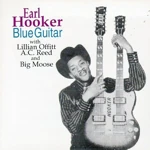 Buy from Amazon Blue Guitar by Earl Hooker - features You'd better be Sure with vocals by Ricky Allen
Legacy
“You’d Better Be Sure” launched Ricky Allen as Mel London’s most successful and prolific Age artist and helped solidify the label’s reputation for contemporary Chicago blues-soul hybrids. It was a strong regional seller, heavily played on WVON (then VOL), and led to steady club work for Allen. While “Cut You A-Loose” became his signature national hit and a later blues standard (covered by James Cotton, Otis Rush, Koko Taylor, and others), the earlier single demonstrated his ability to blend gospel-inflected soul vocals with blues structures and R&B drive.
Allen’s career peaked in the early-to-mid 1960s with further Age, USA, Bright Star, and Four Brothers releases before he largely stepped away from full-time performing in the 1970s (working in laundry and limousine services). He made occasional later appearances, including European festivals and Chicago Blues Festival spots in the early 2000s. The track endures as an example of the transitional “soul-blues” sound that anticipated later Chicago artists and remains prized by collectors of early-1960s independent R&B.