
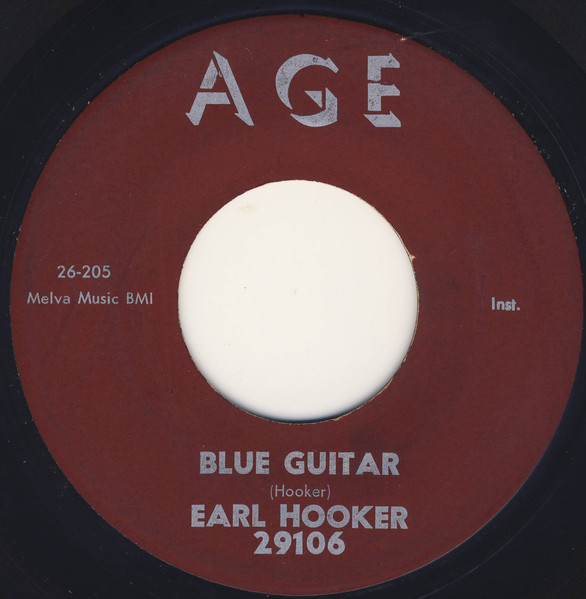
“Blue Guitar” is a slow blues instrumental by Chicago guitarist Earl Zebedee Hooker (1930–1970), recorded in May 1961 and released in 1962 on Age 29106 (a subsidiary of Mel London’s Chief label). It became one of Hooker’s signature pieces, a regional favorite, and the foundation for Muddy Waters’ “You Shook Me.”
Recording Sessions and Producer
The famous version was captured almost by accident. During a warm-up before a scheduled session in May 1961 in Chicago, Hooker and his band played an impromptu slow blues featuring his slide guitar. The tune was played once; Hooker was reportedly unaware it was being taped. Producer Mel London (owner of the Chief/Age/Profile group of labels) saved the recording. Looking for material the following spring, he issued it as the single “Blue Guitar” b/w “Swear to Tell the Truth” (Age 29106). It sold unusually well for an instrumental blues side and entered the repertoires of other Chicago bluesmen.
An earlier, different version titled “Blue Guitar” (or sometimes referenced in relation to “Blue Guitar Blues”) was recorded on July 15, 1953, at the Memphis Recording Service (Sun Records) with producer/engineer Sam Phillips. Personnel included Hooker (guitar), Joe Willie “Pinetop” Perkins (piano), possibly a harmonica player (sometimes listed as Little Walker, though accounts differ), unknown bass, and Willie Nix (drums). It remained unissued until later archival releases (e.g., Charly compilations in the 1980s/1990s). A still earlier 1952 King Records side, “Blue Guitar Blues” (Hooker’s first record), is stylistically distinct.
Hooker also recorded a later version of “Blue Guitar” for his 1969 Bluesway album Don’t Have to Worry (producer Ed Michel), with a different lineup including Johnny “Big Moose” Walker (piano/organ), Gino Skaggs (bass), Roosevelt Shaw (drums), and Jeff Carp (harmonica).
Songwriters
The composition is credited solely to Earl Hooker. It is an original instrumental built around his melodic slide ideas rather than a traditional song with lyrics. When Leonard Chess licensed the Age track for Muddy Waters, Willie Dixon supplied lyrics, transforming it into the vocal “You Shook Me” (credited to Dixon on the Chess release, though the underlying music remains Hooker’s). The original instrumental publishing is associated with ABC/Dunhill Music (later Universal). Hooker’s authorship reflects his role as a “musician’s musician” whose strength lay in pure guitar expression rather than songwriting in the conventional vocal-blues sense.
Musicians
Precise personnel for the May 1961 Age session are not exhaustively documented in every source (it was a warm-up tape), but typical Hooker band members from the Chief/Age period included associates such as A.C. Reed (tenor saxophone), Johnny “Big Moose” Walker (organ/piano), Lafayette Leake (piano on some related dates), Willie Dixon (bass on some contemporaneous sessions), and various drummers. One detailed account of the “You Shook Me” backing track lists A.C. Reed (tenor), Earl Hooker (guitar), Johnny “Big Moose” Walker (organ), Lafayette Leake (piano), Willie Dixon (bass), and Bobby Little (drums). Contemporary descriptions note a full sound with harmonica and saxophone support. Hooker played in standard tuning with a light touch that allowed seamless blending of fretted notes, bends, and slide.
Musical Style and Analysis
As noted, Hooker is the sole credited composer. The piece is pure instrumental blues, not a reworking of a pre-existing vocal song (though it draws on the broader vocabulary of Delta-to-Chicago traditions). Its power comes from Hooker’s melodic invention and technical mastery rather than structural novelty or lyrical content.
Musically, “Blue Guitar” is a slow 12-bar blues in a minor-inflected mode (often discussed in D minor/blues scale terms). Hooker’s primary influences—Robert Nighthawk (slide technique and articulation) and T-Bone Walker (modern electric phrasing, showmanship, and single-note fluency)—are clearly audible, yet the result is distinctly his own. He plays in standard tuning (unusual for many bottleneck specialists who preferred open tunings) with exceptionally light touch, allowing precise intonation, minimal string noise, and fluid transitions between fretted notes, string bends, and slide.
Key stylistic hallmarks visible in the track (as analyzed in guitar literature):
- The intro reworks a classic country-blues lick associated with Tampa Red (originally likely on resonator) into a haunting, singing electric melody. It features decorated D minor pentatonic and blues-scale lines rather than the simpler triadic/chordal approach of earlier rural slide styles.
- Vocalesque vibrato and purposeful chromaticism, including half-step leading-tone motions (e.g., A–G♯–A and D–C♯–D) and microtonal slides.
- Seamless alternation of slide and fretted techniques: flurries and bends in the T-Bone/B.B. King tradition without the slide, then pure slide melody, all within the same phrase.
- Rich, full band texture (rhythm section plus horns/harmonica support) that frames the guitar without crowding it; Hooker’s lines “sing” with a conversational, almost human quality that later players found hard to replicate.
The overall effect is melodic, atmospheric, and deeply bluesy rather than flashy or high-energy. It prioritizes tone, phrasing, and emotional contour—qualities that made it ideal for the Muddy Waters vocal overdub and that continue to reward close listening. In the context of Hooker’s broader output (e.g., “Blues in D Natural,” “Calling All Blues”), “Blue Guitar” stands as a concise masterclass in his ability to make the electric guitar speak with the intimacy and expressiveness of the human voice.
Other Versions and Covers
- Muddy Waters – “You Shook Me” (Chess, 1962): Waters overdubbed Dixon’s lyrics onto Hooker’s original Age instrumental track. Chess later commissioned additional Hooker instrumentals for similar treatment (including the basis for “You Need Love”).
- Jeff Beck Group (with Rod Stewart, 1968): Covered the Waters version.
- Led Zeppelin (1969): Their heavy adaptation of “You Shook Me” (and separately “You Need Love”/“Whole Lotta Love”) brought the material to rock audiences.
- Other covers or related versions include Willie Dixon’s own recording, Hubert Sumlin, Lucky Peterson, Ronnie Earl, Jimmy Page & the Black Crowes, Etta James, B.B. King with John Lee Hooker, and others. Heart referenced related material as “Mother Earth Blues.” Instrumental tributes and live versions by players who knew Hooker (e.g., accounts from the 1990s noting its status as his signature piece) also exist.
Suggested Listening
 Buy from Amazon Blue Guitar
 Buy from AmazonThe Electrifying Blues Guitar Of Earl Hooker: Ride Hooker Ride 1953-1962
Legacy
“Blue Guitar” cemented Hooker’s reputation among peers as one of the premier slide guitarists of postwar Chicago blues—a “musician’s musician” praised by B.B. King, Buddy Guy, and others. Its commercial success as an instrumental was rare and led directly to the Chess/Muddy Waters collaboration, which in turn fed into the British blues-rock boom via Led Zeppelin. Hooker’s fluid standard-tuned slide, vocal-like vibrato, and ability to alternate fretted and slide phrases influenced later players across blues and rock. The track appears on numerous compilations (Paula, P-Vine, etc.) under titles such as Blue Guitar: The Chief/Age/U.S.A. Sessions 1960–1963. Despite Hooker’s early death from tuberculosis in 1970 and limited mainstream fame during his lifetime, the song remains a touchstone of electric blues guitar artistry and a key link between Chicago blues and classic rock.









