In the annals of American music, there are origin stories that seem almost too perfectly constructed to be true, tales of rebellion and redemption that follow the archetypal patterns of myth. The story of Charles Edward Davenport—who would become known to the world as Cow Cow Davenport, the self-proclaimed and not entirely unjustified "Man Who Gave America Boogie Woogie"—contains all these elements and more. Born on April 23, 1894, in Anniston, Alabama, he was the son of a preacher man who wanted nothing more than for his boy to follow him into the ministry, and a mother who played the organ for their church and perhaps inadvertently planted the seed of musical obsession that would eventually derail every plan his father had made for him.
Anniston in the 1890s was a railroad town in the foothills of the Appalachian Mountains, a place where the industrial New South met the agricultural Old South, where the Calhoun County landscape rolled with red clay hills and pine forests, and where the lives of black families were circumscribed by the rigid codes of Jim Crow. Clem Davenport, Charles's father, worked as a delivery man for a retail grocery store, a respectable working-class position that allowed him to support his large family—Charles was one of eight children. His wife, Queen Cary, took in laundry at their home, and by the 1900 census, the family was established enough that their eldest daughter, Annie, had become a public school teacher.
It was, by the standards of black Alabama at the turn of the century, a relatively stable household, one in which education and religious devotion were valued, and in which the temptations of secular music were viewed with appropriate suspicion.
Charles began playing piano at the age of twelve, and from the first, his inclinations ran toward the popular and the profane rather than the sacred. He learned initially on the church organ from his mother, absorbing the harmonic foundations of hymnody and spirituals, but it was the piano that captured his imagination—the instrument of ragtime, of barrelhouses, of the "fast" music that accompanied dancing and drinking and all the pleasures that his father's sermons condemned.
By 1910, when the census taker found him working as a laborer in what appeared to be a pipefitter's shop, Charles had already been playing for several years, developing a style that blended the Southern ragtime he heard in local entertainments with something harder, more driving, something that would eventually coalesce into what the world would call boogie woogie.
His father, Clem, could see where this was heading, and he did what concerned fathers have always done when their children stray from the righteous path: he intervened. In 1910, Charles was sent to Selma University, a Baptist college and theological seminary in Selma, Alabama, where he would receive the education and spiritual formation necessary to become a man of the cloth.
The family's financial situation makes this decision somewhat puzzling—seminary education was not cheap—but the church may have subsidized his attendance, and Clem Davenport was evidently determined to save his son from the piano, even if it meant considerable sacrifice.
Charles's time at Selma was brief and, from the perspective of his later career, magnificently disastrous. He would later recount, with a mixture of pride and amusement, what happened there. The seminary, like many religious institutions of the period, allowed social gatherings but forbade dancing. Charles was invited to play piano at these events, and his ragtime playing proved irresistible. "At that school I could play piano like I wanted to," he recalled in a 1944 interview with The Jazz Record. "I'd get invitations to all the socials, and I would play. At that time they didn't allow them to dance, but they would march up a breeze. Quite naturally with my old ragtime playing, when they'd get to corners they'd kind of shake themselves."
The girls, he noted, "got so frisky they couldn't march in time." This was more than the seminary authorities could tolerate. Charles was expelled, sent home in disgrace, his father's hopes dashed and his own future as a musician set on its inevitable course.
The expulsion from Selma was not merely a biographical anecdote; it was, according to Davenport's own account, the inspiration for one of his most enduring compositions. "Mama Don't Allow It"—or more precisely, "Mama Don't Allow No Easy Riders Around Here," as he recorded it—sprang directly from this experience of rebellion against religious authority, a comic defiance of the strictures placed upon young black musicians in the South.
Whether Davenport actually composed the song or adapted it from earlier folk material—W.C. Handy also claimed authorship of a similar tune—matters less than the fact that it became indelibly associated with him, a declaration of musical independence that resonated through the decades.
The Carnival, the Road, and the Making of a Style
Returning to Anniston in disgrace, Charles Davenport faced the classic dilemma of the young black musician in the early twentieth-century South: how to make a living doing the only thing he was truly good at, in a society that offered few legitimate opportunities for black entertainers and even fewer for black pianists who refused to play the respectable music their elders preferred. The path he chose was the path of the road, the traveling show, the medicine show and carnival circuit that provided employment, however precarious, for black performers across the rural South.
His first significant engagement came with K.G. Barkoot's Traveling Carnival, a large show that had been established decades earlier and that traveled the Eastern United States with its own special train.
Barkoot was a Lebanese immigrant who had built his carnival into a respectable family entertainment, and for a young pianist like Davenport, the carnival offered something invaluable: exposure to a wider world, experience in entertaining diverse audiences, and the opportunity to refine his craft under the pressure of nightly performance. He worked as a blackface minstrel, a comedian, a singer, and a piano player, developing the versatility that would serve him well in the vaudeville years to come.
It was during his time with Barkoot that Davenport encountered Bob Davis, a pianist who would become his most important early mentor. Davis showed him things about the piano that he had never learned on his own—the relationships between keys, the way to modulate from A-flat to C-sharp, the techniques that allowed a musician to accompany singers in different keys rather than being confined to the one or two in which he was comfortable.
Before Davis, Davenport later admitted, "I didn't know but one key, and they called me a one-key piano player." Davis transformed him from a talented amateur into a professional musician, capable of holding his own in any musical situation.
But the carnival life was competitive, and when a "real" piano player joined the organization, Davenport felt his position threatened. Rather than compete directly on piano, he began to develop his other talents—his singing, his comedy, his ability to write songs that suited his own vocal style. He started performing his own compositions, and in doing so, he discovered that he possessed a gift for the kind of narrative blues that would define his best work. The conditions of the South, the daily humiliations of Jim Crow, the economic exploitation and social degradation that accompanied black life in Alabama and Georgia, provided the material for what he would later call "Jim Crow Blues."
The style that Davenport was developing during these years was not yet called boogie woogie. He himself claimed to have coined the term "boogie music," derived from "boogie man" or "bogeyman," the European folk figure who punished naughty children. In Davenport's usage, it referred to the music played in "joints where nice people did not go"—the barrelhouses, honky-tonks, and back rooms where the piano was the center of social life and the music was raw, rhythmic, and designed for dancing.
The "woogie," he suggested, was merely a rhyming addition that matched the rhythm of the style. Whether this etymology is accurate or apocryphal—other musicians, including the Thomas brothers from Arkansas, made similar claims—it captures something essential about Davenport's self-conception. He saw himself not merely as a piano player but as an originator, a man who had given a name to something that had been emerging from the black communities of the South for decades.
After leaving Barkoot, Davenport made his way to Birmingham, where he played in the Black Bottom district, a neighborhood of saloons and houses of prostitution where a pianist could find steady work and little respectability. He reportedly worked in a brothel for a few dollars a week plus room and board, and though he claimed to be "scared of sporting women," the environment must have shaped his music in ways both obvious and subtle.
The piano in such establishments was not background music; it was the engine of the social experience, driving the dancing, accompanying the drinking, providing the soundtrack to transactions both commercial and intimate. The pianist who could keep a room full of dancers moving through the night, who could adapt to the shifting moods of a Saturday crowd, was a valuable commodity, and Davenport was learning to be exactly that.
Dora Carr and the Birth of a Recording Career
By the early 1920s, Charles Davenport had transformed himself from a carnival novelty act into a polished vaudeville entertainer. He had married a blues singer and pianist named Helen Rivers around 1921 or 1922, though the marriage lasted only about a year before she left to pursue her own career.
The departure hit him hard, by his own account, but it also provided the emotional material for what would become his signature composition.
According to the story he told throughout his life, he was drinking heavily one night, moving from honky-tonk to honky-tonk in a state of romantic despair, when he walked on stage barely able to stand. He improvised a song on the spot, making up words about waking up to find his woman gone, about falling out of bed and hanging his head and moaning. The song was initially called "Railroad Blues," though there were already several pieces by that name in circulation.
Over time, this improvisation evolved into something more structured, a boogie-woogie instrumental with a train theme that captured the rhythmic essence of the locomotive—the chugging bass, the ringing treble, the sense of relentless forward motion.
The transformation from "Railroad Blues" to "Cow Cow Blues" was gradual, but the name change was definitive. As Davenport told the New York Daily News in 1942, he was writing a blues song that described a switchman boarding a train from the cowcatcher. "The word 'cow' seemed to stick in my mind," he explained. "One night in a theater I ended a song with 'Nobody here can do what papa-cow cow-can do.' When the audience wanted to get acquainted with me after the show, they addressed me as 'Papa Cow Cow.' From then on ever since I have been called such a moniker."
The nickname stuck, and Charles Edward Davenport became Cow Cow Davenport, a name that was memorable, marketable, and perfectly suited to the emerging culture of blues nicknames.
His entry into professional vaudeville came through his partnership with Dora Carr, a blues singer he met either in Macon, Georgia, or on the TOBA circuit—the Theater Owners Booking Association, the black vaudeville circuit that provided the primary venue for African American entertainers in the 1920s.
Carr was persistent, by all accounts, insisting that Davenport become her accompanist and perhaps something more. Their personal relationship remains obscure—whether they were romantically involved is unclear—but their professional partnership was solid. From 1923 to 1926, Davenport was Carr's primary accompanist and singing partner, and with a couple of other musicians they formed the act "Davenport & Company," performing comedy numbers and blues songs across the TOBA circuit.
Their big break came in New Orleans in 1923, where they met Ralph S. Peer, the legendary OKeh record producer who had been engaged in remote recording of rural musicians throughout the South. Peer recommended they come to New York to record, and in October 1924, Davenport made his first recordings as an accompanist for Dora Carr, with Clarence Williams on piano.
It would be another year before Davenport was allowed to play piano on his own recordings. A session for Gennett Records in Richmond, Indiana, in 1925 went unissued—possibly because of his existing OKeh contract—and it was not until later that year that Clarence Williams permitted him to accompany Carr on piano.
The October 1, 1925, OKeh session was the turning point. Davenport played piano on four sides, including "Good Woman's Blues," "Black Girl Gets There Just the Same," and "Fifth Street Blues," demonstrating a slower, more conventional blues style that perhaps reflected Williams's influence. But the fourth side was the one that mattered: "Cow Cow Blues," the first recording of Davenport's signature boogie-woogie style. Dora Carr sang a fine blues vocal over Davenport's persistent riffs, and the record announced the arrival of a major new voice in blues piano.
There has been considerable debate about the originality of "Cow Cow Blues." The main left-hand riff bears a striking resemblance to the trio section of "Trilby Rag," composed by Carey Morgan in 1915, a popular vaudeville piece that Davenport almost certainly encountered during his years on the stage.
However, while Morgan's piece executes the pattern on a major seventh chord, Davenport's version leans toward an authentic blues-driven minor seventh pattern with rhythmic variations in both hands. The relationship between "Trilby Rag" and "Cow Cow Blues" is less one of plagiarism than of creative adaptation, a process common in folk and blues music, where existing musical materials are transformed by individual sensibility into something new. That same strain would be borrowed and adapted by countless boogie-woogie and blues players in the decades to come, becoming part of the shared vocabulary of the genre.
The Vocalion Years and the Discovery of Pine Top Smith
The partnership with Dora Carr ended in 1926, when she left him for another man. Davenport was now a solo act, working the Chicago clubs and vaudeville circuits, building a reputation as one of the most exciting piano players in the city. Chicago in the late 1920s was the epicenter of blues recording, a place where the migration of Southern blacks had created a vast audience for race records, and where the major labels maintained active studios to capture the sounds of the new urban South. Davenport's timing was impeccable; he arrived in Chicago just as the recording industry was entering its golden age, and his talents as both performer and talent scout would make him one of the most recorded black pianists of the period.
In 1927, he recorded for Paramount Records, accompanying various instrumentalists in small ensemble settings. These sessions produced "Jim Crow Blues," one of his most explicitly political compositions, as well as some of his first recordings with a new vocal partner, Ivy Smith.
Smith, who was sometimes billed as Ruby Rankin or Iva France, would become his primary collaborator for the next several years, and their act, known variously as the Chicago Steppers or simply Davenport and Smith, would prove durable and commercially successful.
But it was his association with Vocalion Records, the Brunswick subsidiary dedicated to race records, that defined his most productive period. Through his connection with J. Mayo Williams, the former college football player who headed Vocalion's black music division, Davenport became not merely a recording artist but a staff arranger, composer, and talent scout, earning a steady $85 per week—a respectable income for a black musician in 1929—and living in a relatively nice apartment at 35th and Wabash.
His role as talent scout was not merely administrative; it was creative and personal. Davenport was actively involved in discovering and nurturing new talent, and his most significant discovery was a young pianist from Alabama named Clarence Smith, who would become known to the world as Pine Top Smith. The story of their meeting has been told many times, with Davenport's own account inevitably shading toward self-aggrandizement, but the core facts are clear enough. Davenport was in Pittsburgh in late 1927 or early 1928, playing at the Star Theater on Wylie Avenue, when he ventured into the local honky-tonks and encountered Pine Top at the Sachem Alley.
Pine Top had heard Davenport's "Cow Cow Blues" and wanted to meet him. He sat down and played, and Davenport, recognizing something special, told him, "Boy, look here, you sure have got a mean boogie woogie." Pine Top, by Davenport's account, didn't even know what he was playing. Davenport claimed to have given him the name for his style, to have helped him arrange his material, and to have encouraged him to move to Chicago, where he roomed in the same building as Albert Ammons and Meade "Lux" Lewis.
Whether Davenport actually coined the term "boogie woogie" or merely helped popularize it, his role in Pine Top's career was substantial. He introduced the young pianist to Mayo Williams at Vocalion, and in December 1928, Pine Top recorded "Pine Top's Boogie Woogie," the first record to bear that phrase in its title and the recording that would cement the name of the genre in the public mind.
The irony of this discovery was profound. Davenport, the older musician who had been recording boogie-woogie piano since 1925, would always be somewhat overshadowed by the younger man whose single hit record became the defining document of the style. Pine Top's success was immediate and enormous, but it was also brief; on March 15, 1929, just two months after his last recording session and one day before he was scheduled to return to the studio, he was shot and killed in a Chicago dance hall brawl at the age of twenty-four.
Davenport had facilitated the career of the man who would become, in death, the primary symbol of boogie woogie, and he would spend the rest of his life negotiating the complex legacy of that relationship—proud of his role in Pine Top's success, but never quite receiving the credit he felt he deserved.
The year 1929 was Davenport's annus mirabilis as a recording artist. He cut approximately thirty-four issued sides for Vocalion and Gennett, working not only with Ivy Smith but with the Southern Blues Singers, guitarist and vocalist "Lovin'" Sam Theard, and various other collaborators.
He recorded brilliant solo material, including "Atlanta Rag," a vivacious performance that drew upon his ragtime roots while demonstrating the rhythmic drive that had become his trademark. He accompanied novelty acts like "Hound Head" Henry, whose vocals included imitations of trains, boats, and birds. He cut blues standards and original compositions, comic numbers and serious laments, establishing a discography that remains one of the most varied and impressive of any blues pianist of the period.
The Crash and the Long Decline
The Great Depression did not merely disrupt the American economy; it shattered the ecosystem of black entertainment that had sustained musicians like Cow Cow Davenport throughout the 1920s. Race record sales, which had peaked in the late 1920s, collapsed almost overnight as consumers who could barely afford food had no disposable income for phonograph records. The recording industry contracted drastically, and the steady stream of studio work that had supported Davenport and his peers dried up. His final pre-Depression recordings came in June 1930 at Gennett in Richmond, Indiana, and after that, the opportunities vanished.
Davenport's response to the economic catastrophe was characteristic of his generation: he kept moving, kept working, kept trying to find an audience even as the audiences disappeared. He had invested in a bus, charging it against his expected Paramount royalties, and hired a small troupe of performers to enhance his road show. They found some success in Kansas City, but resistance mounted as they moved south. By the time they reached Mobile, Alabama, the troupe had disbanded, and Davenport was forced to pawn his bus to pay his performers. He would retrieve it occasionally, only to pawn it again, caught in the cycle of debt and desperation that defined the Depression years for so many working musicians.
Broke and suffering from arthritis and mild paralysis in his right arm, Davenport made the decision that would define the next phase of his life: he relocated to Cleveland, Ohio, where his sister Martha had settled. Cleveland would remain his home for the rest of his life, the city where he would experience his greatest humiliations and his partial redemption. He tried to maintain his career on the dying TOBA circuit, adapting to the new realities of the economic downturn and the changing tastes in music, but the vaudeville world that had nurtured him was vanishing, replaced by the movies and the radio and the emerging culture of swing bands and big-band jazz.
Around 1936 or 1937, he met Peggy Taylor, a singer and dancer whose act included snakes—an exotic touch that must have seemed both thrilling and dangerous in the context of a declining vaudeville circuit. Davenport was smitten, and they formed a partnership, with Charles fronting her show, wearing a cowboy hat and talking to the audience while Peggy performed.
The act was not without its problems; they ran afoul of law enforcement for various infractions, some related to the snakes, others to unpaid debts. But they stayed together, moving in around 1937 and eventually marrying, though the legal status of their union remains uncertain.
Davenport took advantage of the Federal work relief programs, finding employment with the WPA as a supervisor for Cleveland recreational programs.
It was steady work, respectable work, but it was not music, and for a man who had spent his life at the piano, the silence must have been deafening. He maintained contact with Mayo Williams, who had moved to Decca Records following their acquisition of Vocalion, hoping that the connection might yield new recording opportunities.
In 1938, that hope was partially realized. Williams arranged a recording session in New York City on May 8, but fate intervened in the cruelest possible way. Davenport suffered a severe stroke early that year, which debilitated his right hand and made piano playing impossible.
He went to the session anyway, but he could not play. Instead, he provided vocals while Sammy Price, a younger pianist who had worked with Davenport previously, played the piano. Five usable sides were recorded, but they were not the comeback Davenport had envisioned. They were a reminder of what he had lost, and a harbinger of the difficult years to come.
To add insult to injury, the boogie-woogie craze that he had helped to create finally exploded into the mainstream at the end of 1938, just months after his stroke. Albert Ammons, Meade "Lux" Lewis, and Pete Johnson staged their legendary concerts at Carnegie Hall and the Cafe Society, bringing boogie woogie to white audiences and the national media. The music that Davenport had been playing since the 1910s, that he had recorded since 1925, that he had named and nurtured and promoted, was now a national fad, and he was unable to participate in its success.
The Onyx Club and the Art Hodes Redemption
The 1940s found Cow Cow Davenport in reduced circumstances, oscillating between Cleveland and New York, taking day jobs as a dishwasher and men's room attendant while trying to maintain some connection to the music world that had once been his entire life. He suffered a second stroke in 1942, which further damaged his right hand and made any return to full pianistic prowess increasingly unlikely.
He was, by his own later admission, washing dishes in the Onyx Club in New York when salvation arrived in the unlikely form of Art Hodes, a white jazz and boogie-woogie pianist who had been advocating for traditional jazz through radio broadcasts and magazine articles since the late 1930s.
Hodes had been introduced to Davenport by Herb Abramson during a visit to New York in which Cow Cow was trying to sell some of his compositions to publishers. Hodes asked him to appear on his WNYC radio show on June 3, 1942, billing him as the "father of modern boogie-woogie."
Davenport was not playing particularly well at this point—his hands were still recovering, his coordination impaired by the strokes—but his singing and his stories, his sheer presence as a living link to the origins of the music, carried him through. Hodes was impressed, and more importantly, he was moved to action. He became Davenport's champion, using his platform in Jazz Record magazine and his connections in the music industry to bring attention to the neglected pioneer.
The Hodes connection resulted in a series of recording opportunities that would have been unthinkable without his advocacy. In 1945, Davenport recorded eight sides for J.H. Alderton Jr.'s Comet label, his first recordings as a pianist in seven years.
He also cut sides for Solo Art and Jazz Record, though these were not released, and participated in a Circle Records session facilitated by the jazz historian Rudi Blesh, which included interviews with both Charles and Peggy. Hodes featured him at a Blue Note concert at Town Hall in 1945 and used him as an editor for Jazz Record Magazine, giving him a voice in the critical discourse surrounding the music he had helped create.
Perhaps the most significant achievement of this period was Davenport's long-delayed admission to ASCAP, the American Society of Composers, Authors, and Publishers. He had been applying since the mid-1930s, but boogie woogie carried a stigma in the organization, and the racial and class biases of the music industry had kept him out.
Through the efforts of Hodes and Columbia producer George Avakian, Davenport finally became a certified ASCAP member in 1946, entitled to receive royalties for recordings and sheet music sales of his work. The amounts were minimal, but the recognition mattered. It was, as those involved saw it, a victory of sorts, a formal acknowledgment that the man who had given America boogie woogie was finally being treated as a composer rather than merely a performer.
The irony of Davenport's partial redemption was compounded by a strange twist of popular culture. In 1942, the song "Cow Cow Boogie (Cuma-Ti-Yi-Yi-Ay)" became a massive hit for Freddie Slack's orchestra with vocalist Ella Mae Morse, released on the fledgling Capitol Records label.
The song, written by Benny Carter, Gene DePaul, and Don Raye for the Abbott and Costello film
Ride 'Em Cowboy, combined the Western song craze with the boogie-woogie fad, and it had nothing to do with Davenport's actual music. Whether the composers knew of Davenport or were simply playing on a title they had heard is unclear, but the song made the name "Cow Cow" famous in a way that Davenport's own recordings never had. He was, in a sense, a victim of his own nickname, celebrated by association with a song he had not written and that bore only the most superficial relationship to his artistry.
The Final Years in Cleveland
After an appearance at the Stuyvesant Casino in New York in 1948, Davenport effectively retired from active performance. He returned to Cleveland and found work at Thomson Products, a postwar defense plant, where he stayed as long as his health permitted.
Peggy Taylor—also known as Carrie Williams—worked as a crafts instructor at a local recreation center and was active in the Gilpin Players of Karamu House, Cleveland's renowned African American theater institution. The 1950 census showed Charles without an occupation, listed as a roomer in his own home, with both he and Peggy recorded as widowed rather than married, a curious detail that may reflect enumerator error or some legal complication in their union.
Even in his sixties, Davenport refused to surrender entirely. In July 1955, a Cleveland newspaper ran an article about his plans to open a record shop at 7706 Kinsman Avenue Southeast. "Those old boogie-woogie blues will soon be rolling out again for a famous old-time who refuses to give up," the article proclaimed.
Davenport claimed to have written 133 songs, with 89 already published or recorded. He named Fats Waller as his favorite musician, and noted that Peggy had written "I Can't Sleep" for Montana Taylor in 1944. The image of the aging pioneer preparing for one more comeback, one more venture into the world of music commerce, is both inspiring and heartbreaking. He had been playing piano for more than fifty years, had survived the carnival circuit and the vaudeville stage, the recording studios of the 1920s and the indignities of the Depression, the strokes that had nearly silenced him and the rediscovery that had partially restored him. He was not ready to quit.
But his body had other plans. Continued hardening of the arteries, the cumulative effect of decades of hard living and harder traveling, finally claimed him on December 3, 1955, in Cleveland.
He was sixty-one years old, a lifespan that seems brief by modern standards but that was, for a black musician of his generation who had endured the physical and psychological tolls of Jim Crow America, something close to the expected term. He was buried in Evergreen Cemetery in Bedford Heights, Ohio, far from the Alabama hills where he had been born, but in the city that had become his home and that would, in time, honor his memory.
The Music: Style, Substance, and the Art of the Boogie
To understand Cow Cow Davenport's place in the history of American music requires an appreciation of what he actually played—the specific qualities of his piano style that distinguished him from his contemporaries and that established the template for boogie woogie as a genre. Davenport was not the only pianist playing this music in the 1910s and 1920s; the Thomas brothers from Arkansas, Jimmy Blythe in Chicago, and countless anonymous barrelhouse players throughout the South were developing similar approaches. But Davenport's recordings, beginning with "Cow Cow Blues" in 1925, provide the earliest sustained documentation of the style, and they reveal a musician of remarkable inventiveness and rhythmic power.
The essence of boogie woogie lies in the left hand, the ostinato bass patterns that provide the relentless rhythmic drive that distinguishes the genre from ragtime and stride piano. Davenport's left hand was a marvel of precision and power, capable of maintaining the eight-to-the-bar patterns that simulate the motion of a train while his right hand improvised melodic variations above. The "cow cow" of his signature tune referred explicitly to the train's cowcatcher, and the music evokes the railroad with an almost cinematic specificity—the chugging rhythm, the whistle-like treble figures, the sense of unstoppable momentum.
But Davenport was not merely a one-trick pony. His recordings reveal a musician comfortable in multiple styles and tempos. The 1927 Paramount sessions show him accompanying violin and cornet in small ensemble settings, demonstrating his ability to function as a band pianist rather than merely a soloist. His work with Ivy Smith on Vocalion in 1928 and 1929 ranges from slow blues to up-tempo stomps, from comic novelties to serious laments. The solo recordings from 1929, including "Atlanta Rag" and various blues pieces, show a pianist who had fully absorbed the ragtime tradition and was transforming it into something harder, more rhythmic, more suited to the dance halls and rent parties of the urban North.
His vocal style was equally distinctive. Davenport was not a classic blues shouter in the manner of a Big Joe Turner or a smooth crooner like Charles Brown; he was a talker, a storyteller, a comedian who used his voice as another instrument in the ensemble. His early recordings with Dora Carr show a playful interplay between piano and vocal, a sense of musical conversation that reflects their years of working together on stage. His later solo recordings feature the kind of spoken asides and exhortations that would become standard in boogie-woogie performance, the direct address to the audience that breaks down the barrier between performer and listener.
The compositions that bear his name, whether wholly original or adapted from existing materials, constitute a significant body of work. "Cow Cow Blues" is the cornerstone, but "Mama Don't Allow It," "Jim Crow Blues," "I'll Be Glad When You're Dead (You Rascal You)"—which he claimed to have written and sold to Sam Theard, who in turn provided it to Louis Armstrong—and the various train-themed and party-themed pieces that filled his recording sessions all demonstrate a composer with a keen ear for memorable hooks and danceable rhythms.
The ASCAP recognition he finally received in 1946 was based on the accumulated weight of these compositions, the sheer volume of material that had entered the jazz and blues repertoire through his pen and his piano.
Influence and the Chain of Transmission
The influence of Cow Cow Davenport on subsequent generations of musicians is both direct and diffuse, visible in specific recordings and audible in the broader evolution of American popular music. The most immediate and obvious line of influence runs through the boogie-woogie pianists who came after him—Albert Ammons, Meade "Lux" Lewis, Pete Johnson, and the countless others who took the eight-to-the-bar left hand and made it the foundation of a genre. These musicians acknowledged Davenport, either explicitly or implicitly, as a predecessor, and the jam sessions that characterized the boogie-woogie revival of the late 1930s and early 1940s were built upon patterns that Davenport had established in the 1920s.
The influence on Pine Top Smith was, of course, the most consequential. Davenport's role in bringing Smith to Chicago, in connecting him with Mayo Williams and Vocalion Records, in encouraging the recording of "Pine Top's Boogie Woogie," cannot be overstated. That single record, released in 1928 and reissued repeatedly in the decades that followed, became the primary text of boogie woogie, the recording that introduced the term to the general public and that established the formal and rhetorical conventions of the genre.
When Tommy Dorsey's big band version sold five million copies in 1938, when Bing Crosby and Count Basie recorded their interpretations, when the boogie-woogie craze swept America and then the world, the chain of transmission led back, through Pine Top Smith, to Cow Cow Davenport.
The influence on Ray Charles is more specific and more surprising. In 1953, Ahmet Ertegun wrote "Mess Around" for Charles, the singer's first significant step away from his Nat King Cole-influenced ballad style and toward the rawer, more rhythmic approach that would define his Atlantic Records period.
"Mess Around" was explicitly based on the chord changes and rhythmic feel of "Cow Cow Blues," adapted for a modern R&B context. Charles would later incorporate similar patterns into "What'd I Say," one of the foundational texts of soul music. The boogie-woogie bass line, transmitted through Davenport's original recording, through Pine Top Smith's adaptation, through the big-band arrangements of the 1940s, had become part of the DNA of rock and roll and rhythm and blues.
The rock and roll connection extends further. Jerry Lee Lewis, Little Richard, and the early rockabilly pianists all drew upon boogie-woogie patterns that can be traced, however distantly, to the innovations of Davenport and his generation. The left-hand patterns that drive "Great Balls of Fire" and "Tutti Frutti" are variations on the eight-to-the-bar ostinato that Davenport helped to popularize. The New Orleans piano tradition, as practiced by Professor Longhair, Allen Toussaint, and Dr. John, incorporates Caribbean rhythms and what Jelly Roll Morton called "the Spanish tinge," but its left-hand approach owes a clear debt to the boogie-woogie pioneers, including Davenport.
In the world of jazz, Davenport's influence is more subtle but no less real. The stride pianists of the 1920s and 1930s—Fats Waller, James P. Johnson, Willie "The Lion" Smith—incorporated boogie-woogie elements into their playing, and the boundary between stride and boogie was always more permeable than genre purists liked to admit. Waller himself, named by Davenport as his favorite musician, was a master of the rhythmic drive that characterized boogie woogie, and his recordings from the 1930s and early 1940s occasionally feature left-hand patterns that would not have been out of place on a Davenport session.
The folk and blues revival of the 1950s and 1960s brought renewed attention to the pioneers of the genre, and Davenport's recordings were reissued on LP compilations that introduced his music to a new generation of listeners. The Magpie Records releases of the 1970s, including
Alabama Strut and the various volumes of his complete recordings, made his work available in coherent form for the first time, allowing scholars and enthusiasts to trace his development from the early OKeh sessions through the Vocalion and Gennett years to the late Comet recordings.
Document Records has continued this work with comprehensive CD reissues that present Davenport's entire recorded legacy in chronological order, accompanied by the detailed discographical research that transforms a collection of 78 rpm sides into a coherent artistic biography.
The Alabama Music Hall of Fame and the Question of Origins
Cow Cow Davenport was inducted into the Alabama Music Hall of Fame, a posthumous honor that places him among the most distinguished musicians to emerge from the state.
The recognition is fitting, for Davenport's Alabama roots shaped his music in ways both obvious and subtle. The church music of his childhood, the ragtime he encountered in Anniston and Birmingham, the work songs and field hollers of the rural South, the very rhythms of Southern black speech—all of these found their way into his playing, filtered through the experience of the road and the recording studio into something that was recognizably of Alabama and yet universal in its appeal.
The question of whether Davenport actually "invented" boogie woogie is, in the end, unanswerable and perhaps unimportant. Music historians have identified elements of the boogie-woogie bass pattern in recordings and sheet music from as early as 1915, in Artie Matthews's "Weary Blues" and the published works of the Thomas brothers.
Jelly Roll Morton claimed to have heard boogie woogie in New Orleans in 1904; Lead Belly traced it to the lumber camps of East Texas in the 1870s; W.C. Handy encountered it in Memphis in 1909. The style emerged from the confluence of ragtime, blues, and the specific rhythmic demands of barrelhouse dancing, developed simultaneously in multiple locations by multiple musicians who may never have met and who certainly never thought of themselves as creating a "genre."
What can be said with confidence is that Cow Cow Davenport was among the earliest to record the style, that he played a crucial role in naming and popularizing it, that he discovered and nurtured the musician who made the first hit record in the genre, and that his own compositions and performances established patterns that would be followed by generations of pianists. His business card may have claimed that he was "The Man that Gave America Boogie-Woogie," and as the guitarist and folklorist Dave Van Ronk used to say, there is no point in arguing with the claim. He had as good a claim as anyone, and better than most.
Suggested Listening
 Buy from Amazon Cow Cow Davenport 1926-1938
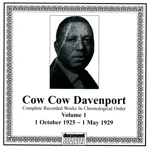 Buy from Amazon Cow Cow Davenport Vol 1 1925-1929
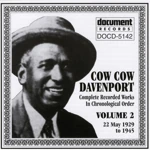 Buy from Amazon Cow Cow Davenport Vol 2 1929-1945
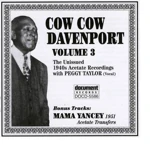 Buy from Amazon Cow Cow Davenport Vol 3 1940's
The Enduring Power of the Cow Cow Blues
To listen to Cow Cow Davenport's recordings today is to hear the sound of American music in the process of becoming itself. The earliest sides, from 1925 and 1926, capture a musician still negotiating the transition from ragtime to blues, from the composed formalism of the earlier style to the improvisational freedom of the later one. The Vocalion and Gennett recordings of 1928 and 1929 reveal a master at the height of his powers, a pianist who could drive a dance floor wild with his left hand while spinning melodic variations with his right. The late recordings for Comet and Circle, made after the strokes that impaired his technique, show a musician whose spirit remained undiminished even as his body failed him, whose voice and whose presence could still command attention even when his fingers could no longer execute the complex patterns of his youth.
The train imagery that pervades his work—the cowcatcher, the railroad blues, the endless forward motion of the boogie-woogie bass—takes on an additional resonance in the context of African American history. The railroad was the means of escape from the South, the vehicle of the Great Migration, the symbol of freedom and movement and the possibility of a better life. Davenport's music captures this double meaning: the train as literal transportation and as metaphorical transcendence, the mechanical rhythm as both constraint and liberation. His left hand pounds out the rhythm of the rails while his right hand sings the melody of the journey, and in the tension between the two lies the essence of the blues.
For the blues enthusiast, Cow Cow Davenport offers a window into a world that has largely vanished—the world of the black vaudeville circuit, of the medicine show and the carnival, of the TOBA theaters and the rent parties, of the recording studios where race records were made and marketed to a segregated audience. He was not a blues singer in the classic sense, not a Delta guitarist or a Chicago shouter, but something equally essential: the pianist who made the blues move, who provided the rhythmic foundation for the dancing and the drinking and the communal celebration that has always been at the heart of the music. His influence runs through every pianist who has ever played an eight-to-the-bar bass pattern, through every rock and roll record that features a boogie-woogie piano break, through the endless variations and adaptations that have kept this music alive for nearly a century.
He died in Cleveland in 1955, just as the world was beginning to change, just as the civil rights movement was gathering momentum and the music he had helped create was about to be transformed by electric instruments and teenage rebellion into something he might not have recognized. But the patterns he established, the rhythms he pioneered, the very name he gave to the music—all of these endured. Cow Cow Davenport was not merely a historical figure; he was a living bridge between the rural South of the early twentieth century and the urban North of the mid-century, between the sacred music of the church and the secular music of the barrelhouse, between the composed traditions of ragtime and the improvisational freedom of jazz and blues.
The man who gave America boogie woogie has never received the full measure of recognition that his contribution deserves. He remains, for many listeners, a name on old 78 rpm labels, a footnote in the histories of Pine Top Smith and Ray Charles, a pioneer whose own recordings are less famous than those of the musicians he influenced. But for those who take the time to listen, who place the needle on the groove of "Cow Cow Blues" or "Jim Crow Blues" or any of the dozens of sides he recorded across three decades, the power is immediate and undeniable. Here was a man who found his music in the face of every obstacle his society could place in his path—expelled from seminary for playing ragtime, impoverished by the Depression, struck down by illness, ignored by the industry he had helped build—and who kept playing anyway. That is the blues. That is the story of Cow Cow Davenport. And that is why his music still matters, still moves, still boogies, all these years after the last train left the station.