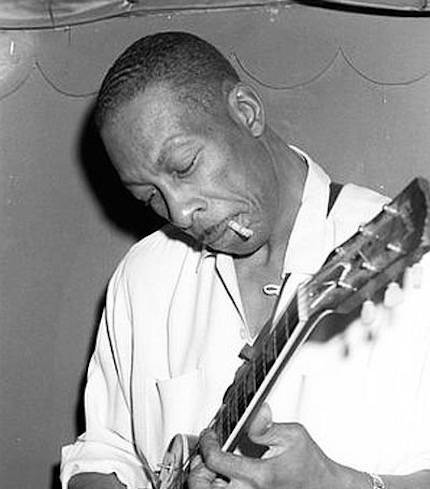
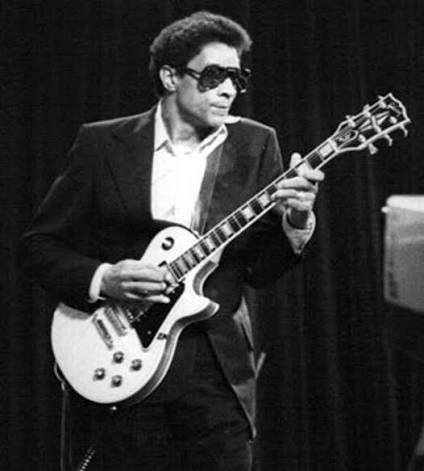
In the crowded landscape of postwar Chicago blues, where electrified Delta grit collided with urban sophistication and rhythm and blues was still finding its footing, Arbee Stidham carved out a singular space that belonged entirely to him. He was neither the rawest shouter nor the most polished crooner, neither a pure country blues traditionalist nor a full-throated R&B showman. Instead, Stidham occupied the fertile middle ground where blues phrasing met jazz harmony, where a tenor saxophone could wail with the same emotional authority as a human voice, and where a single number-one record could define a career without ever quite defining the man who made it. Born in the Arkansas Delta and seasoned on the road with Bessie Smith before finding his way to Chicago's South Side, Stidham was a musician of uncommon adaptability—a multi-instrumentalist, bandleader, songwriter, and eventually a guitarist whose late-career reinvention spoke to the resilience that the blues demands of its practitioners.
Arbee William Stidham entered the world on February 9, 1917, in De Valls Bluff, Arkansas, a small town in Prairie County situated along the White River, squarely within the cultural orbit of the Mississippi Delta.
He was born into a family where music was not merely entertainment but a way of life. His father, Luddie Stidham, was a professional musician who played in the orchestra of Jimmie Lunceford, the celebrated big-band leader whose sophisticated swing arrangements would influence generations of jazz musicians. Stidham's uncle Ernest led the Memphis Jug Band, one of the most important and commercially successful jug bands of the prewar era, while another uncle, Isaiah, was an accomplished violinist.
These were working musicians who understood the road, the stage, and the recording studio as intimately as they understood their own instruments.
Stidham's formal education took place at the Prairie Valley Training School and later at Paul Laurence Dunbar High School in Little Rock, but his real education happened in the spaces between classes, in the parlors and front porches where family members traded licks and stories. His first instrument was the clarinet, given to him by a local merchant in De Valls Bluff, and he took to it with the natural aptitude that comes from growing up in a household where instrumental proficiency was simply expected. "That's what I learned to play," Stidham later recalled, "and after I learned to play the clarinet, I went to the saxophone."
The alto saxophone would become his primary voice for the first three decades of his musical life, the instrument through which he would channel the jazz-inflected blues sensibility that would eventually define his singing style as well.
Yet Stidham's path to the blues was not without its obstacles, and the most formidable of these came from within his own home. His mother, Mable Stidham, was a woman of strong religious conviction who viewed the blues—though in her Arkansas vernacular she called them "reels"—as music of the devil. "I always loved the blues," Stidham remembered in later interviews, "They didn't call the blues 'blues' when I was a boy, they called them 'reels.' My mother used to tell me '...You don't do nothing but sing those reels—and you're going to hell.'"
He would order records by Louis Armstrong and other jazz and blues artists, listening to them late at night at low volume to avoid detection, only to have his mother confiscate them when she inevitably heard the music drifting through the house. His grandfather, however, proved to be a conspiratorial ally, stealing the records back and returning them to the young Arbee, who absorbed their lessons in secret.
By the age of twelve, Stidham had already made his first public appearance, performing at the Ninth Street Theatre in Little Rock. His mother attended the entire show without sitting down, her body language a mixture of anxiety and reluctant pride. When the performance ended, she grabbed her son, hugged and kissed him, and delivered a verdict that perfectly encapsulated the complex relationship between blues music and the Black church in the American South: "I'm proud of you in a way, but you're still going to hell, singing those reels."
It was a scene that would be repeated, in various forms, in countless Black households across the Jim Crow South, where the blues represented both a source of income and a source of spiritual anxiety.
At thirteen, Stidham formed his own seven-piece ensemble, "Arbee Stidham and His Southern Syncopators," a name that signaled his jazz ambitions as much as his blues roots.
The band quickly established itself as a formidable regional act, appearing frequently on KARK-AM radio in Little Rock and working clubs in both Little Rock and Memphis, Tennessee. The Memphis connection was crucial; it placed Stidham within the orbit of Beale Street, where the blues was being transformed from rural folk music into urban entertainment, and where his uncle's Memphis Jug Band had already proven that Black Southern musicians could achieve commercial success.
The Southern Syncopators' reputation eventually reached the ears of the greatest blues singer of the era. In 1930 and 1931, Stidham's band backed Bessie Smith during tour stops in the South, an apprenticeship that no amount of formal training could have matched.
To share a stage with the Empress of the Blues at the height of her powers was to receive a master class in phrasing, dynamics, and the art of commanding an audience's attention. Smith's influence on Stidham would be subtle but enduring; her ability to bend a melody until it expressed something beyond the reach of the written note, her understanding of how to build a performance from whisper to roar, these were lessons that Stidham would internalize and eventually translate into his own vocal style.
During the 1930s, Stidham and his band continued to tour throughout the South, eventually making their way to Chicago, where they played with Lucky Millinder's orchestra.
These were the years of the Great Depression, when even established musicians struggled to find work, and when the juke joints and dance halls that provided employment for Black entertainers were often the only economic engines running in impoverished Southern towns. Stidham survived these lean years through a combination of musical versatility and sheer persistence, playing clarinet, saxophone, and harmonica as the gig demanded, and singing when the situation called for a front man rather than an instrumentalist.
In the mid-1940s, Stidham made the move that would define his professional life, relocating to Chicago and inserting himself into the most vibrant blues scene in the nation. The postwar Chicago of Stidham's arrival was a city in musical ferment. The Great Migration had brought hundreds of thousands of Black Southerners to the city, and with them came the Delta blues, which was now being electrified and amplified in the clubs of the South Side and West Side. Stidham, however, arrived in Chicago with a different toolkit. His jazz background, his experience with big bands and orchestras, and his sophisticated harmonic sense set him apart from the Delta transplants who were then reshaping the city's musical identity. He was, in the estimation of the authors of the All Music Guide to the Blues, "exactly the sort of singer that thrived in the R&B or 'race' market after World War II; although essentially a bluesman, he wasn't a blues purist... his mixture of blues, jazz and gospel made him quite popular... in the '40s and '50s."
This was a musician who could navigate chord changes that would have tied a pure Delta player in knots, who understood the value of a well-placed saxophone solo, and whose vocal delivery carried the smooth authority of a man who had spent years making himself heard over horn sections.
It was in Chicago that Stidham connected with Lester Melrose, the legendary talent scout and record producer whose name is inseparable from the development of the Chicago blues sound. Melrose had been instrumental in the careers of Tampa Red, Big Bill Broonzy, Washboard Sam, Jazz Gillum, and countless others. Melrose recognized in Stidham something that the major labels were beginning to understand: the postwar "race" market was evolving, and the audience for blues was no longer satisfied with solo guitarists and plaintive field hollers. They wanted bands, horns, polished arrangements, and singers who could deliver a ballad with the same conviction they brought to a stomping blues shuffle. Melrose signed Stidham to RCA Victor in 1947, and the singer entered the studio for his first session with the confidence of a man who had spent two decades preparing for this moment.
"My Heart Belongs to You" was not, by the standards of the day, a typical blues record. It was a ballad, slow and smoldering, built around Stidham's plaintive vocal and a saxophone line that wept rather than wailed. The song's structure owed as much to the pop ballads of the era as to the twelve-bar blues form, and its emotional register was one of romantic devotion rather than the sexual braggadocio or existential complaint that characterized much of the blues repertoire. Yet it was precisely this accessibility, this willingness to meet the listener halfway between the juke joint and the parlor, that made the record a phenomenon.
When the single was released, a copy found its way to Zenas Sears, an Atlanta disc jockey and music producer at WGST-AM. Sears played the record, and the response was immediate and overwhelming. His audience flooded the station with calls, demanding to hear the song again and again. Recognizing that he had something extraordinary on his hands, Sears recommended the record to Gene Nobles, the influential R&B disc jockey at Nashville's WLAC-AM, whose powerful clear-channel signal reached deep into the South. The first night Nobles played "My Heart Belongs to You," he received 181 calls requesting an immediate replay. In June 1948, the record reached number one on the Billboard "Race Records" chart and also found its way onto Billboard's list of the "ten most-played juke box records" for several consecutive weeks, a distinction that spoke to its popularity not merely as a radio hit but as a song that people were willing to pay money to hear in bars and clubs across the country.
For Stidham, the success was both exhilarating and daunting. He had spent his entire adult life working toward this moment, and now that it had arrived, he faced the pressure that every one-hit wonder knows: the pressure to do it again. The RCA Victor sessions that produced "My Heart Belongs to You" also yielded other material, and Stidham would continue to record for the label until March 1950, often working with the saxophonist Sax Mallard.
Yet none of these subsequent releases matched the commercial impact of that first, devastating ballad. The record industry of the late 1940s was a volatile ecosystem of major labels, independent startups, and fly-by-night operations, and even a proven hitmaker was not guaranteed consistent support.
The years following "My Heart Belongs to You" were a study in professional persistence. Stidham recorded for Checker, the Chess brothers' subsidiary label, cutting sessions in 1952 and 1953 that showcased his continued evolution as a jazz-influenced blues vocalist. He moved to States Records, another Chicago independent, and in 1956 he became one of the flagship artists for Abco, a short-lived label operated by Eli Toscano.
The Abco sessions, recorded at Universal Recording in Chicago, featured some of the city's finest session musicians, including the guitarist Wayne Bennett and, on one memorable date, the harmonica genius Walter Horton, who overdubbed himself playing both amplified and unamplified harmonica on the track "When I Find My Baby."
These independent label recordings reveal a musician who was never content to simply repeat the formula of his hit. Stidham experimented with stop-time rhythms, spoken asides, and arrangements that blended blues structures with jazz harmonies. Yet the marketplace was crowded, and the independent labels that recorded him lacked the promotional muscle of RCA Victor.
Adding to the frustrations of this period was the casual carelessness with which the record industry treated its artists. On some releases, Stidham's name was misspelled as "R. B. Stidham," a mistake that would persist for decades and that even found its way onto a 1985 Ace Records compilation of Ike Turner's Kings of Rhythm, which credited Stidham's composition "My Heart Belongs to You" to the nonexistent "R. B. Stidham."
For a musician who had spent his life building a reputation, this kind of erasure was galling, yet it was also typical of an industry that viewed blues artists as interchangeable commodities rather than individual artists with careers to nurture.
The 1950s brought Stidham a crisis that would have ended the career of a less determined musician. He was involved in a serious car accident that left him with injuries so severe that he could no longer play the saxophone without suffering nosebleeds. For a man who had defined himself through his horn since childhood, this was a devastating blow. Stidham fell into a deep depression, convinced that his musical life was over. It was his wife who provided the push he needed, urging him to learn the guitar, an instrument he had never seriously pursued despite his years in the blues world.
Stidham bought a guitar and began the humbling process of starting over. He was not without teachers. Big Maceo Merriweather, the brilliant Chicago pianist whose "Worried Life Blues" was already a standard, pointed Stidham toward Earl Hooker, the left-handed guitar wizard whose single-string technique was the talk of the South Side. "You're always running around with Hooker," Merriweather told him, "that's somebody who could tell you something." Stidham took the advice to heart. "Hooker would teach me the single string thing, 'cause he was a wizard at that. He would stop by every once in a while and give me pointers."
Big Bill Broonzy, the elder statesman of Chicago blues, also lent his expertise, and between these mentors, Stidham began to develop a guitar style that favored cleanly articulated single notes over strumming, a T-Bone Walker-influenced approach that complemented his jazz-inflected vocals rather than competing with them.
This reinvention was not merely physical; it was artistic. Stidham's move from saxophone to guitar placed him in a different lineage, one that stretched from the Delta to the West Coast and back to Chicago, and it forced him to reconceive his relationship to the blues. The saxophone had allowed him to float above the changes, to comment on the harmony from a position of melodic freedom. The guitar demanded a more grounded, rhythmic approach, and Stidham rose to the challenge with the same discipline that had carried him from the clarinet to the saxophone decades earlier.
The blues revival of the 1960s, driven by the discovery of prewar country blues by white folk audiences and the renewed interest in postwar Chicago blues among British rock musicians, created new opportunities for artists who had been bypassed by the first wave of R&B success. Stidham was well positioned to benefit from this revival. His jazz-influenced approach appealed to the folk and jazz crowds that were now packing clubs and festivals, and his recent conversion to guitar made him a more versatile performer than many of his saxophone-bound contemporaries.
In 1960 and 1961, Stidham recorded two albums that would become the definitive documents of his mature style. The first, "Arbee's Blues," was released on Folkways Records, the legendary label founded by Moses Asch that specialized in documenting American roots music with an ethnographer's rigor. The second, "Tired of Wandering: The Blues of Arbee Stidham," appeared on Prestige's Bluesville imprint, recorded on November 7, 1960, and featuring a set of songs that ranged from the title track's weary resignation to the boogie-tinged optimism of "Brother's Boogie."
These recordings showcased Stidham's T-Bone Walker-influenced guitar and what one reviewer described as his "wailing tenor voice," a vocal instrument that had only deepened in authority with age. The Folkways and Bluesville albums also placed Stidham in the company of other Chicago legends. He recorded with Memphis Slim on Folkways sessions, and his work from this period reveals a musician who had fully absorbed the lessons of his guitar apprenticeship.
In 1965, Stidham returned to Memphis and recorded five songs at Sam Phillips's Sun Records studio. The session was not immediately released; the tapes sat in the Sun vaults for eleven years before appearing on a Charly Records compilation in 1976.
These Sun recordings are a fascinating coda to Stidham's 1960s work, capturing him in the same studio where Howlin' Wolf, B.B. King, and Elvis Presley had laid down tracks that changed American music.
In the 1970s, Stidham relocated to Cleveland, Ohio, a city with its own deep blues tradition and a thriving club scene that welcomed veteran Chicago musicians. He became a regular fixture at the Pirates Cove nightclub in the Flats, the industrial district along the Cuyahoga River that had become a hub for live music. There, he often performed with Robert Lockwood Jr. and the All Stars, sharing stages with one of the most sophisticated guitarists in the blues world.
Stidham's Cleveland years were not merely a matter of club dates and local gigs. He also became an educator, lecturing on the blues at Cleveland State University during the 1970s. His lectures were not dry historical surveys; they were living testimonials, delivered by a man who had backed Bessie Smith, recorded for RCA Victor, and learned guitar from Earl Hooker. When Stidham spoke about the blues, he did so with the authority of a practitioner who had lived every note he played.
In 1973, while living in Cleveland, Stidham became the subject of "The Bluesman," a short documentary film directed by Robert West, a professor at Kent State University. The film was described as "a portrait of the underground legend, American blues singer Arbee Stidham, a Depression era musician in a film of melancholy reality."
It was a fitting description for a man whose career had been marked by both triumph and obscurity, whose one massive hit had made him famous without making him rich, and whose decades of work had earned him the respect of his peers without ever quite securing him the mainstream recognition that some less talented artists enjoyed.
Stidham's live performances in his final years demonstrated that he had lost none of his power as a stage performer. In January 1982, he joined Willie Dixon's "Blues Rent Party" band for a performance at the Chicago Winter Jazz Fair, held at the Blackstone Hotel. The band was a Chicago blues all-star unit, featuring Sunnyland Slim on piano, Homesick James on guitar, and Odie Payne on drums.
The following August, he led his own Arbee Stidham Blues Band at the 4th Annual Kool Jazz Festival in Grant Park, Chicago, before a crowd of 8,000 fans. The band was a formidable aggregation of Chicago talent: Henderson Smith on trumpet, Ahmad Salaheldeen and Tommy "Madman" Jones and Nat Reed on saxophones, Lacey Gibson on guitar, Lafayette Leake on piano, Camille on bass, and Odie Payne on drums. A review in the Chicago Tribune captured the essence of Stidham's late-career appeal: "Blues shouter Arbee Stidham gave the crowd of 8,000 fans a rough, cheerfully energetic set. Stalking the stage with the sly, bent-kneed zeal of a Groucho Marx, Stidham sang with a similarly sly sense of humor."
It was a performance that summed up everything that made him unique: the jazz-influenced sophistication, the blues shouter's power, the entertainer's instinct for connecting with an audience, and the survivor's knowledge that every gig was a victory against the forces that had tried to silence him.
Arbee Stidham's place in the blues pantheon is that of a bridge builder. He connected the prewar world of big bands and jug bands to the postwar era of R&B and electric blues. He linked the jazz harmonies of his father's generation to the gutbucket sincerity of the Delta transplants who were reshaping Chicago. And he demonstrated, through his own example, that the blues was not a static form but a living tradition capable of absorbing new influences and accommodating new instruments.
His vocal style was the product of decades of listening and performing. The authors of the All Music Guide to the Blues captured his essence when they noted that he was "exactly the sort of singer that thrived in the R&B or 'race' market after World War II." His voice was a tenor instrument with a warbling vibrato that could suggest vulnerability or authority depending on the demands of the song. He was not a shouter in the manner of Big Joe Turner or Wynonie Harris, nor was he a smooth crooner in the style of Charles Brown. He occupied a middle space, using jazz phrasing to navigate blues chord changes, and bringing a musician's harmonic sophistication to material that might have seemed simple in less capable hands.
As a guitarist, Stidham's late-blooming career on the instrument was a testament to his adaptability. The T-Bone Walker influence was audible in his single-note lines and his clean, articulated attack, but there was also something distinctly personal in his playing, a reflection of the years he had spent as a horn player thinking in terms of breath and phrase rather than fret and string. His guitar work on the Folkways and Bluesville recordings of the early 1960s stands as some of the most underrated playing of the Chicago blues revival, precise and expressive, never showy for its own sake but always serving the song.
Stidham's influence on subsequent generations of musicians is subtle but real. "My Heart Belongs to You" has been covered and compiled countless times, and its success helped establish the template for the blues ballad as a commercial form. His work with Bessie Smith, though largely unrecorded, places him in the direct lineage of the classic blues singers who established the vocal conventions that all subsequent blues artists would inherit. And his willingness to embrace education, to lecture at Cleveland State University and to appear in documentary films, helped establish the blues as a subject worthy of serious cultural attention, paving the way for the academic study of the music that would flourish in the decades after his death.
Arbee Stidham died on April 26, 1988, at the University of Chicago Medical Center in Cook County, Illinois. He was 71 years old. He is buried at Oakridge Cemetery in Hillside, Illinois. In 2020, the Killer Blues Headstone Project, an organization dedicated to marking the graves of overlooked blues musicians, placed a proper headstone at his burial site, ensuring that future generations of blues pilgrims would have a physical marker to visit and honor.
The headstone was a belated but necessary recognition of a musician who had given his life to a music that America was often too indifferent to properly celebrate. Stidham's career spanned the Depression, the war years, the postwar R&B boom, the 1960s folk revival, and the 1970s blues-rock explosion. He played with Bessie Smith, learned from Earl Hooker, recorded for RCA Victor and Sun Records, lectured at a university, and performed for 8,000 people in Grant Park. He was a one-hit wonder who was so much more than his one hit, a jazzman who was also a bluesman, a saxophonist who became a guitarist, a mother's son who sang the reels despite her warnings that they would send him to hell.
In the end, Arbee Stidham's story is the story of the blues itself: a music born of struggle, shaped by migration, amplified by technology, and sustained by the stubborn belief that even the hardest life contains moments of beauty worth singing about. "My Heart Belongs to You" was his greatest commercial success, but his true legacy lies in the decades of work that preceded and followed it, in the lessons he passed to his students at Cleveland State, in the films that preserved his image for posterity, and in the example he set for every musician who has ever had to start over, learn a new instrument, and find a new voice. The blues, as Stidham lived it, was not a prison of twelve bars and three chords. It was a vast territory, and he explored more of it than most of his contemporaries ever knew existed.
Suggested Listening
 Buy from Amazon Tired of Wandering: The Blues of Arbee Stidham
 Buy from Amazon Arbee's Blues