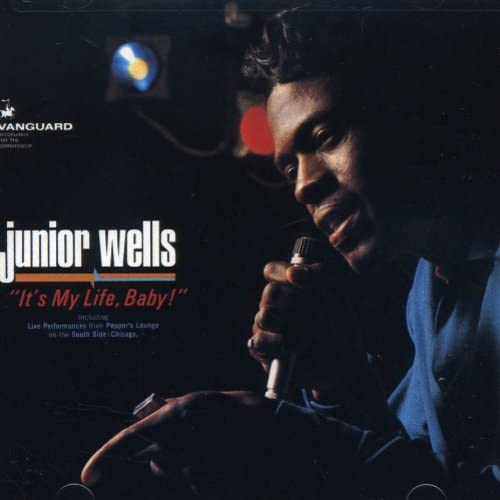
Released in December 1966 on Vanguard Records (catalog no. VRS-9231), It's My Life, Baby! stands as one of the definitive Chicago blues albums of the mid-1960s. Recorded during a pivotal period in Junior Wells's career, the album captures the extraordinary musical partnership between Wells and guitarist Buddy Guy at the height of their creative powers. The record is notable for its hybrid structure, blending studio precision with the raw immediacy of a South Side Chicago blues club.
Recording Sessions & Production
The album was produced by Samuel Charters, the renowned musicologist, poet, and producer who played a crucial role in documenting blues for Vanguard during the 1960s folk-blues revival. Charters also contributed the album's liner notes. Some sources additionally credit Bob Koester (founder of Delmark Records, who had produced Wells's landmark Hoodoo Man Blues the previous year) with production involvement, though Charters is the primary credited producer.
The sessions were split between two distinct environments:
-
Universal Studios, Chicago — Seven tracks were cut in the same Chicago studio complex where Chess Records worked their magic. These studio sessions allowed for controlled arrangements and cleaner sound.
-
Pepper's Lounge, Chicago — Five tracks were recorded live at Pepper's Lounge on 43rd Street on Chicago's South Side, deliberately capturing the atmosphere of a working blues band interacting with a club audience.
This dual approach gave the album its unique character: the studio half showcasing tight, arranged Chicago blues and soul-influenced numbers, while the live half captured the sweat, spontaneity, and communal energy of the South Side club scene.
The Musicians
The core band on It's My Life, Baby! represented the cream of Chicago blues talent:
-
Junior Wells — Vocals, harmonica
-
Buddy Guy — Lead guitar
-
Walter Beasley (2) — Rhythm guitar (studio tracks only)
-
Leroy Stewart — Bass
-
Little Al — Drums (studio tracks)
-
Fred Below — Drums (live tracks at Pepper's Lounge)
For the Pepper's Lounge live recordings, the band was leaner: Wells, Guy, Stewart, and Below, with Walter Beasley absent and Fred Below (Wells's former bandmate from the Aces) stepping in on drums.
Buddy Guy's presence is essential to the album's identity. Fresh off their collaboration on Hoodoo Man Blues (1965), Guy and Wells had developed an almost telepathic musical rapport. Guy's guitar work here ranges from controlled B.B. King-influenced lines to raw, gutty South Side aggression, while Wells's harmonica moves from screaming peaks to moaning lows with a percussive, staccato attack that mirrored the emerging funk sensibilities of the era.
Track-by-Track Breakdown
Side One
1. "It's My Life, Baby" (4:21)
Songwriters: Don Robey & Ferdinand Washington
Recording: Live at Pepper's Lounge
The title track and album opener was captured live at Pepper's Lounge. A half-instrumental, half-vocal workout, it finds Wells using his signature "spitting" harp style to powerful effect over gutty guitar breaks from Guy. The song builds tension through dynamic shifts, with Wells's harp and Guy's guitar trading ferocious blows. The composition had previously been recorded by Bobby "Blue" Bland, but Wells makes it his own through sheer sonic force.
2. "It's So Sad to Be Lonely"
Songwriter: Sonny Boy Williamson II (Rice Miller)
Recording: Live at Pepper's Lounge
A tribute to the late Sonny Boy Williamson II, whom Wells deeply admired. Before launching into the song, Wells addresses the crowd: "You have to get the blues now, low down and dirty..." The live recording captures a beautiful, crying harp style from Wells and gutty, empathetic guitar from Guy. The track pays homage to Williamson not through imitation but through emotional truth.
3. "Country Girl"
Songwriter: Unknown/Traditional
Recording: Universal Studios (studio)
One of the more straightforward blues numbers on the album. Contemporary reviewer Tony Glover (in Crawdaddy magazine) considered this track merely "so-so" relative to the rest of the album, though he noted it was still "a long ways ahead of most of Wells's imitators."
4. "You Lied to Me"
Songwriter: Little Junior Parker (originally recorded as "That's All Right")
Recording: Universal Studios (studio)
This track is actually Wells's version of Little Junior Parker's "That's All Right," retitled here. The studio arrangement features what Glover described as an "outa sight unison harp-guitar solo in counterpoint" between Wells and Guy—a moment of intricate musical interplay that demonstrates their extraordinary chemistry.
5. "Stormy Monday Blues" (4:19)
Songwriters: Billy Eckstine, Bob Crowder & Earl Hines
Recording: Universal Studios (studio)
Note: This is the Billy Eckstine/Earl Hines standard, not the T-Bone Walker "Stormy Monday." The studio band creates what Glover called "a beautifully rich heavy tapestry of sound," and Buddy Guy contributes a stunning jazz-blues solo that stretches the harmonic boundaries of the Chicago blues idiom. The track showcases the more sophisticated, jazz-tinged side of the Wells-Guy partnership.
6. "Shake It Baby" (3:37)
Songwriters: Unknown (possibly Wells/Guy)
Recording: Universal Studios (studio)
A dance-oriented number heavily influenced by the James Brown funk-soul revolution. Wells pushes his vocal into a more rhythmic, shouting style, and the band locks into a tight, propulsive groove. This track represents Wells's conscious effort to bridge the gap between traditional Chicago blues and the contemporary soul movement.
Side Two
7. "Checking On My Baby" (3:07)
Songwriter: Sonny Boy Williamson II
Recording: Universal Studios (studio)
An uptempo jump blues originally recorded by Sonny Boy Williamson II in 1960. Wells made this one of his signature repertoire pieces, and here the studio band delivers a tightly controlled shuffle with precise harp and guitar breaks. The track demonstrates Wells's mastery of the uptempo Chicago shuffle style.
8. "Early In The Morning"
Songwriter: Traditional (associated with Sonny Boy Williamson I)
Recording: Live at Pepper's Lounge
Another live cut paying tribute to the Sonny Boy Williamson lineage—this time Sonny Boy Williamson I (John Lee Williamson), who first recorded the song in 1937. Wells introduces it with spoken patter about getting "down in the alley" to play the blues about "them little girls. Young...tender...old...don't make no difference." The performance builds to a screaming harp break that proves he isn't kidding.
9. "(I Got A) Stomach Ache"
Songwriters: Buddy Guy & Junior Wells
Recording: Universal Studios (studio)
A novelty-tinged, gimmicky number built around a call-and-response of "oooh, ah, oooh ah ouch" vocals. Despite its humorous premise, the groove is undeniable, and the track shows Wells's willingness to incorporate theatrical showmanship into his blues.
10. "Look How Baby"
Songwriter: Unknown/Traditional
Recording: Live at Pepper's Lounge
The final live track and one of the album's emotional peaks. Glover described it as "down-in-the-bottom, no-bullshit blues." The tempo is slow and heavy, with Leroy Stewart's bass booming out notes that "hang forever." Guy's guitar reaches high, falters, then pulls back down into the groove. The live recording captures a moment of collective truth-telling between band and audience.
11. "Slow, Slow"
Songwriter: Unknown/Traditional
Recording: Live at Pepper's Lounge
The album's only instrumental, captured during the late set at Pepper's Lounge. The mood is late-night and introspective, reminiscent of the complex jazz-blues instrumentals that Little Walter used to record. Wells's sense of dynamics and contrast is perfect here—his control of the harp's timbre creates a haunting atmosphere without the need for spooky echo chambers.
12. "Everything's Going To Be Alright"
Songwriter: Little Walter (McKinley Morganfield/Muddy Waters also sometimes credited on later versions; originally by Little Walter, 1959)
Recording: Universal Studios (studio)
The album closes with a studio reading of this Little Walter classic (originally released as "Everything Gonna Be Alright" in 1959). Wells delivers it with reassuring authority, riding atop a solid studio groove. Glover considered this and "Country Girl" the album's weaker cuts, though still superior to most contemporary blues imitators.
Buy This Album
 Buy from Amazon It's My Life, Baby! (1966)
Critical Assessment
Contemporary critics recognized It's My Life, Baby! as a landmark recording. In a 1967 Crawdaddy review, Tony Glover declared it the closest any album had come to capturing the actual feel of the bar-blues life. He praised the live cuts as possessing "more fire and drive" than the studio material, noting that Wells and Guy reached heights of communication on the Pepper's Lounge recordings that bordered on telepathy.
The album is historically significant as the second full-length collaboration between Wells and Guy (following Hoodoo Man Blues), cementing their reputation as one of the most formidable singer/harpist-guitarist partnerships in blues history. Where Hoodoo Man Blues had established their studio chemistry, It's My Life, Baby! expanded their palette to include live club energy, soul-funk influences ("Shake It Baby," "Stomach Ache"), and jazz-tinged sophistication ("Stormy Monday Blues").
Today, It's My Life, Baby! remains an essential document of 1960s Chicago blues—capturing not just the sound of the era, but the very atmosphere of the South Side clubs where the music lived and breathed.