
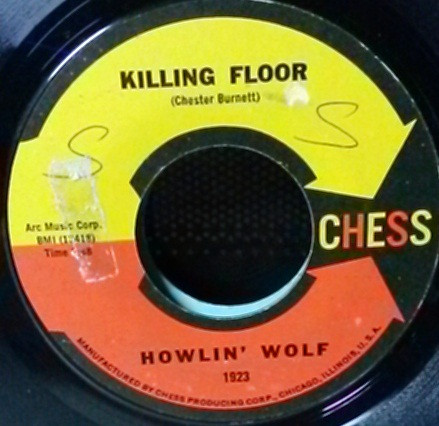
“Killing Floor” (often stylized “Killin’ Floor”), recorded by Howlin’ Wolf in August 1964 and released as a Chess single (Chess 1923, backed with “Louise”) in late 1964 or early 1965, stands as one of the defining classics of postwar Chicago electric blues. An upbeat twelve-bar blues driven by an instantly recognizable guitar riff, it became a blues standard and a frequent source of inspiration (and litigation) for rock musicians. The song was inducted into the Blues Hall of Fame as a Classic of Blues Recording in 1991.
Recording Sessions and Producer
The track was cut in August 1964 at Chess Studios in Chicago. Producers were Leonard Chess, Phil Chess, and Willie Dixon. The session captured Howlin’ Wolf at a mature peak in his Chess career, with a full, horn-augmented band delivering a tight, energetic performance. The song later appeared on compilations such as The Real Folk Blues (1966). Wolf re-recorded it in 1970 during the London Howlin’ Wolf Sessions with a rock all-star cast that included Eric Clapton, Bill Wyman, Charlie Watts, and others.
Songwriters — Detailed Focus
The song is credited to Chester Burnett (Howlin’ Wolf’s real name). While Willie Dixon wrote many of Wolf’s best-known songs (“Spoonful,” “Little Red Rooster,” “Back Door Man,” “I Ain’t Superstitious”), “Killing Floor” is one of Wolf’s own compositions. Hubert Sumlin, Wolf’s longtime guitarist and musical foil, confirmed the song’s meaning and origin in interviews: the “killing floor” refers to the blood-soaked area of a slaughterhouse where animals are killed, used here as a stark metaphor for a destructive romantic relationship. As Sumlin explained, it describes a woman who has a man “down,” treating him so badly that he feels he would rather be dead—“she went out of her way to try to kill you.”
The concept of the “killing floor” as hard-luck imagery predates Wolf. Doctor Clayton recorded “On the Killin’ Floor” in 1942–43, a tale of poverty and downfall that includes lines about high-priced whiskey and women putting the singer on the killing floor. Wolf adapted and personalized the idea into a more focused narrative of romantic betrayal and regret (“I should’ve quit you a long time ago… I let you put me on the killing floor”). The lyrics are concise, repetitive, and declarative in classic blues AAB form, emphasizing missed chances to leave (“If I had followed my first mind… I’d a been gone”) and the realization of being trapped in a damaging situation. Wolf’s authorship here highlights his ability to craft powerful, personal material beyond the Dixon-penned mythic or boastful songs that often defined his image.
Musicians
- Howlin’ Wolf (Chester Burnett) — lead vocals
- Hubert Sumlin — electric lead guitar (the signature riff)
- Buddy Guy — acoustic/rhythm guitar
- Lafayette Leake — piano
- Andrew “Blueblood” McMahon (sometimes listed as Andrew Palmer) — bass
- Sam Lay — drums
- Arnold Rogers — tenor saxophone
- Donald Hankins — baritone saxophone
(Some session logs also note Willie Dixon on bass for related tracks around this period.) The combination of Sumlin’s stinging electric lead, Guy’s rhythmic acoustic slap (with tape echo), Leake’s piano, a solid rhythm section, and punching horns creates a full, propulsive Chicago blues sound.
Musical Style and Analysis
“Killing Floor” is an upbeat, mid-to-up-tempo twelve-bar blues, typically in A or a related key, lasting about 2:48. Its most distinctive feature is Hubert Sumlin’s “instantly familiar” descending guitar riff—a concise, repeating figure drawn from the minor pentatonic scale that runs throughout the song rather than serving only as an intro. The riff provides both melodic identity and rhythmic drive, interlocking with the shuffle or swinging groove of the drums and bass.
Wolf’s vocal is a classic example of his powerful, gravelly, almost howling delivery—raw, commanding, and full of emotional weight. He phrases the lyrics with rhythmic precision and intensity, turning personal regret into a forceful statement. The arrangement builds energy through the interplay of elements: Sumlin’s riff and fills, Buddy Guy’s percussive acoustic guitar (often described as having a rockabilly-like slap via tape echo), Lafayette Leake’s piano accents, and the two-saxophone horn section delivering sharp, soul-revue-style stabs between verses. The overall effect is driving and cathartic rather than purely mournful—a rave-up that channels the pain of the lyrics into kinetic blues power.
Structurally it adheres to the twelve-bar form with standard I–IV–V movement, but the continuous presence of the riff and the tight band interplay give it a modern, almost proto-rock urgency. Dynamics rise and fall with the vocal lines and instrumental responses, creating a sense of propulsion that made the song ideal for both dance floors and later rock reinterpretation.
 Buy from Amazon The London Howlin' Wolf Sessions
Other Versions
The song quickly entered the blues and rock repertoire. Notable versions include:
- Jimi Hendrix, who performed it extensively in the mid-1960s (with Curtis Knight and the Squires, and as a frequent set-opener with the Experience), often at a faster tempo with extended, innovative guitar work. A famous early jam with Cream in London helped introduce him to British musicians.
- Albert King (1969).
- The Electric Flag (Mike Bloomfield).
- Led Zeppelin’s “The Lemon Song” (Led Zeppelin II, 1969), which heavily adapted the riff, structure, and some lyrical ideas (plus a verse from Robert Johnson’s “Traveling Riverside Blues”). ARC Music (Wolf’s publisher) sued; the case was settled out of court, and Howlin’ Wolf (as Chester Burnett) received co-writing credit.
- Later covers by Johnny Winter, Joe Bonamassa, Slash featuring Brian Johnson (with Steven Tyler on harmonica, 2024), and many blues and blues-rock artists.
Wolf himself revisited it on the 1970 London sessions.
Legacy
“Killing Floor” is one of Howlin’ Wolf’s most recognizable and frequently covered songs, a staple of blues bands and a bridge to rock. Its guitar riff became one of the most borrowed figures in blues-rock, influencing generations of players. The Blues Hall of Fame induction citation notes its popularity among both blues and rock musicians and its status as one of Wolf’s most often-covered tracks. Through Hendrix’s fiery live versions and Led Zeppelin’s adaptation (despite the legal issues), it helped carry Chicago electric blues into the rock era. More than six decades later, the original remains a high-water mark of Wolf’s partnership with Hubert Sumlin and a powerful example of how personal emotional content, a killer riff, and a tight ensemble could create an enduring blues classic.









