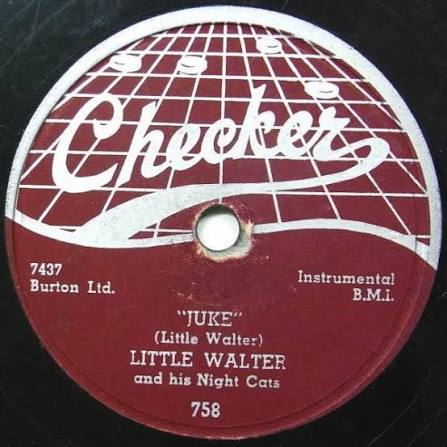
“Juke,” recorded by Little Walter (Marion Walter Jacobs) on May 12, 1952, is the single most influential harmonica instrumental in blues history and the only harmonica instrumental ever to reach No. 1 on the Billboard R&B chart. Released in August 1952 on Checker Records (a Chess subsidiary) as the A-side of Checker 758 (backed with “Can’t Hold On Much Longer”), it spent eight weeks at No. 1 and remained on the chart for roughly 20 weeks, becoming the biggest hit Chess/Checker had released up to that point and one of the major R&B hits of 1952. It is widely regarded as the “national anthem of blues harmonica.”
Recording Sessions and Producer
The session took place on May 12, 1952, at Universal Recording Studios (111 E. Ontario Street) on Chicago’s Near North Side, engineered by Bill Putnam (who had earlier recorded the Harmonicats’ hit “Peg O’ My Heart”). Contrary to long-standing lore that “Juke” was an afterthought at the end of a Muddy Waters session, it was the first song attempted and the first completed take of Little Walter’s debut session as a leader for Leonard Chess. Two takes of “Juke” were cut; the second (or the take closest to the band’s live version) was selected for release. Walter then recorded multiple takes of the vocal B-side “Can’t Hold On Much Longer.” Only after those sides were finished did Muddy Waters cut his sole track that day, “Please Have Mercy,” with the same band.
Producer was Leonard Chess. The band on the date was essentially Muddy Waters’ working group at the time, billed on the single as Little Walter & His Night Cats.
Songwriters
The song is credited to Walter Jacobs (Little Walter). It is an original instrumental composition, though it draws on existing musical ideas in the blues and jazz traditions, as was common in the era.
Little Walter had been playing a related untitled boogie/instrumental as a stage theme or intermission number with the Muddy Waters band. Guitarist Jimmy Rogers recalled elements linked to an unrecorded intermission piece associated with pianist Sunnyland Slim (sometimes called “Get Up the Stairs Mademoiselle”). Some accounts (including claims by Snooky Pryor) suggest influence from Pryor’s “Snooky and Moody’s Boogie.” The opening six-note phrase has been compared to common jazz/swing horn riffs of the 1930s–40s (including similarities noted to Louis Armstrong’s “Leap Frog”), but the bulk of the piece is Walter’s own invention—a series of improvisational choruses built around a swinging shuffle feel.
Walter’s genius lay in transforming these elements into a fully realized, saxophone-like instrumental statement tailored to the amplified harmonica. He composed and arranged the piece for maximum impact on the dance floor and the jukebox (the title “Juke” deliberately evokes both jukeboxes and juke joints). No co-writers are credited; the song is firmly associated with Walter’s emerging identity as a bandleader and innovator.
Musicians
- Little Walter (Marion Walter Jacobs) — amplified harmonica (Hohner Marine Band, second position/cross harp on an A harmonica for the key of E)
- Muddy Waters — guitar
- Jimmy Rogers — guitar
- Elgin Evans (also known as Elga Edmonds) — drums
No bass or piano is present on the released take. The sparse instrumentation throws the focus entirely onto Walter’s harmonica, supported by a tight, swinging rhythm section.
Musical Style and Analysis
“Juke” is a swinging twelve-bar blues instrumental in E (played in second position on an A harmonica), lasting approximately 2:44. It features a boogie-woogie guitar pattern and a strong shuffle groove. The form consists of roughly eight choruses. Time signatures briefly shift (including moments of 3/4 and 2/4), adding subtle rhythmic interest within the overall 4/4 framework.
The opening “head” is a repeated, memorable six-note riff that functions like a jazz horn section call. From there Walter launches into extended improvisational choruses characterized by long, flowing, saxophone-like phrases, deep tone, dynamic builds and releases, tongue-blocking techniques, bends, octaves, and articulated phrasing. He uses soft pulls, strategic use of the 3-blow and other positions, and a highly controlled vibrato and hand effects.
The defining technical innovation is the amplified sound: Walter cupped a small bullet-style microphone (often a Shure or similar intercom mic) tightly against the harmonica and ran it into an overdriven guitar amplifier (Valco, Silvertone, or similar). This produced a thick, distorted, horn-like tone with sustain and presence far beyond acoustic harmonica. The result was a lead voice capable of cutting through a band and carrying an entire instrumental track—the first time the harmonica had been presented this way on a major hit.
Rhythmically, the piece is dance-oriented and propulsive. Harmonically it stays within standard blues I–IV–V territory, but Walter’s melodic invention, chromatic suggestions, and rhythmic displacements elevate it far beyond a simple boogie. The performance builds intensity across choruses before releasing, creating a complete, self-contained statement that rewards repeated listening and remains a technical benchmark for harmonica players.
Other Versions
An alternate take (vastly different) was finally issued decades later on reissue compilations. The song quickly became a required number for Chicago harmonica players; ability to play “Juke” was a measure of competence on the South and West Side scenes.
Notable later versions and interpretations include recordings by Big Walter Horton, James Cotton, Carey Bell, Billy Branch, Paul Butterfield, and many others. It has been covered or referenced across blues and blues-rock contexts, and its riff and approach influenced countless instrumental tracks.
Suggested Listening
 Buy from AmazonJuke Joint Blues
Legacy
“Juke” single-handedly elevated the harmonica from a primarily rhythmic or supporting instrument to a frontline lead voice in postwar electric blues. It launched Little Walter’s career as a major solo star (he soon left Muddy Waters’ band, took over the Aces—rechristened the Jukes—and scored a string of hits that often outsold Waters’). The amplified technique pioneered here became the standard for virtually every subsequent blues harmonica player (Junior Wells, James Cotton, Charlie Musselwhite, Kim Wilson, and generations beyond).
The record is frequently cited as one of the songs that shaped rock and roll and appears on the Rock and Roll Hall of Fame’s list of 500 Songs That Shaped Rock and Roll. Its influence extends to the British Invasion and beyond (Mick Jagger has cited Walter as a favorite). More than seven decades later, “Juke” remains the essential repertoire piece for blues harmonica and a landmark demonstration of how amplification, improvisation, and rhythmic drive could redefine an instrument and an entire genre.