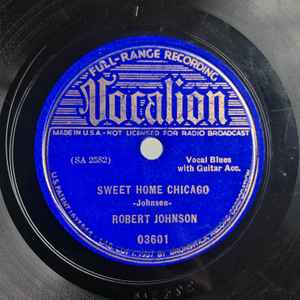
“Sweet Home Chicago,” recorded by Robert Johnson on November 23, 1936, is one of the most enduring and frequently performed blues standards, widely regarded as an unofficial anthem for the city of Chicago despite the geographic ambiguity in its original lyrics. Released in August 1937 on Vocalion (backed with “Walkin’ Blues”), it exemplifies Johnson’s ability to adapt existing material into something distinctive, combining Delta blues intensity with a forward-looking rhythmic drive that foreshadowed postwar electric blues and rock and roll.
Recording Sessions and Producer
Johnson’s first professional sessions took place over three days—November 23, 26, and 27, 1936—in an improvised studio in Room 414 of the Gunter Hotel in San Antonio, Texas. These were arranged after Johnson auditioned for H. C. Speir, a Jackson, Mississippi, talent scout and music-store owner, who recommended him to Ernie Oertle of the American Record Corporation (ARC). Oertle brought Johnson to San Antonio.
The producer was Don Law, ARC’s regional branch manager (with Art Satherley as A&R director for the trip). Law’s involvement was largely supervisory—setting up equipment and directing starts—while Johnson performed solo. “Sweet Home Chicago” was recorded on the first day, Monday, November 23, 1936, as part of a highly productive session that also yielded “I Believe I’ll Dust My Broom,” “Ramblin’ on My Mind,” “Come On in My Kitchen,” “Terraplane Blues,” and others. Johnson used standard tuning with a capo on the second fret for this track. The single appeared months later and achieved only modest regional success during his lifetime.
Songwriters — Detailed Focus
Although traditionally credited solely to Robert Johnson (Robert Leroy Johnson, 1911–1938), “Sweet Home Chicago” has clear and well-documented precedents in earlier blues recordings. This is typical of the prewar blues tradition, in which floating verses, shared melodies, and incremental adaptation were common rather than strict modern notions of original authorship.
The most direct antecedents are:
- Scrapper Blackwell’s “Kokomo Blues” (1928), which introduced a city-specific refrain built around “baby don’t you want to go” and references to packing up and heading to Kokomo, Indiana.
- Kokomo Arnold’s “Old Original Kokomo Blues” (1934), which refined the form, added counting verses (“one and one is two…”), and used phrases such as “back to that eleven light city / to sweet old Kokomo.” Arnold claimed the song as his own and even took his stage name from it.
Related earlier pieces sharing melodic or structural elements include Madlyn Davis’s “Kokola Blues” (1927), Jabo Williams’s “Ko Ko Mo Blues” (1932), and various “Honey Dripper”/“Red Cross” songs associated with Roosevelt Sykes and Walter Roland.
Johnson transformed the material. He shifted the destination from the relatively obscure Kokomo to Chicago (a major endpoint of the Great Migration) while inserting the puzzling line “back to the land of California / to my sweet home Chicago.” Later performers almost universally altered this to clearer variants such as “back to that same old place, sweet home Chicago” (popularized by Roosevelt Sykes in 1955 and cemented by Magic Sam, Freddie King, and the Blues Brothers). Johnson retained Arnold’s counting verses and overall AAB structure but infused the song with his own high, near-falsetto vocal delivery and a propulsive guitar rhythm. The result is less a wholesale invention than a masterful adaptation that reoriented the song toward themes of aspirational migration and urban longing, making it far more resonant and durable.
Johnson’s broader songwriting approach combined Delta roots (he absorbed styles from Son House, Charley Patton, and others) with commercial awareness—structuring material to fit the roughly three-minute 78-rpm format—and a gift for memorable hooks and rhythmic innovation. “Sweet Home Chicago” sits among his more accessible, uptempo pieces rather than the darker, more introspective material of his later Dallas sessions.
Musicians
Johnson performed entirely solo: vocals and acoustic guitar. No other musicians appear on the recording. His accompaniment draws on boogie-woogie and barrelhouse piano patterns (adapted from players such as Roosevelt Sykes and Walter Roland) rather than the bottleneck style of Kokomo Arnold, creating a driving, shuffle-based rhythm that feels modern and anticipates electric blues guitar approaches.
Musical Style and Analysis
“Sweet Home Chicago” is a mid-tempo twelve-bar blues (or close variant) with a strong shuffle feel. Johnson plays in standard tuning with a capo at the second fret, producing a bright, ringing tone. The guitar features a relentless, propulsive bass-line pattern that functions like a left-hand piano boogie, interspersed with fills, turnarounds, and a distinctive “railroad” or train-whistle-style lick in the turnaround. Unlike his more slide-dominated or fingerstyle pieces (e.g., “Cross Road Blues”), the accompaniment here prioritizes rhythmic drive over intricate independent lines.
The vocal is high, urgent, and often near-falsetto, with a pleading quality on the refrain “Oh, baby, don’t you want to go.” Johnson uses the classic AAB lyrical structure, but the first verse and refrain establish the geographic invitation, while subsequent verses incorporate the counting device (“one and one is two, two and two is four…”) that builds momentum and a sense of playful persuasion. The overall effect is more buoyant and invitational than many of Johnson’s darker songs, yet still carries an undercurrent of restlessness and desire for escape or return.
Harmonically it stays within conventional blues I–IV–V territory (commonly analyzed in E or related keys depending on the capo), but Johnson’s rhythmic phrasing and emphatic accents give it forward momentum. The performance lasts just under three minutes and demonstrates his skill at balancing vocal expression with self-accompaniment in a single take.
Suggested Listening
 Buy from Amazon The Centennial Collection
Other Versions
The song remained relatively obscure until the postwar period. Key later versions include:
- Roosevelt Sykes’s 1955 recording (“Sweet Old Chicago”), which clarified the lyrics and helped establish the modern form.
- Junior Parker’s 1958 upbeat ensemble version (credited in part to Sykes), which reached the R&B charts.
- Magic Sam’s definitive electric Chicago blues reading on West Side Soul (1967), widely considered a high-water mark for the song in a band context.
- Freddie King’s powerful interpretations.
- The Blues Brothers’ high-energy performance in the 1980 film The Blues Brothers (dedicated on-screen to Magic Sam), which brought the song to a mass popular audience and remains one of its best-known renditions.
- Versions by Taj Mahal, Eric Clapton, Fleetwood Mac, Status Quo, Steve Miller Band, Buddy Guy (including a famous White House performance with B.B. King and President Obama), and countless others in blues, rock, and jam contexts.
It is a staple of blues jams and live sets worldwide.
Legacy
“Sweet Home Chicago” is frequently described as the blues equivalent of “When the Saints Go Marching In”—a communal standard that nearly every blues musician knows and that audiences instantly recognize. It has become an unofficial anthem for Chicago and a symbol of the Great Migration’s cultural impact, even though Johnson’s original lyrics mixed California and Chicago imagery and he himself had little documented connection to the city. The song was inducted into the Blues Hall of Fame as a Classic of Blues Recording and appears on the Rock and Roll Hall of Fame’s list of songs that shaped rock and roll.
Its rhythmic blueprint—particularly the driving guitar shuffle—influenced generations of electric blues and rock players. Through Magic Sam, the Blues Brothers, and continuous live performance, it bridges prewar Delta blues, postwar Chicago blues, and mainstream popular culture. Despite ongoing debate over precise authorship and the odd geography of the original lyric, Johnson’s version remains the definitive starting point, and the song itself continues to function as both a historical artifact and a living, endlessly adaptable blues anthem.