
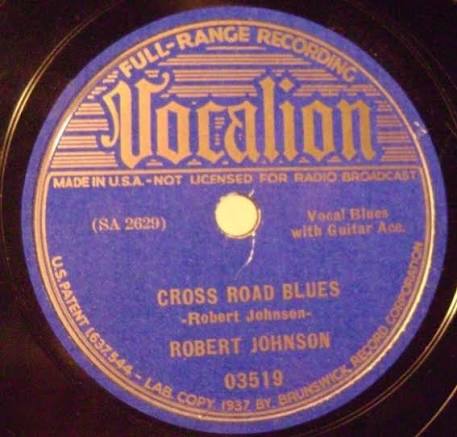
“Cross Road Blues” (commonly known as “Crossroads”), written and performed by Robert Johnson, is one of the most iconic and mythologized recordings in Delta blues and a foundational influence on rock music. Recorded in 1936 and released in 1937 on Vocalion, the song captures Johnson’s intense solo acoustic style and has become inseparable from the folklore surrounding his life and supposed deal with the devil. It stands as a high point of his brief recorded output and a bridge between rural Mississippi blues and later electric styles.
Recording Sessions and Producer
Robert Johnson’s first professional recording sessions took place over three days—November 23, 26, and 27, 1936—in an improvised studio set up in Room 414 of the Gunter Hotel in San Antonio, Texas. These sessions were arranged after Johnson auditioned for H. C. Speir, a Jackson, Mississippi, music-store owner and talent scout. Speir recommended him to Ernie Oertle, a representative for the American Record Corporation (ARC). Oertle arranged Johnson’s travel to San Antonio.
The producer was Don Law, a British-born ARC executive who supervised the sessions. Art Satherley served as A&R (artist and repertoire) director for the ARC trip. Law’s role appears to have been largely logistical: setting up the equipment and signaling starts. Johnson performed facing a corner or wall (accounts vary between shyness and acoustic “corner loading” to enhance the guitar sound). No additional musicians were present; everything was captured as a solo vocal-and-guitar performance on portable equipment.
“Cross Road Blues” was cut on the final day, Friday, November 27, 1936. Two takes were recorded (matrix SA-2629). Take 1 became the issued master; Take 2 (slightly different in structure and containing an extra verse in some accounts) remained unissued until later reissues and anthologies. The single (Vocalion 03519, coupled with “Ramblin’ on My Mind”) was released in May 1937. It was a regional success but did not achieve national impact during Johnson’s lifetime. Johnson recorded a second set of sessions in Dallas in June 1937 under the same producer, but “Cross Road Blues” originates solely from the San Antonio dates. Across both Texas trips he cut a total of 29 masters.
Songwriters
Robert Johnson (Robert Leroy Johnson, May 8, 1911 – August 16, 1938) is the sole credited songwriter (lyrics and music). Born in Hazlehurst, Mississippi, and raised primarily in the Delta region, Johnson absorbed the styles of earlier Delta players—particularly Son House, Charley Patton, and Willie Brown—while also incorporating elements from commercial blues, piano-influenced urban styles, and popular records of the era. He was a highly adaptive and sophisticated composer who structured songs carefully to fit the roughly three-minute limit of a 78-rpm side, moving beyond the more loosely assembled, floating-verse approach of many earlier country blues artists.
Johnson’s writing on “Cross Road Blues” draws on traditional blues formulas (traveling, isolation, pleading for mercy, flagging a ride) while creating a tightly focused dramatic scene. The crossroads motif itself belongs to a broader Southern folklore complex involving spiritual power, decision-making, and supernatural encounters, though the song itself contains no explicit reference to the devil. Scholars note that Johnson may have been performing versions of the song as early as 1932. His lyrics often blend personal anguish, religious imagery, and worldly restlessness; here the narrator falls to his knees asking the Lord for mercy, tries unsuccessfully to hitch a ride as darkness falls, and ultimately asks a friend (Willie Brown) to be told that he is “sinking down.” The result is a portrait of profound loneliness and spiritual crisis rather than a literal Faustian bargain—though later myth-making fused the song with stories of Johnson selling his soul.
Johnson’s overall catalog demonstrates remarkable economy and innovation: he fused Delta slide techniques with more complex harmonic and rhythmic ideas, used through-composed elements, and created vivid, self-contained narratives. Only 29 songs survive from his two sessions, yet they form one of the most influential bodies of work in American popular music.
Musicians
Johnson performed entirely alone: vocals and acoustic guitar (using a bottleneck or metal slide). No other musicians appear on the recording. His guitar work is frequently described as sounding like two players at once—bass lines, rhythmic strumming, and melodic slide answers interlocking with the voice.
Musical Style and Analysis
“Cross Road Blues” is pure Delta blues, performed solo with intense expressive force. Johnson uses an open (Spanish) G tuning, commonly described as tuned to the key of B (or sometimes discussed in relation to A-flat with capo), which facilitates slide playing across multiple strings. The slide is central: it answers and dialogues with the vocal rather than merely accompanying it, producing wailing bends, glissandi, and microtonal inflections that heighten the song’s tension and emotional urgency.
Structurally the song departs from a rigid twelve-bar blues. Verses vary in length (often fourteen or fifteen bars), and harmonic progressions are frequently implied rather than fully stated. Full IV and V chords are not always articulated; the dominant is sometimes only suggested by note choices (e.g., E–D–G with a flatted seventh). The overall form remains rooted in the classic AAB lyrical pattern of blues, but Johnson’s flexible phrasing, irregular measure lengths, and emphatic rhythmic accents give the performance a restless, almost conversational quality. Rhythmic sophistication is high: aggressive off-beat accents, variable phrase lengths, and a driving yet uneven pulse create a sense of urgency and instability that mirrors the lyrics.
The vocal delivery is raw and highly expressive—Johnson’s high, sometimes strained tenor can break, growl, or soar. Call-and-response between voice and slide guitar is constant. The guitar’s lower strings provide harmonic anchors (primarily tonic and subdominant seventh-chord sonorities) while the slide operates in a higher register, often echoing or commenting on the vocal line. The performance ends with a stop-time effect that underscores the final sense of isolation. Tempo is moderate but feels driven; the overall atmosphere is dark, desolate, and emotionally charged.
Lyrically the song unfolds as a sequential drama: arriving at the crossroads and falling to his knees in prayer; standing and trying to flag a ride as no one stops; watching the sun go down and believing he is “sinking down”; and finally asking that Willie Brown be told of his plight. A second take includes an additional verse looking east and west and lamenting the absence of a “sweet woman.” The crossroads functions both as a literal place of transit and as a metaphor for existential crisis.
Suggested Listening
 Buy from Amazon The Centennial Collection
Other Versions
Johnson’s original remained relatively obscure until the 1961 Columbia compilation King of the Delta Blues Singers brought it to a new audience. Elmore James recorded related material under titles such as “Standing at the Crossroads.” The song’s modern fame exploded with Cream’s electrified version, retitled “Crossroads,” recorded live at the Winterland Ballroom in San Francisco on March 10, 1968, and released on the double album Wheels of Fire. Eric Clapton extracted a prominent riff from Johnson’s playing, streamlined the form for a power-trio setting, and delivered one of the most celebrated guitar performances in rock history. Clapton had earlier tried the song with the ad-hoc group Eric Clapton and the Powerhouse (1966) and continued to perform it throughout his career.
Subsequent covers and interpretations include versions by Ry Cooder, John Mayer, Rush, the Cowboy Junkies, Peter Green, and many blues and rock artists. The song appears frequently in tribute albums, live sets, and film soundtracks.
Legacy
“Cross Road Blues” is central to the Robert Johnson mythology. Although the lyrics contain no explicit pact with the devil, the song’s desolate atmosphere, crossroads setting, and Johnson’s subsequent reputation as a supernatural figure fused in popular imagination with earlier folklore (stories associated with Tommy Johnson and others). The 1960s British blues revival and American folk-blues rediscovery elevated Johnson to near-mythic status; Cream’s version in particular introduced the song (and Johnson) to a mass rock audience.
Both Johnson’s original and Cream’s adaptation appear on the Rock and Roll Hall of Fame’s list of “500 Songs That Shaped Rock and Roll.” Rolling Stone ranked Johnson’s recording among the “500 Greatest Songs of All Time.” The song has been inducted into the Blues Hall of Fame as a Classic of Blues Recording. Its influence extends through electric blues, blues-rock, hard rock, and beyond—demonstrating how a solitary acoustic performance from a Mississippi hotel room in 1936 could reshape the language of popular music decades later. Johnson’s complete recorded output remains a cornerstone of the blues canon, and “Cross Road Blues” stands as one of its most powerful and enduring statements of isolation, spiritual longing, and artistic intensity.









