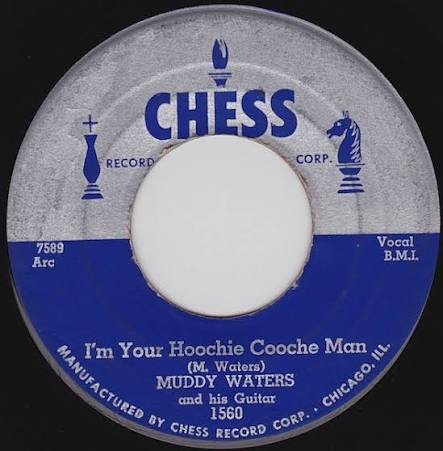
"I'm Your Hoochie Coochie Man" (originally titled "I'm Your Hoochie Cooche Man"), written by Willie Dixon and first recorded by Muddy Waters on January 7, 1954, for Chess Records, is a cornerstone of Chicago blues and a foundational influence on rock and roll. It peaked at No. 3 on the Billboard R&B chart (and No. 8 on the Best Seller chart), becoming Waters’ biggest commercial hit of the era, spending roughly three months on the charts and selling strongly (reports noted thousands of copies in a single week in some markets). The original appears on many compilations, including The Best of Muddy Waters (1958). It was inducted into the Blues Hall of Fame (1984), received a Grammy Hall of Fame Award (1998), was added to the National Recording Registry by the Library of Congress (2004), and appears on the Rock and Roll Hall of Fame’s “500 Songs That Shaped Rock and Roll” list and Rolling Stone’s “500 Greatest Songs of All Time.”
Recording Session and Producer
The session took place on January 7, 1954, at Chess Studios in Chicago. It was one of the first times Waters recorded with his full working band rather than the sparser setups common on earlier Chess (and Aristocrat) sides. Producer Leonard Chess oversaw the date (Phil Chess was also involved in the label’s operations). Two takes were cut; the master and alternate differ only slightly in timing (about six seconds on a nearly three-minute track) due to the band’s tightness, with occasional minor rushes or drags in the alternate.
The song had been developed in late 1953. After the success of Waters’ “Mad Love (I Want You to Love Me)” (also a Dixon song with related elements), Dixon pitched “Hoochie Coochie Man” to Leonard Chess, who told him that if Muddy liked it, he should give it to him. Dixon presented it to Waters at the Club Zanzibar (14th and Ashland on Chicago’s South Side) during an intermission—accounts place the discussion in the men’s room. Waters, already familiar with the themes and structures, learned it quickly enough to try it onstage that night or soon after; guitarist Jimmy Rogers recalled Dixon humming the tune, writing out lyrics, and the band gradually building the arrangement through live performance.
Musicians
The classic lineup, often described as a “who’s who” of Chicago blues, was:
- Muddy Waters (McKinley Morganfield) — lead vocals and electric guitar
- Jimmy Rogers — second guitar
- Little Walter (Marion Jacobs) — amplified harmonica (often noted for its saxophone-like tone and intensity)
- Otis Spann — piano
- Willie Dixon — upright (double) bass (his first appearance on a Waters session in this role)
- Elgin Evans (also known as Elga Edmonds) — drums (Fred Below, who replaced Evans later in 1954, is sometimes listed or credited in discographies; sources vary on the precise drummer for this exact date)
This was essentially Waters’ preferred working band of the early-to-mid-1950s. The full ensemble sound—electric guitars, amplified harmonica, piano, bass, and drums—marked a shift from Waters’ earlier, more Delta-rooted, sparsely accompanied sides toward the powerful urban Chicago blues that defined the decade.
Songwriters — Detailed Focus on Willie Dixon
The sole credited songwriter is Willie Dixon (William James Dixon, July 1, 1915 – January 29, 1992), born in Vicksburg, Mississippi. One of 14 children, he grew up hearing his mother (Daisy) recite her own religious poetry and rhyme everyday speech—habits he absorbed. He sang in a gospel quartet, moved to Chicago in 1936, briefly boxed (winning the Illinois Golden Gloves amateur heavyweight title), and turned seriously to music around 1939, mastering upright bass. He worked with groups including the Big Three Trio (1946–1952) before joining Chess Records full-time as house bassist, arranger, talent scout, producer, and staff songwriter.
Dixon became the “poet laureate” of postwar Chicago blues, writing or co-writing more than 500 songs. Key compositions include “Hoochie Coochie Man,” “I Just Want to Make Love to You,” and “I’m Ready” (for Waters); “Little Red Rooster,” “Back Door Man,” and “Spoonful” (for Howlin’ Wolf); “My Babe” (for Little Walter); and others recorded by Bo Diddley, Sonny Boy Williamson II, Koko Taylor, and many more. His songs fused Delta folk traditions, hoodoo imagery, sexual bravado, and urban swagger into concise, dramatic narratives that fit amplified band arrangements. He often drew from a communal pool of floating verses, toasts, children’s games, and folklore, refining them into personal property while creating archetypal characters (the powerful, virile, supernaturally aided man).
For “Hoochie Coochie Man,” Dixon tailored the material specifically to Waters’ persona and psychology after observing him in South Side clubs. He built on Waters’ earlier themes of fortune, sexuality, and hoodoo (e.g., “Gypsy Woman,” “Louisiana Blues”) but heightened the flamboyance, macho posturing, and supernatural sensationalism. Dixon later explained the mystic elements by noting longstanding human belief in astrology, fortune-telling, and related practices (comparing “hoochie coochie” or “hoodoo” folk to biblical wise men or “two-head” people). He sold many songs cheaply in the early years (sometimes for as little as $30); later he fought for better royalties, founding his own publishing company (Hoochie Coochie Music) and suing over unauthorized uses (including a settlement with Led Zeppelin involving related material).
Dixon’s approach was pragmatic and collaborative: he hummed ideas, wrote lyrics, and helped shape arrangements. The stop-time riff itself was developed with the band and echoed elements of “Mad Love.” His writing gave Waters (and others) complete, story-like songs rather than purely free-associative blues verses, with a strong refrain/hook that felt closer to pop structure while remaining deeply rooted in blues.
Musical Style and Analysis
The song is a classic of electric Chicago blues, expanding the standard 12-bar form into a 16-bar blues progression. The first four bars are doubled, so the harmony stays on the tonic (I) for eight bars (half the form). The second half follows the conventional last eight bars of a 12-bar blues (I–IV–V7 structure functioning as a refrain). It is in the key of A, at a moderate blues tempo of approximately 72 bpm, and notated in 12/8 time (or felt in a triplet/shuffle feel). There are three 16-bar sections.
Signature stop-time arrangement: During the first half of each progression, the full band plays a heavy, unhurried, repeating riff (Dixon described a five-note figure; sources note an eighth note + triplets + eighth, or similar descending/syncopated pattern, often with competing lines between guitar and harmonica) and then falls silent (or nearly silent) while Waters delivers a vocal line. This creates dramatic tension, call-and-response between voice and instruments, and a teasing, game-like effect with the audience. The riff is similar to that of “Mad Love” but extended and intensified. In the second half, the band shifts to a continuous shuffle groove with harmonica trills, guitar riffs, piano chords, thumping bass, and drums—a dense, powerful texture rarely heard in small combos before rock. Amplification is pushed toward distortion (especially Little Walter’s harmonica), a hallmark of Chicago blues and a direct precedent for rock.
Lyrics and themes: The narrative is chronological and boastful. Verse 1 reaches back before the narrator’s birth: a gypsy woman prophesies to his mother that a “boy child’s comin’, gonna be a son of a gun” who will make “pretty womens jump an’ shout.” Verse 2 is present-tense: the narrator lists hoodoo charms (“I got a black cat bone / I got a mojo too / I got John the Conqueror root”) that will “mess with you” and make women lead him by the hand. Verse 3 projects into the future with the lucky number seven (“On the seventh hour / On the seventh day / On the seventh month…”). The recurring refrain/chorus (“But you know I’m here / Everybody knows I’m here / Well you know I’m the hoochie coochie man…”) affirms identity and presence. “Hoochie coochie” draws from a late-19th-century sexually provocative dance (a precursor to striptease, associated with the 1893 Chicago World’s Fair), slang for sex/alcohol, and associations with hoodoo practitioners or sexually potent figures. The result is a self-mythologizing testament of virility, supernatural power, and sexual dominance, delivered with Waters’ deep, gravelly, half-conversational yet declamatory voice, using blue notes and natural bends.
The overall effect is swaggering, tense, and theatrical—bridging Delta acoustic traditions (hoodoo imagery, personal mythology) with urban electric power. Waters’ vocal delivery is authoritative and sexually charged without overstatement; the band’s stop-time silence frames his boasts like a spotlight.
 Buy from Amazon Hoochie Coochie Man
Other Versions
Waters himself recorded multiple studio and live versions over decades (including later re-recordings and performances into the 1970s–80s). Notable covers and adaptations include:
- Bo Diddley’s “I’m a Man” (1955), which recycled the main riff and similar vocal melody with new lyrics and became a major R&B hit (itself answered by Waters’ “Mannish Boy”).
- Early British blues/R&B versions by Alexis Korner’s Blues Incorporated, Manfred Mann, the Graham Bond Organisation (with Jack Bruce and Ginger Baker), and Long John Baldry (who named a band after the song).
- Jazz versions by Jimmy Smith (organ).
- Rock and blues-rock takes by Chuck Berry (live), Jimi Hendrix (BBC sessions and rehearsals), Steppenwolf, the Allman Brothers Band (Idlewild South, with Duane Allman’s slide), Motörhead, Eric Clapton (From the Cradle), Buddy Guy, B.B. King, the Shadows of Knight, and many others.
- Later or specialized versions by Etta James (as “Hoochie Coochie Gal”), Skip Easterling (jazz-funk-inflected), and various contemporary blues artists.
Jerry Leiber and Mike Stoller also adapted the riff for the Robins’ “Riot in Cell Block No. 9.”
Legacy
The song crystallized Muddy Waters’ image as the powerful, virile “Hoochie Coochie Man” and solidified Willie Dixon’s stature as Chess’s premier songwriter. Its stop-time riff entered the “lingua franca” of blues, R&B, jazz, and rock and roll, becoming one of the most recognizable musical phrases in the blues. It helped define the full-band electric Chicago sound that British Invasion groups (Rolling Stones, Animals, Yardbirds, etc.) absorbed and amplified into rock. Music historians describe it as a keystone linking Delta blues to rock & roll—a song that can sound pure blues in one context and pure rock in another while remaining essentially the same. Its influence appears in countless covers, samples, and stylistic borrowings; it remains a standard for blues and blues-rock performers. Beyond commercial success, it stands as a vivid document of mid-1950s Black urban culture, sexuality, folklore, and musical innovation at the precise moment electric blues was shaping the future of popular music.