
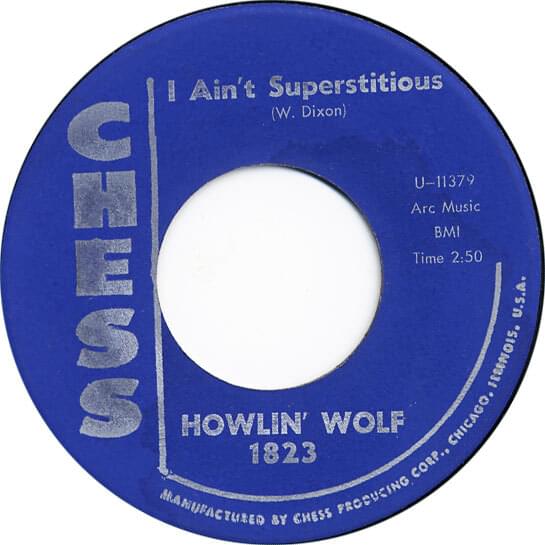
“I Ain’t Superstitious” is a Willie Dixon-penned Chicago blues classic first recorded by Howlin’ Wolf in late 1961. It ranks among the strongest examples of the Dixon–Wolf partnership and became a blues-rock standard through later covers.
Recording Session and Production
The song was recorded in December 1961 at Chess Studios in Chicago. It was cut during the same session that produced “You’ll Be Mine” and “Just Like I Treat You.” Producers were Leonard Chess, Phil Chess, and Willie Dixon (who also played bass and arranged).
Chess released it in late 1961 or early 1962 as the B-side of the single “Just Like I Treat You” (Chess 1823). It later appeared on compilations including the 1969 Chess album Evil and various Wolf retrospectives. Wolf re-recorded it for the 1971 album The London Howlin’ Wolf Sessions.
 Buy from Amazon Evil
Musicians
- Howlin’ Wolf (Chester Burnett): vocals
- Hubert Sumlin: guitar
- Jimmy Rogers: guitar
- Henry Gray: piano
- Willie Dixon: upright bass
- Sam Lay: drums
This is a classic Chess house-band lineup of the early 1960s, with Sumlin’s distinctive angular guitar work and Dixon’s propulsive bass forming the core. Some accounts note minor variations in secondary credits, but the above personnel is the most consistently documented.
Songwriters
Willie Dixon is the sole credited songwriter. Dixon was Chess Records’ house bassist, arranger, producer, and most important songwriter of the late 1950s and early 1960s. He specialized in crafting material that amplified an artist’s existing persona. For Howlin’ Wolf, Dixon wrote a string of defining songs—“Spoonful,” “Back Door Man,” “Wang Dang Doodle,” “Little Red Rooster,” “Evil,” and “I Ain’t Superstitious”—that cast Wolf as a larger-than-life, dangerous, and sometimes darkly humorous figure.
Dixon drew on longstanding African American folk beliefs and Southern superstitions for the lyrics. The song catalogs common omens: a black cat crossing one’s path, being swept with a broom (associated with bad luck or arrest), an itching right hand (money coming), a jumping left eye (someone must leave or die), and howling dogs (a sign of death). The narrator repeatedly insists “I ain’t superstitious” while clearly reacting to each sign, creating a witty, self-aware contradiction. Dixon himself explained the idea: people claim they are not superstitious, yet everyday observations (a rising dark cloud, for example) trigger superstitious responses. “Everybody’s superstitious of something one way or another.”
Earlier related songs existed—Washboard Sam’s 1938 “Suspicious Blues” and Jazz Gillum’s 1947 “The Blues What Am” used similar catalogs of omens—but Dixon reshaped the material into a tighter, more rhythmic, and personality-driven vehicle perfectly suited to Wolf’s voice and presence. Dixon’s genius lay in turning folk material into urban electric blues that felt both traditional and modern.
The song’s structure is distinctive. It is a mid-tempo stop-time blues that does not follow a conventional 12-bar progression throughout. The first two lines of each verse often stay on the tonic chord, with the harmonic change delayed until the third line. Frequent rhythmic breaks and a walking-bass pattern musically illustrate the narrator’s hesitation—stopping at the sight of an omen he claims not to believe in.
Musical Style and Analysis
“I Ain’t Superstitious” is a mid-tempo, stop-time blues with a loose, swaggering groove and a length of approximately 2:55. It is more aggressive and sophisticated than pure Delta blues—an urban Chicago cousin that absorbs elements of contemporary R&B, jazz, and pop while remaining firmly rooted in the blues.
The arrangement is driven by Willie Dixon’s walking bass and the dual guitars of Hubert Sumlin and Jimmy Rogers. Sumlin’s playing is characteristically angular and sparse—sharp single-note lines and sudden rhythmic suspensions rather than dense chordal accompaniment. Henry Gray’s piano provides rolling fills, and Sam Lay’s drums lock the stop-time accents. The frequent breaks create a sense of dramatic pause that mirrors the lyric’s theme of momentary doubt.
Wolf’s vocal performance is central. His enormous, gravelly voice delivers the denials of superstition with a mixture of bravado, sly humor, and underlying unease. He inhabits the character of a man who insists he is rational while clearly reacting to every traditional omen. The result is both comic and slightly ominous—classic Dixon writing filtered through Wolf’s monumental presence.
Lyrically the song is a catalog of folk beliefs turned into a personal statement:
- Black cat crossing the trail
- Being swept with a broom (risk of jail)
- Itching right hand (money coming)
- Jumping left eye (someone has to go)
- Howling dogs (sign of death)
The repeated insistence “I ain’t superstitious” while listing these signs creates the song’s ironic core. It is less a rejection of superstition than an acknowledgment of how deeply such beliefs are embedded in everyday life.
Other Versions and Covers
- Jeff Beck Group (1968, Truth, with Rod Stewart on vocals): The most famous cover. Beck’s inventive, wah-wah-drenched guitar work and the heavier blues-rock arrangement transformed the song into a classic-rock staple. It was ranked No. 86 on Rolling Stone’s list of the “100 Greatest Guitar Songs of All Time.”
- Howlin’ Wolf himself re-recorded it for The London Howlin’ Wolf Sessions (1971) with Eric Clapton, Steve Winwood, Bill Wyman, Charlie Watts, and others.
- Willie Dixon recorded his own version on the 1970 album I Am the Blues.
- Other notable covers include Savoy Brown, Megadeth (thrash-metal version on Peace Sells… but Who’s Buying?, 1986), Lonnie Brooks, Santana (with Jonny Lang), and various live performances by blues and rock artists.
 Buy from Amazon The London Howlin' Wolf Sessions
Legacy
“I Ain’t Superstitious” was inducted into the Blues Hall of Fame in 2017 as a “Classic of Blues Recording.” The induction statement called it “an ominous Willie Dixon composition” and noted the popularity of the Jeff Beck version with rock audiences.
The song exemplifies the peak of the Dixon–Wolf collaboration and the mature Chess Chicago blues sound of the early 1960s. Through the Jeff Beck Group’s cover, it reached a massive rock audience and helped introduce Wolf’s music (and Dixon’s songwriting) to a new generation. It remains a standard of both traditional blues and blues-rock repertoires, valued for its witty lyrics, distinctive stop-time arrangement, and the perfect match between Dixon’s writing and Wolf’s larger-than-life delivery. Alongside tracks such as “Spoonful” and “Back Door Man,” it stands as one of the essential documents of postwar electric blues.









