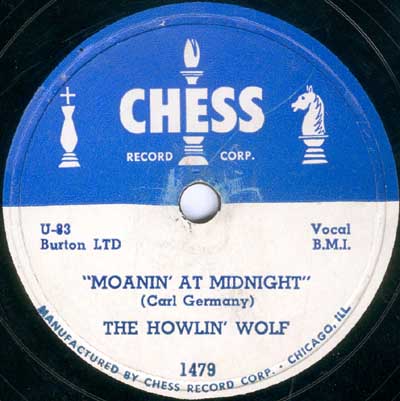
“Moanin’ at Midnight” is Howlin’ Wolf’s debut single for Chess Records, recorded in 1951, and one of the most atmospheric and foundational recordings of postwar electric blues. It introduced his extraordinary voice and presence to a national audience and helped define the raw, electrified Memphis-to-Chicago blues sound.
Recording Session and Production
The song was recorded in July 1951 (some sources cite May or a July/August window) at Sam Phillips’ Memphis Recording Service (706 Union Avenue, Memphis, Tennessee—the future Sun Studio). Phillips produced and engineered the session. He had not yet launched the Sun label and regularly leased masters to other companies; these sides were leased to Chess Records in Chicago.
Chess released it in August 1951 as the A-side of Chess 1479, paired with “How Many More Years” as the B-side. “Moanin’ at Midnight” reached No. 10 on the Billboard Most Played Juke Box R&B Records chart in November 1951. Although the B-side eventually became the bigger commercial hit (peaking at No. 4), “Moanin’ at Midnight” was the side that first announced Wolf’s arrival and remains the more atmospheric and distinctive of the two.
Phillips later described the track as “the most different record I ever heard.” He was deeply impressed by Wolf’s voice and presence, famously saying of Wolf’s sound that it was the place “where the soul of man never dies.” A parallel version (titled “Morning at Midnight”) was cut for the Bihari brothers’ RPM label around the same period at radio station KWEM in West Memphis, creating a short-lived conflict between Chess and Modern/RPM before Wolf settled exclusively with Chess.
Musicians
- Howlin’ Wolf (Chester Burnett): vocals and harmonica
- Willie Johnson: electric guitar
- Ike Turner: piano (widely credited; some early accounts note minor uncertainty)
- Willie Steele (or Steel): drums
The sparse instrumentation leaves maximum space for Wolf’s voice and harmonica. No bass is listed on the primary accounts; the guitar and piano supply the low-end weight. This was essentially Wolf’s West Memphis band of the period, with Ike Turner (then a young talent scout and pianist) having helped bring Wolf to Phillips after hearing him on local radio.
Songwriters
The song is credited to Chester Burnett (Howlin’ Wolf). On the original Chess single it was attributed to Carl Germany (a Chicago disc jockey and dance promoter), a common Chess practice of assigning credits as favors or payoffs. Later reissues correctly restored credit to Burnett. The RPM version was credited to Howlin’ Wolf.
Burnett drew on deep Delta blues traditions. He had absorbed the music of Charley Patton (his early mentor), Tommy Johnson (whose falsetto ululations and delicate style influenced the more lyrical side of Wolf’s approach), and the “blue yodel” of Jimmie Rodgers, which Wolf openly acknowledged as an influence on his howling. The song’s wordless moans, falsetto cries, and sense of nocturnal isolation grow directly from these sources, transformed by Wolf’s immense physical presence and electrified delivery.
Unlike later collaborations with Willie Dixon, this is pure early Wolf: personal, atmospheric, and rooted in the rural Southern blues he grew up with, rather than the more structured, persona-driven material Dixon would later supply. The lyrics are minimal and impressionistic—focused on a sense of lonely, restless presence in the night—allowing the vocal performance and sonic atmosphere to carry the emotional weight.
Musical Style and Analysis
“Moanin’ at Midnight” is a sparse, hypnotic, largely one-chord (or modal) blues that prioritizes atmosphere and vocal intensity over conventional 12-bar structure or harmonic movement. It opens with Wolf’s solitary, lonesome harmonica riff, immediately establishing a nocturnal, desolate mood. His voice then enters with guttural, almost animalistic moans and howls that feel less like conventional singing and more like an elemental force.
The arrangement is deliberately minimal. Willie Johnson’s electric guitar provides distorted, echoing answers and sparse riffs rather than dense chordal support. Ike Turner’s piano is present but understated, and Willie Steele’s drums keep a simple, steady pulse. The overall effect is of vast empty space—perfectly suited to the midnight setting of the title—through which Wolf’s voice and harmonica cut like a distant train whistle or a howl across open country.
Vocally, the performance is extraordinary. Wolf moves between deep, gravelly declarations, high falsetto ululations, and pure wordless moaning. The howl itself is the song’s signature: part blue yodel, part field holler, part pure visceral expression. Critics and listeners have long noted its eerie, almost supernatural quality—lonely, fierce, and otherworldly. Phillips’ production captures this with remarkable clarity for the era, allowing the voice to dominate while the instruments create a raw, slightly overloaded electric texture that foreshadows later blues and rock intensity.
Thematically, the song evokes isolation, restlessness, and a sense of being haunted or haunted by the night. There is little narrative detail; instead it creates a pure mood of midnight blues—someone out there in the dark, knocking, moaning, unable to rest. This atmospheric approach distinguishes it from more straightforward blues complaints and makes it one of the most distinctive opening statements in the history of recorded blues.
Buy the Album
 Buy from Amazon Moanin' at Midnight
Other Versions and Covers
Wolf recorded a near-contemporary alternate version for RPM as “Morning at Midnight.” Both the Chess and RPM versions later appeared on various compilations. The Chess original was included on Wolf’s 1959 debut album Moanin’ in the Moonlight, which took its title from the song and remains one of the essential early Chess blues LPs.
While it has not been covered as frequently as some later Wolf/Dixon songs, it has been performed and recorded by blues artists who value its atmospheric power. It remains a staple of Wolf retrospectives and is frequently cited in discussions of his early Memphis period. Live versions by Wolf himself preserved the song’s eerie intensity into later years.
Legacy
“Moanin’ at Midnight” is the record that first brought Howlin’ Wolf to national attention and established the template for his career: a massive, otherworldly voice married to raw electric instrumentation. Sam Phillips regarded it as one of the most unique recordings he ever made, and it stands alongside “How Many More Years” as the foundation of Wolf’s Chess catalog.
The track exemplifies the transition from acoustic Delta blues to amplified postwar electric blues. Its combination of rural howling traditions with electric guitar distortion and sparse, powerful production helped shape the Chicago blues sound that followed and strongly influenced the British blues revival of the 1960s. Artists from the Rolling Stones generation onward absorbed its intensity, even if they more often covered later, more structured Wolf material.
It remains a landmark of early 1950s blues recording—proof that atmosphere, vocal power, and sonic personality could be as compelling as formal songcraft. Alongside its flip side, it forms one of the greatest debut singles in American music history and continues to stand as pure, undiluted Howlin’ Wolf: lonely, fierce, and unforgettable.