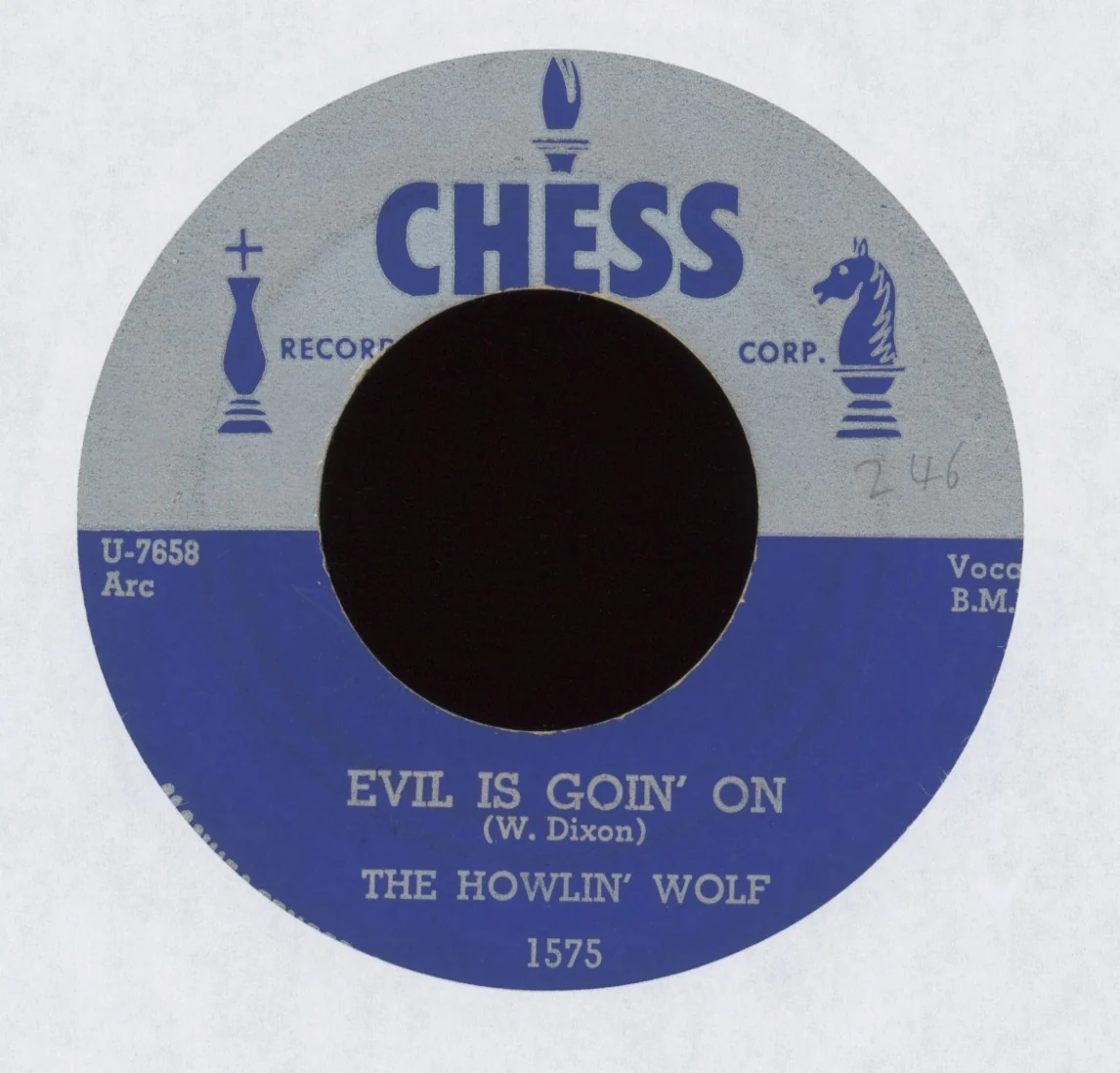
“Evil” (also known as “Evil Is Goin’ On” or “Evil (Is Going On)”) is a classic Chicago blues song written by Willie Dixon and first recorded by Howlin’ Wolf in 1954. It stands as one of the earliest and most successful examples of the Dixon–Wolf collaboration and helped define Wolf’s menacing, warning-laden persona.
Recording Session and Production
Howlin’ Wolf recorded the song on May 25, 1954, at Chess Studios in Chicago. It was released later that year as the A-side of Chess 1575, with “Baby How Long” as the B-side. Producers were Leonard Chess, Phil Chess, and Willie Dixon (who also played bass and arranged). The track later appeared on the 1959 compilation Moanin’ in the Moonlight.
Wolf re-recorded a psychedelic-tinged version for the 1969 album The Howlin’ Wolf Album (sometimes called This Is Howlin’ Wolf’s New Album). That remake was issued as a single and became Wolf’s last charting release, reaching No. 43 on the Billboard R&B chart.
Musicians
- Howlin’ Wolf (Chester Burnett): vocals and harmonica
- Hubert Sumlin: guitar
- Jody Williams: guitar
- Otis Spann: piano
- Willie Dixon: double bass
- Earl Phillips: drums
This was an early Chess house-band configuration. Sumlin (still relatively new to the band) and Jody Williams provided the dual-guitar attack, while Spann’s piano and Dixon’s bass anchored the groove. Wolf’s intermittent harmonica adds atmosphere.
Songwriters
Willie Dixon is the sole credited songwriter. Dixon was Chess Records’ house bassist, arranger, producer, and most prolific songwriter. He specialized in writing material tailored to specific artists’ strengths and public images. For Howlin’ Wolf, Dixon crafted songs that amplified the singer’s larger-than-life, dangerous, and almost supernatural presence—“Evil,” “Spoonful,” “Back Door Man,” “Wang Dang Doodle,” “Little Red Rooster,” and “I Ain’t Superstitious” are prime examples.
“Evil” was one of Dixon’s earliest major successes with Wolf (recorded just after Wolf’s permanent move to Chicago). Dixon later explained that the song suited Wolf’s voice perfectly: “This song worked for Howlin’ Wolf because of his type of voice and the way he pronounced words. There’s a particular song for every voice. You just have to get out of the voice what’s in it.” Dixon cast Wolf in the role of a knowing conjurer or preacher who issues a stark warning rather than a simple complaint.
The lyrics warn a man who is away from home that “evil is goin’ on.” Signs of trouble include sleeplessness, a slow answer on the telephone, and the need to rush back (even if it means hopping a freight train—“grab the first thing smokin’ / if you have to hobo”). The advice is practical and ominous: knock on the front door, then run around to the back to catch the interloper before he escapes. The song never spells out what should happen next, leaving the implication of violence hanging in the air. The repeated refrain—“That’s evil, evil is goin’ on / I am warnin’ ya, brother, you better watch your happy home”—functions like a sermon or a hoodoo warning.
Dixon drew on longstanding blues themes of infidelity, jealousy, and domestic danger, but sharpened them into a concise, dramatic narrative that played perfectly to Wolf’s imposing delivery. The song helped establish the Dixon–Wolf partnership that would dominate Wolf’s recordings for much of the next decade.
Musical Style and Analysis
“Evil” is a mid-tempo twelve-bar blues lasting about 2:55. It features a syncopated backbeat, intermittent stop-time accents, and a stuttering rhythmic feel that Dixon tailored to his bass playing. The arrangement is relatively sparse yet highly effective: dual guitars (Sumlin and Williams) provide angular riffs and fills, Otis Spann contributes upper-register piano figures and rolling fills, Dixon’s bass drives the groove, and Earl Phillips keeps a solid, slightly behind-the-beat pulse. Wolf interjects harmonica phrases and delivers a coarse, emotionally charged vocal that frequently rises into falsetto for dramatic emphasis.
The performance is tense and controlled rather than purely aggressive. Wolf’s strained, gravelly voice conveys both authority and urgency—he is not merely complaining about possible infidelity; he is issuing a prophetic warning. The music mirrors this: the syncopated rhythm and brief instrumental breaks create a sense of unease and impending confrontation. Spann’s piano often takes a prominent soloistic role, sometimes overshadowing the guitars, while the overall texture remains lean and focused on the vocal.
Lyrically the song is a classic blues cautionary tale. Key images include:
- Being far from home and unable to sleep
- Calling home and receiving a slow or suspicious answer
- Rushing back by any means necessary
- Catching the rival “just before he go”
The refrain’s insistence on “evil” elevates ordinary domestic betrayal into something almost supernatural, fitting Wolf’s larger-than-life image. The result is both humorous in its blunt practicality and genuinely menacing.
Buy the Album on Amazon
 Buy from Amazon Moanin' in the Moonlight
Other Versions and Covers
Wolf himself re-recorded the song in a more experimental, psychedelic style for The Howlin’ Wolf Album (1969). Notable covers include:
- Captain Beefheart (live, mid-1960s)
- Canned Heat (1967)
- Derek and the Dominos (1971, with Eric Clapton)
- Cactus (extended live versions, early 1970s)
- Luther Allison
- Gary Moore
- Faces (early rehearsal version)
- Koko Taylor
- Monster Magnet
- Clutch
- The Dead Daisies
- Tom Jones
- Mick Jagger with the Red Devils
The song remains a popular choice for blues and blues-rock bands seeking a dark, mid-tempo vehicle.
Legacy
“Evil” marked an important early success for the Dixon–Wolf partnership and helped solidify Wolf’s image as a bluesman who could deliver both raw power and sly, warning-laden storytelling. It has become a Chicago blues standard and a frequent cover choice for artists exploring the darker, more ominous side of the genre.
The 1969 remake gave Wolf a late-career chart entry, and the original remains a staple of essential Chess and Howlin’ Wolf compilations. Its combination of Dixon’s sharp songwriting, Wolf’s commanding vocal, and a taut Chess-house arrangement continues to influence blues and rock musicians. Along with tracks such as “Smokestack Lightning” and “Forty-Four,” it stands as a cornerstone of Wolf’s mid-1950s output and a defining statement of postwar electric blues.