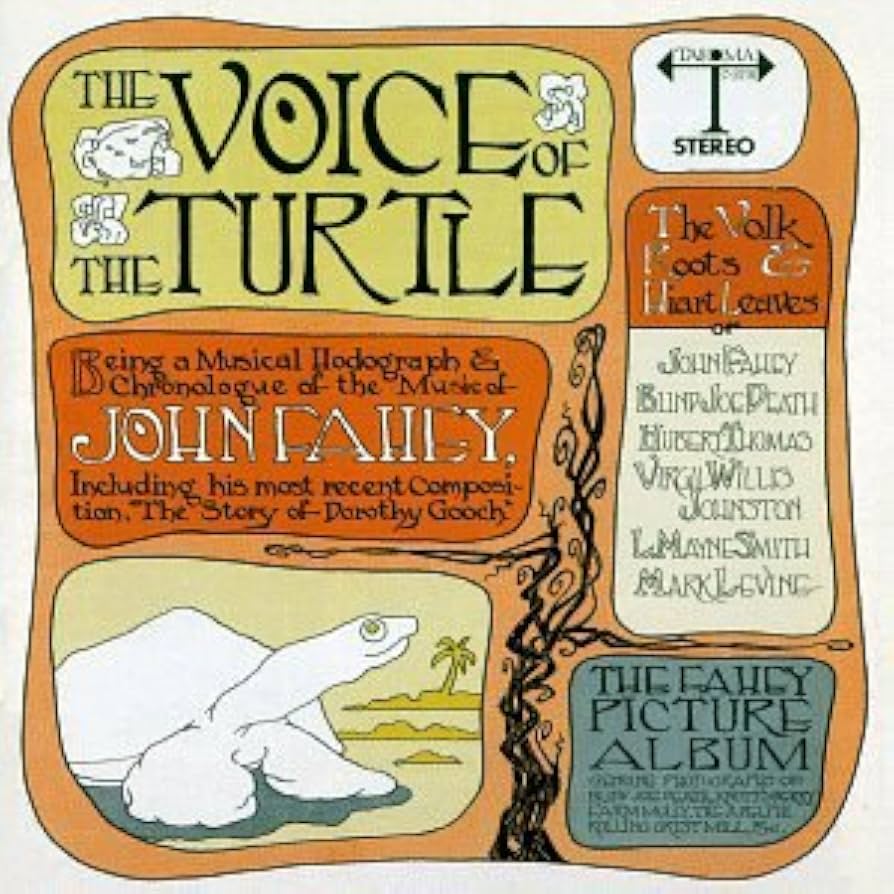
The Voice of the Turtle is a landmark album by John Fahey (February 28, 1939 – February 22, 2001), released on Takoma Records (catalog C-1031) in 1968. A double LP composed entirely of Fahey's solo acoustic guitar performances, it is one of the defining statements of the style that came to be known as American Primitive Guitar—a genre Fahey essentially invented, in which the techniques and sensibilities of pre-war country blues, ragtime, hymnody, and vernacular American music were fused with the extended formal ambitions of modern composition.
The album is frequently cited as one of the first double albums ever devoted to a single solo acoustic guitarist, an audacious format for an instrumental folk record in 1968, when double albums were the province of rock epics and jazz Gesamtkunstwerke. Its seven pieces—several of them extended, suite-like compositions—represent Fahey at a peak of creative ambition, and the album is widely regarded as one of the essential documents of his first, greatest creative period.
The title derives from the Song of Solomon (2:12): "The flowers appear on the earth; the time of the singing of birds is come, and the voice of the turtle is heard in our land." The "turtle" of the scripture is, of course, the turtledove—but for Fahey, whose lifelong engagement with scripture, mythology, and American vernacular religion infused his entire body of work, the phrase carried layers of apocalyptic and redemptive suggestion. It is a fitting title for an album that treats the acoustic guitar not as a folk instrument but as a medium for visionary architecture.
Background and Context
John Fahey and the Invention of American Primitive Guitar
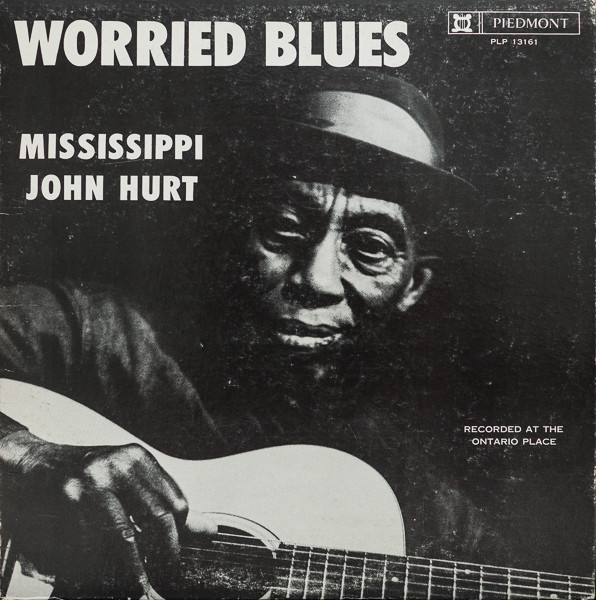
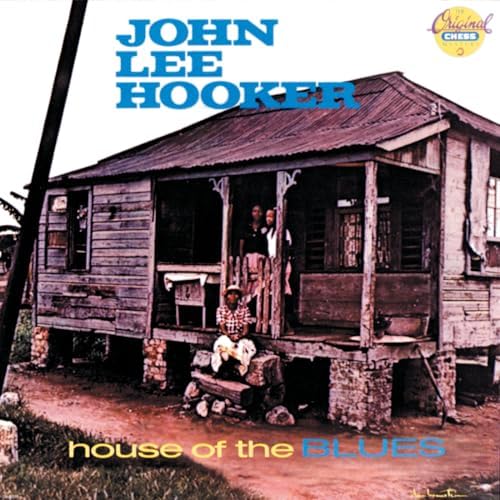
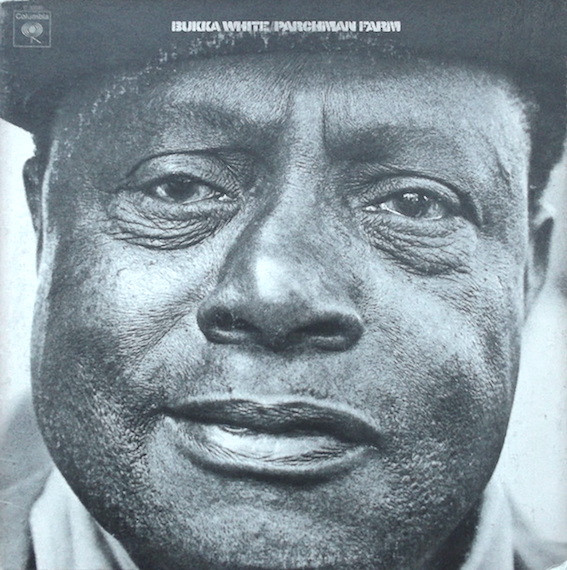
John Fahey was born in Washington, D.C., and raised in nearby Takoma Park, Maryland—the suburb whose name he would later give to his record label. As a teenager in the late 1950s, he became obsessed with pre-war Delta blues, hunting for rare 78s by Charley Patton, Robert Johnson, and Bukka White. This obsession led him both to scholarship and to creation: he would eventually write a master's thesis on Charley Patton at UCLA (later published as the book Charley Patton), and he would personally track down and record Bukka White in 1963.
But Fahey was never a revivalist. From the beginning, his goal was not to reproduce old blues but to build something new from its materials. In 1959, he recorded his first album, Blind Joe Death, credited to a fictional bluesman he had invented—the first of many elaborate jokes, hoaxes, and mythologies that ran through his career. With his friend Ed Denson, he founded Takoma Records (named for Takoma Park) to release it, making Takoma one of the earliest truly independent, artist-run record labels in American music.
Over the following decade, Fahey developed and refined his style across a series of albums—Death Chants, Breakdowns and Military Waltzes (1963), Dance of Death & Other Plantation Favorites (1964), The Transfiguration of Blind Joe Death (1965), The Great San Bernardino Birthday Party (recorded earlier, released 1966), Days Have Gone By (1967), and the experimental Requia (1967/68). His music absorbed not only blues and ragtime but also the hymns and shape-note harmonies of his Southern-explorer mythology, Indian classical music, Brazilian and Hawaiian guitar traditions, and—crucially—the compositional techniques of twentieth-century modernists, above all Charles Ives, whose technique of colliding vernacular materials in layered, dissolving textures Fahey consciously adapted to the solo guitar.
By 1968, Fahey was regarded in folk, underground, and nascent rock-critic circles as one of the most original musicians in America, and Takoma was growing into a significant independent label (it would soon sign Leo Kottke, whose 1969 Takoma debut became the label's biggest success).
The Double Album Statement
The double LP in 1968 was a loaded format. It was the medium of Blonde on Blonde, Freak Out!, and the major statements of the psychedelic era. For a solo acoustic guitarist on an independent label to occupy two full LPs was an act of supreme confidence— tempered, as always with Fahey, by irony. The generous spacing of the album across four sides, the mock-grandiose packaging conventions it evokes, and the absurd magnificence of its track titles all carry a sly, subversive humor that is inseparable from the music's seriousness. Fahey was simultaneously making a masterpiece and mocking the very idea of masterpieces—a duality that defines his best work.
The Sessions
Recording Details
- Recorded: 1967–1968, in California
- Released: 1968, Takoma Records (C-1031, double LP)
- Format: Solo acoustic guitar throughout
Precise session documentation for The Voice of the Turtle is sparse—typical of Takoma's informal, low-overhead approach in the 1960s—and the recordings appear to have been made across a period rather than in a single discrete block of sessions. Many of the pieces had been developed and performed live over several years of touring, and the album versions capture them in fully matured form. As with much of Fahey's Takoma-era catalog, discographical details (exact dates, studios, engineers) vary across sources and reissues.
Production
The album is credited to John Fahey as producer, working within the label he co-founded and controlled. Ed Denson, Fahey's partner in Takoma, oversaw the label's operations during this period. The production aesthetic is a continuation of the approach Fahey had refined across his Takoma catalog: an unadorned, close-mic'd documentation of a single guitar in a room, with minimal processing and no overdubs. Fahey understood that the power of his music lay in its architecture—the layering of bass, melody, and improvised ornament within a single pair of hands—and the recordings present that architecture with clarity and presence rather than studio gloss.
The original LP featured liner notes in the sardonic, mock-scholarly mode Fahey had made his trademark—writings that simultaneously celebrated and parodied the folk revival's obsession with authenticity, biography, and provenance. This textual gamesmanship is essential context for the album: Fahey's mythmaking (the fictional Blind Joe Death, the invented biographies, the absurdist titles) was itself an artistic statement about the constructed nature of "authenticity" in American roots music.
Musicians
- John Fahey – steel-string acoustic guitar (all tracks; all instruments)
There are no other musicians. Every sound on the album comes from a single guitar and a single player—a fact that makes the album's scale and density all the more remarkable. Fahey's technique—typically an alternating-thumb bass foundation in the manner of Delta and Piedmont blues, with free fingers carrying melody, countermelody, and improvised variation, often in open tunings—creates the impression of multiple instruments and multiple musical voices in dialogue.
Musical Style
Several threads converge in the music of The Voice of the Turtle:
-
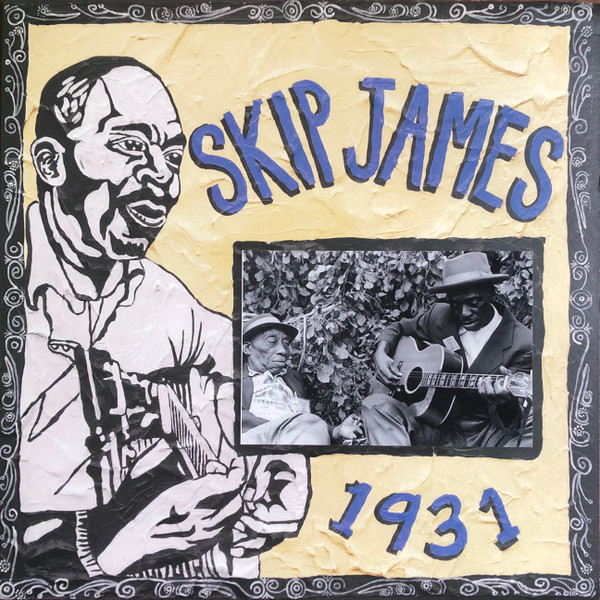
Blues-derived technique: The alternating bass figures, slides, and phrasing of Charley Patton, Skip James, and Bukka White remain the bedrock of Fahey's playing, even when the music departs far from blues form.
-
Ivesian collage: Like Charles Ives, Fahey juxtaposes vernacular materials—hymn fragments, popular song ghosts, blues cells—in forms that unfold episodically, gathering and dissolving rather than developing in the classical sense.
-
Extended forms: The album's major pieces are through-composed or semi-improvised suites lasting five to eight minutes—an eternity by folk standards, natural by the standards of Fahey's ambitions.
-
Vernacular eclecticism: Hawaiian music, Indian modality, hymnody, ragtime, and country dance material all surface within the music's fabric, unified by Fahey's personal harmonic and rhythmic language.
-
Deadpan grandeur and humor: The titles, the pacing, and the music itself balance solemnity with absurdity—a combination Fahey learned equally from surrealist art and from American vernacular comedy.
Track-by-Track Breakdown
As with many independently produced albums of the era, track listings, titles, and sequencing have varied slightly across original pressings and later reissues; some editions include additional material. The breakdown below follows the core seven-piece program of the original Takoma double LP.
1. "Tell Her to Come Back Home"
Songwriter: John Fahey
Details: The album opens with one of Fahey's most driving, direct compositions. "Tell Her to Come Back Home" is built on a propulsive, rolling ostinato—a repeating figure that cycles with the inevitability of a train or a river—over which Fahey layers melodic variations that grow steadily more ornate. The piece has the vernacular directness of his earliest work, but its internal development is more sophisticated: episodes accumulate, textures thicken, and the music keeps circling back to its central figure with the hypnotic persistence of Delta blues.
The title, like so many of Fahey's, sounds lifted from some half-remembered vernacular song—a phrase that evokes heartbreak homespun and folk narrative. Whether it quotes an actual traditional lyric or is Fahey's own invention remains part of the album's play of concealment and disclosure. As an opening statement, the piece announces the album's essential identity: music that sounds "old" and anonymous while being neither.
2. "The Waltz That Carried Us Away and Then a Mosquito Came and Ate Up My Sweetheart"
Songwriter: John Fahey
Details: The album's centerpiece and one of the most celebrated individual pieces in Fahey's entire catalog. The title is pure Fahey—a headlong cascade of romantic melodrama, catastrophe, and insectoid absurdity that promises a narrative the music both delivers and withholds. It is the kind of title that could only exist in the meeting point of American vernacular song, surrealist art, and a very particular strain of deadpan humor.
The music itself is a suite in all but name. True to its title, it begins in waltz time—a lilting, old-fashioned triple-meter melody with the faded elegance of a parlor reminiscence—but the piece refuses to stay in any single world. The waltz figure is gradually transformed, section by section, as Fahey introduces new material, shifts textures and registers, and allows the music to dissolve and reconstitute itself. Moments of blues-derived intensity, modal drift, and hymn-like calm follow one another in an Ivesian stream of memory and association.
The composition demonstrates Fahey's central achievement: the treatment of the solo steel-string guitar as a one-instrument orchestra capable of sustained, large-scale musical argument. Listeners and critics have long cited this piece as the summit of the album and among the finest recordings Fahey ever made—a work in which technique, form, humor, and emotional depth are perfectly fused.
3. "Song"
Songwriter: John Fahey
Details: After the extravagance of the "Waltz," Fahey offers a piece with the plainest title imaginable: "Song." The understatement is itself a statement—following the longest and most elaborate title in his catalog with a single common noun is a deadpan joke, but the music is among the album's most intimate and lyrical.
"Song" is a compact, melody-forward piece in which Fahey foregrounds the singing quality of the guitar. Where the album's major works are architectural, this is a quiet lyric poem: a gently harmonized tune elaborated with subtle variations, its phrases shaped to breathe like a voice. There are hymn-like qualities in its harmonic motion, and its unassuming character provides essential contrast within the album's sequencing—evidence that Fahey's artistry lay not only in extended construction but in knowing exactly when to be simple.
4. "Steamboat Gwine 'Round De Bend"
Songwriter: Traditional material / arranged and composed by John Fahey (presented on the original LP as a medley of several traditional pieces)
Details: The album's great vernacular collage. The title—rendered in a deliberately stylized "plantation schoolbook" dialect—evokes the Mississippi steamboat tradition that runs through Mark Twain, Delta blues, and the entire mythology of the great river, and it is fitting that this piece is where Fahey most explicitly invokes his role as both scholar and mythmaker of the Delta tradition.
The piece is structured as a medley (the original LP identifies it as a medley of multiple songs): a sequence of traditional and vernacular materials—folk and train-song fragments, blues figures, and hymn-like passages—woven into a continuous stream. Like Ives threading "London Bridge" and revival hymns through his orchestral music, Fahey lets familiar American materials surface, collide, and sink back into the flow, treating them less as fixed quotations than as objects carried along by the river of the music.
The arrangement showcases the scholarly side of Fahey's artistry: his encyclopedic command of pre-war vernacular repertoire, absorbed through years of collecting and study, deployed with full compositional control. It is both a tribute to the tradition and a statement that the tradition's materials belong to anyone who can transform them—and that Fahey could transform them as thoroughly as any musician of his generation.
5. "Red Pony"
Songwriter: John Fahey
Details: One of Fahey's most famous and frequently anthologized compositions, named for John Steinbeck's novella The Red Pony (1933)—the bitter-sweet coming-of-age story of a boy and his horse in the Salinas Valley. Fahey was a lifelong reader with a particular attachment to American literature, and the literary allusion is characteristic: Steinbeck's mixture of tenderness, violence, and fatalism is a fitting emotional analogue for Fahey's music.
Musically, "Red Pony" is a fully realized Fahey composition: a memorable, gently modal theme carried over a steady bass foundation, developed with a patience and economy that give the piece its haunting quality. Its melody has the plaintive, wide-open character of American landscape music—evoking, like Steinbeck's novella, the spaces and silences of the rural West as much as the Delta South. Over the years the piece has become one of the signature works of the American Primitive repertoire, studied and covered by generations of fingerstyle guitarists.
6. "On the Beach at Waikiki"
Songwriter: Henry Kailimai (published 1915; English lyrics by G. H. Stover), arranged by John Fahey
Details: The album's one explicit foray into outside repertoire—and a revelation of a side of Fahey that casual listeners sometimes overlook: his deep, lifelong love of Hawaiian music. "On the Beach at Waikiki" is one of the most famous Hawaiian compositions of the early twentieth century, written by Henry Kailimai and published in 1915, at the height of the Hawaiian music craze that swept the American mainland and introduced the steel guitar to the world.
Fahey's arrangement is a solo steel-string homage to the Hawaiian tradition—one of the crucial tributaries of American guitar music, and one with a direct historical connection to the blues (the slide-guitar techniques that shaped Delta blues were themselves partly rooted in Hawaiian steel guitar). His rendition captures the song's lilting, nostalgic melody with a lightness and playfulness that show a different rhythmic character from his blues-based material, while his steel-string phrasing nods to the sliding, singing quality of the Hawaiian style.
Within the album's architecture, the track functions as a bright, sunlit interlude—geographically the farthest point from the Mississippi imagery of "Steamboat Gwine 'Round De Bend," yet connected to it by the shared history of the American guitar.
7. "Marilyn"
Songwriter: John Fahey
Details: The album closes with "Marilyn," an elegiac, slow-moving piece whose title has been widely understood as an allusion to Marilyn Monroe, who had died in 1962 and whose image haunted American popular culture throughout the decade. Whether Fahey intended the reference (in keeping with his practice, he never explained himself plainly) or simply chose a resonant American name, the music carries an unmistakable quality of mourning and farewell.
The composition is one of the album's most beautiful: a spare, contemplative melody given room to breathe, its phrases dissolving into silence and returning like waves. As a closer, it transforms the album's grandeur into stillness—a valedictory piece that sends the listener out of the album's world with a sense of unresolved, aching beauty.
Buy The Album
Significance and Legacy
The Peak of the Takoma Era
The Voice of the Turtle is widely regarded as the summit of Fahey's first creative period (1959–1968). The albums that followed—The Yellow Princess (1969) and others—contain masterpieces of their own, but the Turtle double album represents the fullest realization of Fahey's founding vision: the transformation of vernacular American guitar music into large-scale, personally mythologized art. Its combination of extended formal ambition, encyclopedic vernacular reference, and deadpan self-mythology defines the mature American Primitive style.
A Milestone in the Format of Instrumental Music
The album is often cited as the first double album devoted to a solo acoustic guitarist—a milestone in itself. Its very existence expanded the perceived scope of what a solo instrumentalist could do on record, paving the way for the long-form solo guitar records of Leo Kottke, Robbie Basho, Peter Lang, and the entire school of players that Takoma and Fahey inspired.
The American Primitive Lineage
Fahey's influence radiates through American music along several distinct lines:
-
The Takoma school: Leo Kottke, Robbie Basho, and Peter Lang formed the core of the label's roster, and the interplay between Fahey's work and theirs in 1968–1971 created the template for virtuoso acoustic guitar records in America.
-
The avant-garde: Fahey's Ivesian collage method and his conceptualism (hoaxes, fake liner notes, absurdist titling) made him a patron saint of experimental musicians. Glenn Jones (of Cul de Sac, who collaborated with Fahey on The Epiphany of Glenn Jones, 1995), Jim O'Rourke, and the reissue culture that revived Fahey's career in the 1990s (Table of the Elements, Drag City, Revenant—the label Fahey co-founded) all trace directly to him.
-
The acoustic renaissance: Players including Jack Rose, Bill Orcutt, Steve Gunn, William Tyler, and Daniel Bachman are direct heirs of the American Primitive tradition Fahey founded; The Voice of the Turtle is canonical listening within that lineage.
-
Rock and pop: Kurt Cobain cited Fahey among his influences; Fahey's recordings circulated through the record collections of the Seattle scene and beyond, and his influence is detectable in the unplugged, folk-inflected currents of 1990s alternative music.
The Art of the Title
The album's track titles—"The Waltz That Carried Us Away and Then a Mosquito Came and Ate Up My Sweetheart" above all—became part of Fahey's legend and established a naming tradition within experimental and indie music: titles as found poetry, as jokes, as miniature narratives. The title-as-artwork is now a recognized feature of the musical landscape Fahey helped create.
Scholarship and Reissue
The album has been kept continuously in print through Takoma's later catalog successors (Fantasy and its successors acquired the Takoma catalog and reissued Fahey's 1960s work on CD), and it appears consistently in critical rankings of the greatest guitar records and the essential documents of American experimental music. Alongside The Transfiguration of Blind Joe Death and The Yellow Princess, it forms the core of Fahey's reputation among critics and collectors.
Conclusion
The Voice of the Turtle is the work in which John Fahey's artistry achieved its fullest early expression: the Delta blues tradition expanded into cathedral spaces, American vernacular song set adrift on Ivesian currents, and all of it narrated by a title and a persona that insisted, with a perfectly straight face, that this was folklore. It is at once a virtuoso guitar record, a work of musical scholarship, a joke, a hymn, and a myth.
That it accomplishes all of this with a single guitar and a single player is the final measure of its achievement. For listeners coming to Fahey for the first time, it is one of the essential starting points; for those who know his work, it remains the standard by which his entire catalog—and the entire American Primitive tradition that follows from it—is measured.
Album Details Summary:
- Artist: John Fahey
- Album: The Voice of the Turtle
- Label: Takoma Records (C-1031)
- Recorded: 1967–1968, California
- Released: 1968
- Producer: John Fahey (with Ed Denson overseeing the Takoma label)
- Format: Double LP; solo acoustic guitar throughout
- Personnel: John Fahey (steel-string acoustic guitar)
- Genre: American Primitive guitar, folk, blues, avant-garde acoustic music