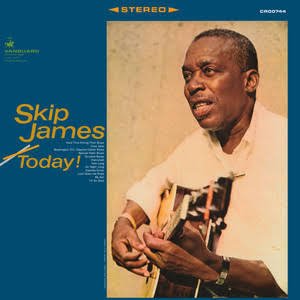
Released in 1966 on Vanguard Records (catalog no. VSD 79219), Today! is the third studio album by Delta blues master Nehemiah "Skip" James and his first for the Vanguard label. Recorded in January 1966, barely a year after his sensational rediscovery at the 1964 Newport Folk Festival, the album captures James at a pivotal moment—revisiting the songs that had made him a legend in 1931 while introducing new compositions that reflected his recent experiences. It has been hailed as one of the finest albums to emerge from the 1960s blues revival, with AllMusic declaring that "Skip James might have made the best music of anyone who resurfaced during the mid-'60s 'rediscovery' era."
Recording Sessions & Production
The album was recorded on January 9 and 10, 1966, at Vanguard Records' West 23rd Street Studios in New York City.
Maynard and Seymour Solomon produced the album. The Solomon brothers were the founders of Vanguard, and their classical-music background lent the label's folk and blues recordings an unusual sonic transparency. As one reviewer noted, "The Solomon Brothers Maynard and Seymour were always sound-conscious and most Vanguard records, regardless of musical genre, sounded transparent, three dimensional and involving."
The recording is notably free of tape hiss, with a silky, liquid string sound that places James's voice and guitar in a three-dimensional space.
The sessions were an intimate affair. James performed mostly solo on acoustic guitar, with only two exceptions: two tracks feature him on piano, and one track includes upright bass accompaniment.
Russ Savakus, Vanguard's "go-to" bassist, appears on "How Long"—the only track with additional musicians.
The album cover photograph was taken by David Gahr at the 1964 Newport Folk Festival, capturing James in the moment of his rediscovery.
The Musician
-
Skip James — Vocals, acoustic guitar, piano
James played primarily in his signature open D-minor tuning (D–A–D–F–A–D), which he had learned from his mentor Henry "Son" Stuckey and which gave his music its haunting, church-like quality.
His fingerpicking style was fast, clean, and classically informed, using the entire register of the guitar with heavy, hypnotic bass lines.
His voice—an eerie, almost ghostly falsetto—had deepened with age and illness (he had recently undergone surgery for a tumorous growth), giving it an even more otherworldly quality than his 1931 recordings.
On the two piano tracks, James employed a barrelhouse, boogie-influenced style that reflected his early experiences playing in Mississippi barrelhouses and his exposure to Little Brother Montgomery.
Track-by-Track Breakdown
Side One
1. "Hard Time Killing Floor Blues" (3:24)
Songwriter: Skip James
Musicians: Skip James (vocals, guitar)
The album opens with one of James's most celebrated compositions, originally recorded for Paramount in 1931. The 1966 version is more measured and reflective than the 1931 original, with James's falsetto conveying a deep sense of sorrow.
The lyric—"People are drifting from door to door / But they can't find no heaven, I don't care where they go"—captures the desperation of the Depression era with an immediacy that transcends time. James's guitar establishes the open D-minor drone that permeates the album, while his vocal soars above it in an almost liturgical cry. The track sets the template for the entire record: stark, unadorned, and emotionally devastating.
Songwriter: Skip James
Musicians: Skip James (vocals, guitar)
The album opens with one of James's most celebrated compositions, originally recorded for Paramount in 1931. The 1966 version is more measured and reflective than the 1931 original, with James's falsetto conveying a deep sense of sorrow.
2. "Crow Jane" (3:00)
Songwriter: Skip James
Musicians: Skip James (vocals, guitar)
A sardonic, mid-tempo blues with an upbeat tempo that belies the darkness of the lyric.
The song addresses "the contrariest woman I ever did know"—Crow Jane, who holds her head high but is destined to die and lay down like everyone else.
James makes the song his own through his distinctive phrasing and the interplay between his voice and guitar, which creates a compelling dynamic.
Songwriter: Skip James
Musicians: Skip James (vocals, guitar)
A sardonic, mid-tempo blues with an upbeat tempo that belies the darkness of the lyric.
3. "Washington D.C. Hospital Center Blues" (4:12)
Songwriter: Skip James
Musicians: Skip James (vocals, guitar)
One of the few newly composed songs on the album, written about James's experiences receiving treatment at a Washington, D.C. hospital shortly after his rediscovery.
The lyric is remarkably direct and autobiographical: "I didn't go hungry, I had plenty to eat / I had good treatment and a place to sleep / Because I was a good man / They knew I was a poor man / They could understand."
The track demonstrates James's ability to transform personal experience into universal art, his guitar providing a mournful counterpoint to the matter-of-fact vocal.
Songwriter: Skip James
Musicians: Skip James (vocals, guitar)
One of the few newly composed songs on the album, written about James's experiences receiving treatment at a Washington, D.C. hospital shortly after his rediscovery.
4. "Special Rider Blues" (5:11)
Songwriter: Skip James
Musicians: Skip James (vocals, guitar)
At over five minutes, this is the longest track on Side One and one of James's most haunting compositions. Originally recorded in 1931, the song features a descending melodic figure and a lyric of profound alienation. The 1966 version is more delicate than the original, with James taking his time, letting each phrase breathe. The "special rider" of the title refers to a railroad pass or, metaphorically, to a lost love who has moved on. James's guitar work is particularly intricate here, with his thumb generating a relentless bass drone while his fingers dance across the higher strings.
5. "Drunken Spree" (2:49)
Songwriter: Skip James (adapted from Rich Griffith)
Musicians: Skip James (vocals, guitar)
A song James picked up from Rich Griffith, one of the men who taught him guitar as a youth in Bentonia.
James recalled first hearing the song as a child, when Henry Stuckey and Rich Griffith were "rappin' out Drunken Spree behind a man with a fiddle" at a country juke joint.
The track is a blues of dissolution and regret, but with a blues presence that is "not as repetitive as many typical blues lyrics are."
Songwriter: Skip James (adapted from Rich Griffith)
Musicians: Skip James (vocals, guitar)
A song James picked up from Rich Griffith, one of the men who taught him guitar as a youth in Bentonia.
6. "Cherryball" (4:28)
Songwriter: Skip James
Musicians: Skip James (vocals, guitar)
Also known as "Cherry Ball Blues," this track finds James in a more lyrical, introspective mood. One reviewer noted that on this song, "Skip sounds like he's singing personally in a whisper to himself late at night & not wanting to disturb the rest of the house."
The guitar work is delicate and atmospheric, with James employing his open D-minor tuning to create a mood of nocturnal intimacy. The song was a highlight of his 1966 Newport Folk Festival performance, where he played it seated between Son House and Bukka White.
Songwriter: Skip James
Musicians: Skip James (vocals, guitar)
Also known as "Cherry Ball Blues," this track finds James in a more lyrical, introspective mood. One reviewer noted that on this song, "Skip sounds like he's singing personally in a whisper to himself late at night & not wanting to disturb the rest of the house."
Side Two
7. "How Long" (2:58)
Songwriter: Leroy Carr
Musicians: Skip James (vocals, piano), Russ Savakus (upright bass)
The only cover on the album and the only track with additional musicians. James interprets Leroy Carr's 1928 standard with his own distinctive approach, moving to piano for a barrelhouse, boogie-tinged treatment.
Savakus's upright bass provides a warm, sympathetic foundation, and the track offers a welcome change of texture from the solo guitar pieces. James's piano style—learned in Mississippi barrelhouses and influenced by Little Brother Montgomery—combines blues, barrelhouse, and private inspiration in a blend that is uniquely his own.
Songwriter: Leroy Carr
Musicians: Skip James (vocals, piano), Russ Savakus (upright bass)
The only cover on the album and the only track with additional musicians. James interprets Leroy Carr's 1928 standard with his own distinctive approach, moving to piano for a barrelhouse, boogie-tinged treatment.
8. "All Night Long" (5:03)
Songwriter: Skip James
Musicians: Skip James (vocals, piano)
The second piano track and the longest on the album. A five-minute-plus blues that allows James to stretch out on keyboard, demonstrating his barrelhouse, boogie-n-blues approach.
The track has a more pronounced rhythmic drive than the guitar pieces, with James's left hand generating a rolling bass line while his right hand cascades across the upper register. The vocal is more animated here, suggesting the atmosphere of the juke joints where James had played in his youth.
Songwriter: Skip James
Musicians: Skip James (vocals, piano)
The second piano track and the longest on the album. A five-minute-plus blues that allows James to stretch out on keyboard, demonstrating his barrelhouse, boogie-n-blues approach.
9. "Cypress Grove" (4:20)
Songwriter: Skip James
Musicians: Skip James (vocals, guitar)
One of James's most powerful compositions, originally recorded in 1931. The lyric—"I'm going away, honey don't you want to go / I'm scared to go back down South / Them people gonna kill me sure"—is delivered with a sense of genuine terror that is almost cinematic.
The 1966 version transports listeners to the Delta's swamps with vivid imagery and storytelling.
James's guitar creates an atmosphere of creeping dread, his falsetto rising to a pitch that seems to transcend the human voice.
Songwriter: Skip James
Musicians: Skip James (vocals, guitar)
One of James's most powerful compositions, originally recorded in 1931. The lyric—"I'm going away, honey don't you want to go / I'm scared to go back down South / Them people gonna kill me sure"—is delivered with a sense of genuine terror that is almost cinematic.
10. "Look Down the Road" (3:16)
Songwriter: Skip James
Musicians: Skip James (vocals, guitar)
The first song Skip James ever learned, according to the album's liner notes.
A blues of resilience and hope with a more pronounced rhythm than some of the other tracks.
The repetitive structure underscores the persistence of the human spirit, while James's vocal conveys a weary determination. The lyric—"Looked down the road far as my eye could see / Couldn't see nothing looked like mine to me"—captures the existential loneliness that pervades so much of James's work.
Songwriter: Skip James
Musicians: Skip James (vocals, guitar)
The first song Skip James ever learned, according to the album's liner notes.
11. "My Gal" (6:06)
Songwriter: Skip James (adapted from "Black Gal," 1931)
Musicians: Skip James (vocals, guitar)
The longest track on the album, running over six minutes. This is a reworked version of James's 1931 recording "Black Gal," which he had adapted for the folk revival audience.
The change in title reflects James's awareness of his new, largely white audience—what one critic called an "accommodation" that, in James's case, "comes together not to drain the music of its meaning but to make it live now, today!"
The track is playful and catchy, showcasing James's versatility and ability to infuse joy into his music.
Songwriter: Skip James (adapted from "Black Gal," 1931)
Musicians: Skip James (vocals, guitar)
The longest track on the album, running over six minutes. This is a reworked version of James's 1931 recording "Black Gal," which he had adapted for the folk revival audience.
12. "I'm So Glad" (1:54)
Songwriter: Skip James
Musicians: Skip James (vocals, guitar)
The album closes with James's most famous composition—a "happy little tiny song" that belies the darkness of much of his repertoire.
Originally recorded in 1931, the song became a sensation when Cream covered it on their 1966 debut Fresh Cream, released later the same year.
Cream's electrified version brought James significant royalty income—the only substantial financial windfall of his career—and introduced his music to a generation of rock listeners.
James's original acoustic version, at under two minutes, is a model of distilled joy—proof that even the most haunted bluesman could find moments of pure, uncomplicated happiness.
Songwriter: Skip James
Musicians: Skip James (vocals, guitar)
The album closes with James's most famous composition—a "happy little tiny song" that belies the darkness of much of his repertoire.
Buy This Album
 Buy from Amazon Today!
Critical Assessment & Legacy
Today! was released in both mono and stereo formats in 1966, with a single reissue in 1968. It was not reissued on vinyl again until a limited Record Store Day mono pressing in 2011, and the 2024 Bluesville/Craft Recordings reissue marked its first wide availability on vinyl in over three decades.
The album's critical reputation has only grown with time. AllMusic's Ron Wynn wrote that "wonderful vocals, superb guitar and a couple of tunes with tasty piano make this essential."
In The Grove Press Guide to Blues on CD, journalist Frank-John Hadley noted: "The songs on the marvelous Today! find a self-respecting and sensitive Black American being completely true to himself, using a feyly tuned guitar and a heart-stopping high tenor to give emotional cogency to his lyrics on life in an unforgiving, merciless prewar Mississippi."
What distinguishes Today! from other rediscovery albums of the era is James's artistic self-awareness. As one critic observed, he was "a conscious and brilliant artist" who attempted "uniquely to bridge the gap between himself and audience."
He introduced songs with context, explained his tunings, and adapted his material for contemporary listeners without sacrificing its emotional truth.
Today, Today! stands as an essential document of the Delta blues tradition and the 1960s folk-blues revival. It is the sound of a man who had been forgotten for 33 years, stepping back into the light with undiminished power and proving that the blues was not merely history but a living, breathing art form. As Skip James himself said at the time: "It's a great privilege and honor and courtesy at this time and at this age, to be able to confront you with something that may perhaps go down in your hearing and may be in history after I'm gone."
He was right.