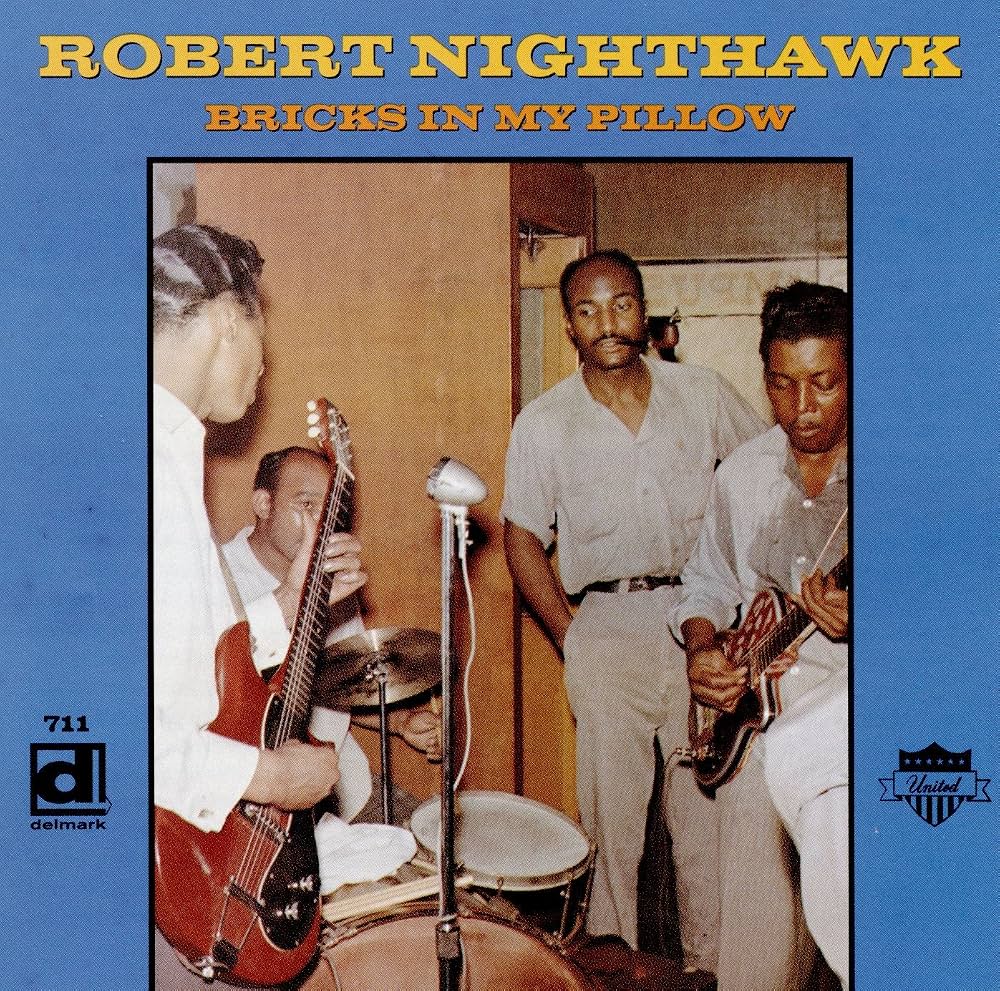
Originally released in 1978 on Pearl Records (a subsidiary of Chicago's Delmark Records, catalog no. PL-11) and subsequently reissued on CD as Delmark DD-711, Bricks in My Pillow is not a studio album in the conventional sense but rather a compilation of Robert Nighthawk's complete recordings for the United and States labels, cut during two sessions in 1951 and 1952. These fourteen tracks—including three previously unreleased alternate takes—represent what many critics consider the finest studio work of Nighthawk's career: the moment when the Delta bluesman's electrified slide guitar met the swinging, urbane rhythm section of postwar Chicago.
Recording Sessions & Production
The album was compiled from two sessions recorded for United Records, the first successful black-owned record company in Chicago, founded by A&R man Lew Simpkins and his financial partner Leonard Allen in July 1951.
United recorded Nighthawk on its very first day of sessions, July 12, 1951, alongside Roosevelt Sykes and J.T. Brown. Two of United's first five releases were by "Robert Nighthawk and his Nighthawks Band."
A second session followed on October 25, 1952, this time for United's subsidiary label, States.
While no single producer is credited in the modern sense, Lew Simpkins served as the label's A&R man and guiding force, while Leonard Allen oversaw operations. United's Allen later dismissed Nighthawk's commercial potential: "Robert Nighthawk? I didn't think nothin' of him. I didn't go into those joints where they were playing. Lew knew him—he had Robert Nighthawk in mind for the first session. So after he cut the session, it did nothin'."
The 1951 session ran smoothly—all four vocals were completed on the first take. The 1952 session required four hours and many additional takes, with "Maggie Campbell" going through eleven takes of varying tempos and piano accompaniments.
The album's title derives from its most famous track, which went unreleased for decades despite being, as one reviewer noted, "probably the song for which Robert Nighthawk is best remembered."
The Musicians
Nighthawk was backed by a formidable Chicago session rhythm section that propelled his Delta-rooted style into new territory:
July 12, 1951 Session:
-
Robert Nighthawk — Guitar, vocals
-
Roosevelt Sykes or Bob Call — Piano
-
Ransom Knowling — Bass
-
Jump Jackson — Drums (probable)
October 25, 1952 Session:
-
Robert Nighthawk — Guitar, vocals
-
Curtis Jones or Bob Call — Piano
-
Ransom Knowling — Bass
-
Unknown drummer
-
Unknown second guitarist (on select tracks)
Roosevelt Sykes, a fellow Helena, Arkansas native, played piano on at least some of the 1951 cuts and can be heard whooping and shouting on "Nighthawk Boogie."
Ransom Knowling's slap bass and Jump Jackson's rock-solid drumming lent what one critic called "plenty of excitement while Nighthawk plays some magnificent slide."
The addition of drums to Nighthawk's sound was significant. Where his earlier Chess/Aristocrat sides had been slower and more somber, the United recordings find him backed by a swinging combo that propels him "almost to the verge of rock and roll on up tempo numbers."
Track-by-Track Breakdown
July 12, 1951 Session
1. "Crying Won't Help You" (2:43)
Songwriter: Traditional/Adapted by Robert Nighthawk
Musicians: Robert Nighthawk (guitar, vocals), Roosevelt Sykes or Bob Call (piano), Ransom Knowling (bass), Jump Jackson (drums)
The album opens with a slow blues that became the B-side to "Kansas City Blues" on United 102. Nighthawk's slide guitar is immediately arresting—crystalline, piercing, and emotionally direct. The song would later become familiar to wider audiences through B.B. King's interpretation.
2. "Take It Easy, Baby" (2:40)
Songwriter: Traditional/Adapted by Robert Nighthawk
Musicians: Robert Nighthawk (guitar, vocals), Roosevelt Sykes or Bob Call (piano), Ransom Knowling (bass), Jump Jackson (drums)
A real rocker that finds the whole band taking off at a furious pace. Nighthawk had originally recorded this song back in 1937 for Bluebird under the name Robert Lee McCoy.
The United version is electrified and propulsive, with Nighthawk's slide guitar riding atop the barrelhouse piano and snapping bass. Released as the B-side to "Feel So Bad" on United 105.
Songwriter: Traditional/Adapted by Robert Nighthawk
Musicians: Robert Nighthawk (guitar, vocals), Roosevelt Sykes or Bob Call (piano), Ransom Knowling (bass), Jump Jackson (drums)
A real rocker that finds the whole band taking off at a furious pace. Nighthawk had originally recorded this song back in 1937 for Bluebird under the name Robert Lee McCoy.
3. "Nighthawk Boogie" (2:33)
Songwriter: Robert Nighthawk
Musicians: Robert Nighthawk (guitar, vocals), Roosevelt Sykes or Bob Call (piano), Ransom Knowling (bass), Jump Jackson (drums)
Nighthawk's theme song from his KFFA radio broadcasts, this frantic instrumental boogie showcases his band in full flight. Roosevelt Sykes can be heard shouting encouragement in the background.
The track remained unreleased until the Bricks in My Pillow compilation, which is remarkable given its energy and appeal.
Songwriter: Robert Nighthawk
Musicians: Robert Nighthawk (guitar, vocals), Roosevelt Sykes or Bob Call (piano), Ransom Knowling (bass), Jump Jackson (drums)
Nighthawk's theme song from his KFFA radio broadcasts, this frantic instrumental boogie showcases his band in full flight. Roosevelt Sykes can be heard shouting encouragement in the background.
4. "Kansas City" (2:34)
Songwriter: Jim Jackson (1927)
Musicians: Robert Nighthawk (guitar, vocals), Roosevelt Sykes or Bob Call (piano), Ransom Knowling (bass), Jump Jackson (drums)
A cover of Jim Jackson's 1927 classic "Kansas City Blues," delivered as a flat-out rockabilly thumper. The track's frenetic pace and slap bass would later inspire Ernest Tubb's Decca cover.
Released as the A-side of United 102, it demonstrates how close Nighthawk's sound was to the emerging rock and roll idiom.
Songwriter: Jim Jackson (1927)
Musicians: Robert Nighthawk (guitar, vocals), Roosevelt Sykes or Bob Call (piano), Ransom Knowling (bass), Jump Jackson (drums)
A cover of Jim Jackson's 1927 classic "Kansas City Blues," delivered as a flat-out rockabilly thumper. The track's frenetic pace and slap bass would later inspire Ernest Tubb's Decca cover.
5. "Feel So Bad" (2:44)
Songwriter: Adaptation of Big Bill Broonzy
Musicians: Robert Nighthawk (guitar, vocals), Roosevelt Sykes or Bob Call (piano), Ransom Knowling (bass), Jump Jackson (drums)
An adaptation of Big Bill Broonzy's tune of similar title, featuring fine, relaxed piano work that Nighthawk himself lauded during the session.
Released as the A-side of United 105.
Songwriter: Adaptation of Big Bill Broonzy
Musicians: Robert Nighthawk (guitar, vocals), Roosevelt Sykes or Bob Call (piano), Ransom Knowling (bass), Jump Jackson (drums)
An adaptation of Big Bill Broonzy's tune of similar title, featuring fine, relaxed piano work that Nighthawk himself lauded during the session.
October 25, 1952 Session
6. "Seventy-Four" (2:49)
Songwriter: Johnnie Temple (original: "Gonna Ride 74," 1938) / Willie Love & His Three Aces ("74 Blues," 1951)
Musicians: Robert Nighthawk (guitar, vocals), Curtis Jones or Bob Call (piano), Ransom Knowling (bass), unknown drummer
Originally cut by Johnnie Temple for Decca in 1938 and later covered by Willie Love & His Three Aces for Trumpet in 1951.
Nighthawk's version is a driving blues with his signature slide work to the fore.
Songwriter: Johnnie Temple (original: "Gonna Ride 74," 1938) / Willie Love & His Three Aces ("74 Blues," 1951)
Musicians: Robert Nighthawk (guitar, vocals), Curtis Jones or Bob Call (piano), Ransom Knowling (bass), unknown drummer
Originally cut by Johnnie Temple for Decca in 1938 and later covered by Willie Love & His Three Aces for Trumpet in 1951.
7. "Seventy-Four" (Alternate) (2:13)
Songwriter: Johnnie Temple
Musicians: Same as above
A shorter alternate take that reveals the experimentation occurring during the session.
Songwriter: Johnnie Temple
Musicians: Same as above
A shorter alternate take that reveals the experimentation occurring during the session.
8. "Maggie Campbell" (2:45)
Songwriter: Tommy Johnson (original: "Maggie Campbell Blues," 1928)
Musicians: Robert Nighthawk (guitar, vocals), Curtis Jones or Bob Call (piano), Ransom Knowling (bass), unknown drummer, unknown second guitarist
Best known from Tommy Johnson's 1928 Victor rendition, Nighthawk's version is taken at a rocking pace with an unusual rhythm that one critic likened to "a big band rumba."
The track went through eleven takes of varying tempos and piano accompaniments before this master was selected. Released as the A-side of States 131.
Songwriter: Tommy Johnson (original: "Maggie Campbell Blues," 1928)
Musicians: Robert Nighthawk (guitar, vocals), Curtis Jones or Bob Call (piano), Ransom Knowling (bass), unknown drummer, unknown second guitarist
Best known from Tommy Johnson's 1928 Victor rendition, Nighthawk's version is taken at a rocking pace with an unusual rhythm that one critic likened to "a big band rumba."
9. "Maggie Campbell" (Alternate) (2:53)
Songwriter: Tommy Johnson
Musicians: Same as above
An alternate take from the extensive session, offering a slightly different approach to the arrangement.
Songwriter: Tommy Johnson
Musicians: Same as above
An alternate take from the extensive session, offering a slightly different approach to the arrangement.
10. "The Moon Is Rising" (2:41)
Songwriter: Adapted from Ivory Joe Hunter's "Blues at Sunrise" (1945) / Kansas City Red repertoire
Musicians: Robert Nighthawk (guitar, vocals), Curtis Jones or Bob Call (piano), Ransom Knowling (bass), unknown drummer
A staple of Nighthawk's King Biscuit radio shows, this was a remake of Ivory Joe Hunter's 1945 hit "Blues at Sunrise."
Kansas City Red, Nighthawk's drummer in Helena, often sang the song. Released as the B-side of States 131, it features subtle slide work and laid-back piano accompaniment.
Songwriter: Adapted from Ivory Joe Hunter's "Blues at Sunrise" (1945) / Kansas City Red repertoire
Musicians: Robert Nighthawk (guitar, vocals), Curtis Jones or Bob Call (piano), Ransom Knowling (bass), unknown drummer
A staple of Nighthawk's King Biscuit radio shows, this was a remake of Ivory Joe Hunter's 1945 hit "Blues at Sunrise."
11. "The Moon Is Rising" (Alternate) (1:58)
Songwriter: Ivory Joe Hunter
Musicians: Same as above
A shorter alternate take.
Songwriter: Ivory Joe Hunter
Musicians: Same as above
A shorter alternate take.
12. "You Missed a Good Man" (2:32)
Songwriter: Tampa Red (1935) / Clarence Williams (original: "You Missed a Good Woman When You Picked All Over Me," 1915)
Musicians: Robert Nighthawk (guitar, vocals), Curtis Jones or Bob Call (piano), Ransom Knowling (bass), unknown drummer
Nighthawk likely picked up this song from Tampa Red, who recorded it in 1935. The basis of the song goes back much further, having been copyrighted by Clarence Williams in 1915 and first recorded by Trixie Smith in 1922.
Tampa Red reworked the lyrics, but the tune and chorus are identical. Nighthawk's version is a mid-tempo blues showcasing his deep, mellow voice.
Songwriter: Tampa Red (1935) / Clarence Williams (original: "You Missed a Good Woman When You Picked All Over Me," 1915)
Musicians: Robert Nighthawk (guitar, vocals), Curtis Jones or Bob Call (piano), Ransom Knowling (bass), unknown drummer
Nighthawk likely picked up this song from Tampa Red, who recorded it in 1935. The basis of the song goes back much further, having been copyrighted by Clarence Williams in 1915 and first recorded by Trixie Smith in 1922.
13. "Bricks in My Pillow" (2:54)
Songwriter: Bumble Bee Slim (original, 1935)
Musicians: Robert Nighthawk (guitar, vocals), Curtis Jones or Bob Call (piano), Ransom Knowling (bass), unknown drummer
The title track and arguably Nighthawk's most famous recording. Originally recorded by Bumble Bee Slim in 1935, the song features one of Nighthawk's most memorable lyrics: "I've got bricks in my pillow mama / And my head can't rest no more / Spiders crawling on my wall / Black snake lying round my floor."
That it remained unreleased until 1978 is one of the great mysteries of blues discography, as it sounds absolutely fine and would likely have been a hit.
Songwriter: Bumble Bee Slim (original, 1935)
Musicians: Robert Nighthawk (guitar, vocals), Curtis Jones or Bob Call (piano), Ransom Knowling (bass), unknown drummer
The title track and arguably Nighthawk's most famous recording. Originally recorded by Bumble Bee Slim in 1935, the song features one of Nighthawk's most memorable lyrics: "I've got bricks in my pillow mama / And my head can't rest no more / Spiders crawling on my wall / Black snake lying round my floor."
14. "U/S Boogie" (2:58)
Songwriter: Robert Nighthawk (instrumental)
Musicians: Robert Nighthawk (guitar), Curtis Jones or Bob Call (piano), Ransom Knowling (bass), unknown drummer, unknown second guitarist
Another instrumental boogie from the 1952 session, this track remained unreleased until the Pearl compilation. It features Nighthawk's magnificent slide guitar in a relaxed, swinging setting, with the unknown second guitarist adding rhythmic texture.
Buy This Album
Critical Assessment & Legacy
Bricks in My Pillow represents Robert Nighthawk melding the sound of the Delta with the more urbane sounds of postwar Chicago. While these recordings are more stylistically diverse than his Chess sides, they also contained fewer originals—most songs had been in his repertoire for years, drawn from radio broadcasts, fellow bluesmen, and the broader tradition.
The album's influence extends far beyond blues circles. Given their 1951/52 release dates, a case could be made that Nighthawk recorded some of the first examples of what would later be called rockabilly—all that's missing is the hiccups.
Nighthawk never achieved the commercial success United had hoped for. He drifted south after the 1952 session, not to record again in a studio until 1964. He was rediscovered busking on Maxwell Street in 1963, leading to a brief flurry of activity before his death from a heart attack in 1967.
Today, Bricks in My Pillow stands as an essential document of postwar Chicago blues and one of the finest slide guitar albums ever recorded. As one critic declared, it is "one of the finest albums I've ever heard"—a testament to the singular genius of a Delta bluesman who electrified his sound and, in the process, helped lay the groundwork for rock and roll.