
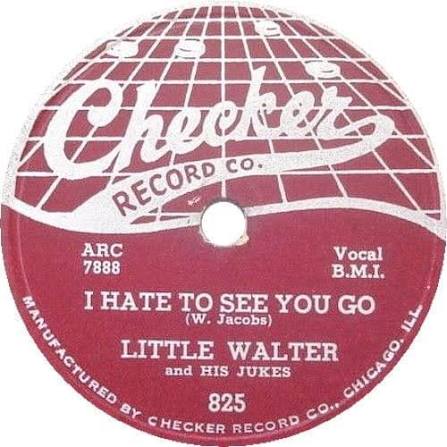
“I Hate to See You Go” (also known as “Hate to See You Go”) is a 1955 Little Walter recording that reworks a Bo Diddley groove into a stomping Chicago blues showcase for Walter’s amplified harmonica and vocal. It was released as the B-side of Checker 825 and later became the title track of a posthumous 1969 Chess compilation.
Recording Session and Production
The song was recorded on April 28, 1955, at Universal Recording Studios in Chicago. It was released in September 1955 as the B-side of “Too Late” on Checker 825. Producers were Leonard Chess and Phil Chess. The track did not chart but has endured as one of Walter’s stronger mid-1950s sides.
An earlier related track, Bo Diddley’s “You Don’t Love Me (You Don’t Care),” had been cut in early March 1955 but was held back by Chess; Walter’s version was issued instead.
Musicians
- Little Walter (Marion Walter Jacobs): vocals and harmonica
- Bo Diddley (Ellas McDaniel): guitar (providing the signature descending riff)
- Luther Tucker: guitar
- Robert Lockwood Jr.: guitar (on some accounts of the session)
- Willie Dixon: bass
- Fred Below: drums
Bo Diddley’s participation is significant—he contributed the distinctive guitar hook from his own earlier recording, creating a direct link between the two versions.
Songwriters
Little Walter is credited as the songwriter (Walter Jacobs). The song is a clear reworking of Bo Diddley’s “You Don’t Love Me (You Don’t Care),” recorded only a month earlier. Diddley’s original is a one-chord modal blues with a driving, hypnotic groove and a descending guitar figure. Walter kept the rhythmic foundation and the guitar hook but supplied new lyrics and a more aggressive, harmonica-driven arrangement.
Walter’s lyrics focus on abandonment and pleading:
“Gone and left me, left me here to cry
Know I love her, she’s my desire
…
Come on back baby, don’t do me wrong
You know I love you, please come back home”
Interestingly, the title phrase “I hate to see you go” does not appear in the lyric itself. The songwriting credit to Walter reflects the common practice of the era, in which an artist who substantially reworked a floating or recently recorded idea often received authorship. Bo Diddley’s cooperation (he played on the session) suggests the adaptation was amicable.
The result is a classic example of how Chicago blues artists shared and transformed material in real time—taking a strong rhythmic idea and reshaping it to suit a different voice and instrumental approach.
Musical Style and Analysis
“I Hate to See You Go” is a mid-tempo, one-chord modal blues lasting about 2:16. It abandons the standard I–IV–V progression in favor of a single chord that creates a hypnotic, driving feel. The arrangement is built around Bo Diddley’s descending guitar riff, a hard-driving rhythm section, and Walter’s amplified harmonica, which sits right at the edge of feedback.
Walter’s harmonica is aggressive and forward in the mix. He uses the instrument both as a rhythmic driver and as a lead voice, producing a thick, slightly distorted tone that was revolutionary at the time. His vocal delivery is urgent and pleading, matching the lyric’s sense of desperation. Fred Below’s drumming provides a solid, shuffling foundation that propels the track without overpowering it, while Dixon’s bass locks in the groove.
The overall effect is a stomping, almost rock-oriented blues that sits between traditional Chicago blues and the emerging rock & roll energy of the mid-1950s. The modal structure and repetitive riff give the song a modern, trance-like quality that later appealed strongly to British blues and rock musicians.
Buy The Album
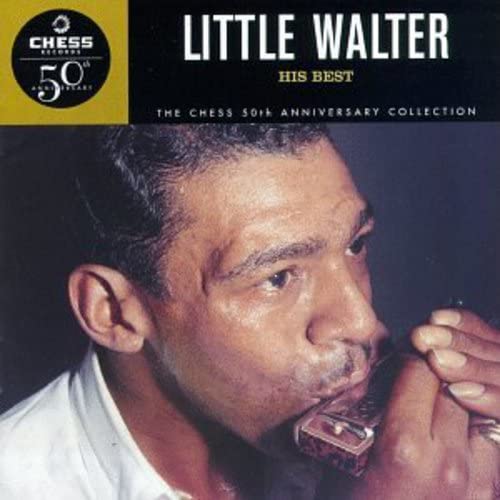 Buy from Amazon His Best: The Chess 50th Anniversary Collection
Other Versions and Covers
The most prominent later version is by the Rolling Stones, who recorded it for their 2016 album Blue & Lonesome and released it as a single. Other notable covers and related versions include performances by the Paul Butterfield Blues Band, Magic Sam, Junior Wells & Buddy Guy, Charlie Musselwhite, George Thorogood, and various contemporary blues artists. Bo Diddley’s original “You Don’t Love Me” has also been widely covered in its own right.
Legacy
“I Hate to See You Go” is a strong example of Little Walter’s ability to take an existing idea and transform it into something personal and powerful. It highlights the collaborative, competitive atmosphere at Chess in the mid-1950s, where artists freely borrowed and reworked each other’s material. The song’s modal groove, Bo Diddley’s guitar contribution, and Walter’s fierce harmonica playing make it a standout track from his peak years.
Its later revival by the Rolling Stones introduced it to a new generation and confirmed its status as a durable piece of Chicago blues. Along with sides such as “My Babe,” “Last Night,” and “Juke,” it helps illustrate why Little Walter remains the most influential harmonica player in postwar blues.









