Overview
"Rollin' and Tumblin'" is one of the most recorded, reinterpreted, and historically significant songs in the entire blues canon. For Muddy Waters specifically, it was not a single performance or a single session — it was a song he returned to multiple times across his career, each recording reflecting a different phase of his artistry, a different band configuration, and a different production context. The song connects the raw Delta blues of the 1920s and 1930s to the electrified Chicago sound of the postwar era, and ultimately to the rock and roll explosion of the 1960s and beyond.
This analysis covers every significant Muddy Waters recording of "Rollin' and Tumblin'," tracing the full arc from its pre-history through the Chess Records era and into the acoustic folk-blues revival of the 1960s.
Part I: The Song's Origins and Pre-History
The Delta Blueprint
Before Muddy Waters ever set foot in a recording studio, "Rollin' and Tumblin'" already had a documented history stretching back to the earliest days of recorded Delta blues.
Hambone Willie Newbern is widely credited with the first recorded version of the song's core musical framework. Newbern — a shadowy figure from Brownsville, Tennessee — recorded "Roll and Tumble Blues" for Okeh Records in 1929. His recording features the distinctive open-tuned, slide-driven guitar riff that would become the song's defining fingerprint: a hypnotic, rolling bass-string figure in open G or open D tuning, with a bottleneck slide riding over the top. The lyrical content — a man lamenting a restless, troubled life and an unfaithful woman — established the thematic template that virtually every subsequent version would draw from.
Robert Johnson, the most mythologized figure in Delta blues history, recorded a version called "If I Had Possession Over Judgment Day" in 1936 for Vocalion Records in San Antonio, Texas. Johnson's version uses the same rolling riff and shares lyrical DNA with Newbern's recording, though Johnson characteristically transformed the material into something more personal and psychologically complex. Some researchers argue Johnson's recording is a direct derivative of Newbern's; others see it as a parallel development from a common folk tradition. Either way, Johnson's version became enormously influential on the generation of Chicago bluesmen who followed.
Muddy Waters himself grew up in the Mississippi Delta — on Stovall's Plantation near Clarksdale — and absorbed this tradition directly. Researcher and musicologist Alan Lomax recorded Muddy playing Delta blues in the field in 1941 and 1942 for the Library of Congress, capturing him in a raw, unaccompanied acoustic style that shows the direct lineage from Newbern and Johnson. Though Lomax's recordings do not include a version of "Rollin' and Tumblin'" specifically, they document the stylistic world from which Muddy's eventual recordings of the song emerged.
Part II: The Baby Face Leroy Trio Recording (Parkway Records, 1950)
Background
The first recording of "Rollin' and Tumblin'" to feature Muddy Waters was not released under his own name. It was recorded under the name of Baby Face Leroy Foster and released on the small Chicago independent label Parkway Records in 1950.
Baby Face Leroy Foster
Baby Face Leroy Foster (born Leroy Foster, January 1, 1923, Algoma, Mississippi; died May 26, 1958, Chicago) was a multi-instrumentalist who could play both guitar and drums. He was a regular presence in the Muddy Waters circle during the late 1940s and early 1950s, gigging on Chicago's South Side club circuit and sitting in on recording sessions for Aristocrat and Chess Records. He was a member of what was informally known as the Muddy Waters band during this period, a loose aggregation of musicians that included Little Walter, Jimmy Rogers, and others.
The Session
The Parkway session that produced this recording of "Rollin' and Tumblin'" took place in early 1950 in Chicago. The personnel consisted of:
- Baby Face Leroy Foster — vocals, guitar (or drums, depending on the take)
- Muddy Waters (McKinley Morganfield) — guitar
- Little Walter (Marion Walter Jacobs) — harmonica
This was an extraordinarily powerful combination. Little Walter was at this point already one of the most innovative harmonica players in Chicago, developing the amplified harp sound that would soon revolutionize the instrument. Muddy Waters was already a Chess Records artist with several strong regional hits to his name. The three musicians had been playing together in clubs and were deeply rehearsed in each other's styles.
The recording captures the song in a raw, almost feral state — the electric guitars distorted and aggressive, Little Walter's amplified harp cutting through the mix like a second lead instrument, Baby Face Leroy's vocals rough and urgent. The arrangement is minimal: the rolling riff forms the entire harmonic and rhythmic foundation, with no chord changes in the conventional sense, just the relentless forward momentum of the groove.
Release and Controversy
The record was released on Parkway Records (label number not widely documented in surviving catalogs) in 1950, credited to the Baby Face Leroy Trio.
The release caused a significant problem. Muddy Waters was under contract to Aristocrat/Chess Records (Aristocrat was transitioning to Chess at this period), and Leonard Chess — co-founder of the label — was furious when he discovered that Muddy had recorded for a competing label. Leonard Chess had been carefully building Muddy's profile as an exclusive Chess artist, and the unauthorized Parkway session was a direct breach of that arrangement. According to accounts documented in blues histories, Leonard Chess confronted Muddy about the recording, and it created a significant tension in their relationship, though the two continued working together.
The Parkway recording is historically important as the first documented electric-band recording of "Rollin' and Tumblin'" and as a snapshot of the Muddy Waters band at a particularly raw and powerful moment, before the Chess studio recordings began to refine and polish the sound.
Part III: The Aristocrat / Chess Records Recordings (1950)
Context: The Aristocrat-to-Chess Transition
Aristocrat Records was founded in Chicago in 1947 by Leonard Chess, his brother Phil Chess, and Evelyn Aron. By 1950, Leonard Chess had bought out Aron's share and was in the process of transitioning the label to a new name: Chess Records. This transition happened gradually through 1950, with some releases carrying the Aristocrat imprint and others the new Chess imprint. Muddy Waters was the label's most important artist during this period.
The January / February 1950 Session — Aristocrat 412
Leonard Chess, having learned about the Baby Face Leroy Trio recording on Parkway, moved quickly to record his own, Chess-controlled version of "Rollin' and Tumblin'" with Muddy Waters. This session took place in early 1950 (some sources indicate January, others February) at a Chicago recording facility.
Personnel:
- Muddy Waters — vocals, electric guitar (slide)
- Big Crawford (Ernest "Big" Crawford) — upright bass
This was a stark, stripped-down duo recording. Big Crawford was Muddy's regular bassist during this period — a large, physically imposing man who played a simple but rock-solid upright bass. The absence of drums, harmonica, or second guitar throws all the focus onto Muddy's slide guitar and vocals, creating a sound that is simultaneously more intimate and more raw than the Baby Face Leroy Trio version.
The session produced two parts:
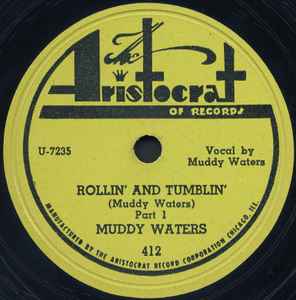
"Rollin' and Tumblin' Part 1" (matrix number U-7235) and "Rollin' and Tumblin' Part 2" (matrix number U-7236) were released as a double-sided single on Aristocrat 412 in February 1950 (with distribution continuing into March 1950). The two-part format was a common practice for blues singles of the era, allowing the song to extend across both sides of a 78 rpm disc.
The recording was produced by Leonard Chess (and/or Evelyn Aron, who was still involved with the label at this transitional moment), though formal production credits in the modern sense were not applied to Chess/Aristocrat recordings of this period — Leonard Chess functioned as the de facto producer, making decisions about arrangements, takes, and sound.
Songwriting Credit
The song was credited to Muddy Waters (McKinley Morganfield) on the Aristocrat release, though as with virtually all traditional blues material of this era, the actual songwriting lineage was far more complex. The core musical material derived from the Hambone Willie Newbern / Robert Johnson tradition, and Muddy's "composition" consisted primarily of his arrangement, his lyrical adaptations, and his performance approach. The practice of blues artists claiming copyright on traditional material they had reworked was universal in this period.
Part IV: The Chess Records Re-Recording (July 11, 1951)
A Powerhouse Session
On July 11, 1951, Leonard Chess convened what historian Robert Campbell has described as a "powerhouse session" for Muddy Waters at the Chess recording facility in Chicago. By this point, Chess Records was fully established under its new name and Leonard Chess was aggressively building his roster and refining his recording approach.
Personnel:
- Muddy Waters — vocals, electric guitar (slide)
- Jimmy Rogers (James A. Lane) — second electric guitar
- Little Walter (Marion Walter Jacobs) — harmonica
- Elgin Evans — drums
- Big Crawford — upright bass
This was the full Muddy Waters band configuration of the early 1950s — the lineup that would define the Chicago electric blues sound. Jimmy Rogers provided rhythm guitar and subtle second-guitar fills. Little Walter's amplified harmonica was now fully developed as a lead instrument. Elgin Evans held down the drums with a steady, swinging feel. Big Crawford anchored the bottom.
The July 11, 1951 session produced a re-recording of "Rollin' and Tumblin'" (matrix numbers U-7261, U-7262, and U-7263 appear in some discographic sources, suggesting multiple takes were cut). This version was released on Chess 1434 in 1950 (some discographic sources list this with a 1950 release date despite the 1951 session, reflecting the sometimes inconsistent dating in Chess Records documentation of this period).
Producer: Leonard Chess
This version is fuller and more driving than the 1950 duo recording, the full band pushing the groove with greater momentum. Little Walter's harp adds a keening, wailing dimension above Muddy's slide guitar, and the interplay between the two instruments — both essentially playing lead simultaneously — creates an extraordinary density of sound.
Part V: The "Folk Singer" Album Recording (1963)
Context: The Folk Blues Revival
By the early 1960s, the cultural landscape around blues music had shifted dramatically. The folk revival movement — centered in New York's Greenwich Village and spreading across college campuses — had created a new, largely white, educated audience for acoustic blues. Artists like John Lee Hooker, Sonny Terry and Brownie McGhee, and Mississippi John Hurt were being rediscovered and presented to this new audience. Chess Records, under the influence of producer and A&R man Willie Dixon, recognized an opportunity to reposition Muddy Waters for this audience.
The result was "Folk Singer" — a landmark album recorded at Chess Records' studio at 2120 South Michigan Avenue, Chicago in 1963 (sessions primarily in late 1963, with the album released in January 1964).
The "Folk Singer" Sessions
Producer: Willie Dixon (with Leonard Chess overseeing) Engineer: Ron Malo (Chess Records' house engineer, who had worked on virtually all of the label's major recordings of the late 1950s and early 1960s)
Willie Dixon conceived "Folk Singer" as a deliberately acoustic, intimate album — a radical departure from the electrified Chicago blues that had defined Muddy's sound for over a decade. The idea was to strip everything back to acoustic guitar and small ensemble, presenting Muddy as a primal, authentic voice of the Delta tradition.
Core Personnel for the "Folk Singer" Sessions:
- Muddy Waters — vocals, acoustic guitar
- Buddy Guy (George Guy) — second acoustic guitar
- Willie Dixon — upright bass
- Clifton James — drums (brushes, used very sparingly)
The presence of Buddy Guy on acoustic guitar is one of the most celebrated aspects of the "Folk Singer" sessions. Guy — who was himself a Chess Records artist and already an acknowledged guitar virtuoso — plays with remarkable restraint and sensitivity, subordinating his own considerable technique to serve Muddy's vision. Photographs from the session, taken inside the Chess Records studio, show Muddy, Dixon, and Guy in close proximity around microphones, capturing the intimate, conversational dynamic that defines the album's sound.
"Rollin' and Tumblin'" on "Folk Singer"
The "Folk Singer" version of "Rollin' and Tumblin'" is acoustically presented, with Muddy playing slide on acoustic guitar — returning the song, in a sense, to its Delta roots. The arrangement is spare: Muddy's slide guitar carries the rolling riff, Buddy Guy provides subtle rhythm guitar, and Willie Dixon's bass provides a deep, woody underpinning. The drums are used with extreme restraint, barely present in the mix.
The recording has a quality of deliberate, meditative intensity. Muddy's voice is deeper and more weathered than on the 1950 recordings — he was in his early 50s by this point — and the acoustic setting strips away the electric energy of the earlier versions, replacing it with something rawer and more elemental.
This version was noted by producer Ry Cooder (who later worked with various blues artists) as an example of exceptional acoustic slide guitar playing.
Songwriting credit: Muddy Waters (McKinley Morganfield)
Part VI: Legacy Recordings and Notable Cover Versions
Muddy Waters' Ongoing Relationship with the Song
Beyond the primary recording sessions documented above, Muddy Waters performed "Rollin' and Tumblin'" throughout his live career. The song was a staple of his live performances from the early 1950s until his death in 1983, and it appears in various live recordings and compilation releases from across the decades.
The Song's Influence on Rock and Roll
"Rollin' and Tumblin'" became one of the most covered songs in the blues-to-rock transmission that defined the 1960s British and American rock explosion:
- Cream recorded a version on their debut album "Fresh Cream" (1966), credited to Eric Clapton. The Cream version is heavily electrified and extended, with Clapton's guitar taking the rolling riff into psychedelic blues-rock territory. The songwriting credit to Clapton rather than Muddy Waters or the earlier sources was a source of controversy.
- The Yardbirds performed versions of the song during their live sets, with both Eric Clapton and later Jeff Beck interpreting the material.
- Canned Heat recorded versions in the late 1960s.
- Bob Dylan recorded a version for his 2006 album "Modern Times", crediting the song to himself — a decision that reignited the ongoing debate about songwriting credits for traditional blues material.
- Johnny Winter, Elmore James, and numerous other artists recorded versions across the decades.
Part VII: Key Personnel Profiles
Muddy Waters (McKinley Morganfield)
Born April 4, 1913 (some sources say 1915), on Issaquena County, Mississippi; raised on Stovall's Plantation near Clarksdale, Mississippi. Died April 30, 1983, Westmont, Illinois. Muddy Waters was the central architect of the Chicago electric blues sound and one of the most influential musicians of the 20th century. His slide guitar technique — derived from the Delta tradition of Son House and Robert Johnson — translated powerfully to the electric guitar, and his Chess Records recordings of the late 1940s through the 1950s defined the template that rock and roll would build upon.
Baby Face Leroy Foster
Born January 1, 1923, Algoma, Mississippi. Died May 26, 1958, Chicago, Illinois. A versatile guitarist and drummer who was a key member of the early Muddy Waters circle. His 1950 Parkway recording of "Rollin' and Tumblin'" with Muddy Waters and Little Walter is one of the rawest and most powerful documents of the Chicago blues transition period.
Little Walter (Marion Walter Jacobs)
Born May 1, 1930, Marksville, Louisiana. Died February 15, 1968, Chicago, Illinois. Widely regarded as the greatest blues harmonica player of all time. Little Walter transformed the harmonica from a folk instrument into an amplified lead voice capable of competing with electric guitars. His presence on the 1950 Baby Face Leroy Trio session and the 1951 Chess session gives those recordings much of their extraordinary intensity.
Big Crawford (Ernest "Big" Crawford)
Muddy Waters' regular bassist from the late 1940s through the early 1950s. Big Crawford played upright bass with a simple, direct style that anchored the early Chess recordings. He appears on both the 1950 Aristocrat duo session and the 1951 Chess band session.
Jimmy Rogers (James A. Lane)
Born June 3, 1924, Ruleville, Mississippi. Died December 19, 1997, Chicago, Illinois. Jimmy Rogers was Muddy Waters' most important musical partner during the early Chess years, providing rhythm guitar and occasional lead guitar in a style that perfectly complemented Muddy's slide playing. His understated, rhythmically precise approach was essential to the sound of the Muddy Waters band.
Elgin Evans
Drummer for the Muddy Waters band during the early 1950s. Evans provided the steady, swinging rhythmic foundation for the Chess recordings of this period, helping to translate the Delta blues groove into the urban Chicago context.
Willie Dixon (William James Dixon)
Born July 1, 1915, Vicksburg, Mississippi. Died January 29, 1992, Burbank, California. Willie Dixon was the most important behind-the-scenes figure in the history of Chess Records — serving simultaneously as bassist, songwriter, arranger, talent scout, and producer. He wrote many of Muddy Waters' greatest hits ("Hoochie Coochie Man," "I'm Ready," "I Just Want to Make Love to You") and produced the "Folk Singer" album, which included the acoustic version of "Rollin' and Tumblin'."
Buddy Guy (George Guy)
Born July 30, 1936, Lettsworth, Louisiana. One of the most gifted guitarists in the history of blues and rock. Buddy Guy's appearance on the "Folk Singer" sessions as acoustic rhythm guitarist is one of the most celebrated examples of his ability to subordinate his own virtuosity to serve a larger musical vision.
Leonard Chess
Born October 12, 1917, Motal, Poland (then Russian Empire). Died October 16, 1969, Chicago, Illinois. Co-founder of Chess Records with his brother Phil Chess. Leonard Chess was the de facto producer of virtually all of the label's most important recordings from the late 1940s through the 1960s, including the Muddy Waters sessions. His ear for sound, his willingness to experiment with microphone placement and room acoustics, and his ability to coax extraordinary performances from his artists made Chess Records the most important blues label in American history.
Ron Malo
Chess Records' house recording engineer from the late 1950s through the 1960s. Malo engineered many of the label's most celebrated recordings, including the "Folk Singer" sessions. His work at 2120 South Michigan Avenue helped define the sonic character of the Chess sound.
Part VIII: Discographic Summary of Muddy Waters' "Rollin' and Tumblin'" Recordings
| Version | Year | Label / Release | Personnel | Producer |
|---|---|---|---|---|
| Baby Face Leroy Trio | 1950 | Parkway Records | Baby Face Leroy Foster (vcl, gtr), Muddy Waters (gtr), Little Walter (harp) | Uncredited (Parkway) |
| Aristocrat 412 (Part 1 & 2) | 1950 | Aristocrat 412 | Muddy Waters (vcl, gtr), Big Crawford (bass) | Leonard Chess / Evelyn Aron |
| Chess 1434 Re-recording | 1951 | Chess 1434 | Muddy Waters (vcl, gtr), Jimmy Rogers (gtr), Little Walter (harp), Elgin Evans (drums), Big Crawford (bass) | Leonard Chess |
| Folk Singer (LP) | 1963 | Chess LP-1483 | Muddy Waters (vcl, acoustic gtr), Buddy Guy (acoustic gtr), Willie Dixon (bass), Clifton James (drums) | Willie Dixon |
Part IX: Musical Analysis
The Core Riff
The defining musical element of "Rollin' and Tumblin'" is its guitar riff — a rolling, repeating figure played in open G or open D tuning with a bottleneck slide. The riff functions simultaneously as melody, harmony, and rhythm: it establishes the tonal center, provides the forward momentum of the groove, and carries the melodic content all at once. This is characteristic of Delta blues slide guitar, where the slide technique collapses the distinction between lead and rhythm playing.
The riff is built on the I chord (the tonic), with the slide creating microtonal inflections — blue notes — that fall between the fixed pitches of Western equal temperament. These inflections are central to the emotional character of the music.
The Structure
The song uses a loose variation of the 12-bar blues form, though Muddy Waters and other performers often stretched or compressed the form according to feel rather than adhering strictly to the 12-bar template. The lyrics follow the AAB pattern of traditional blues verse — the first line stated, repeated (often with slight variation), and then resolved with a contrasting third line.
Lyrical Themes
The lyrics of "Rollin' and Tumblin'" deal with restlessness, displacement, and romantic trouble — universal blues themes. The central image of "rolling and tumbling" suggests both physical restlessness (travelling, moving) and emotional turbulence. The narrator is a man in motion, unable to settle, troubled by a woman who has either left him or wronged him. The image of "crying the whole night long" recurs across multiple versions and speaks to the song's emotional core.
Evolution Across Recordings
Comparing the four primary Muddy Waters versions reveals a fascinating arc:
- The 1950 Baby Face Leroy Trio version is the most raw and aggressive — three musicians playing at full intensity with minimal studio polish.
- The 1950 Aristocrat duo version is the most stripped-back — just Muddy and Big Crawford, creating a direct line from Delta blues to Chicago.
- The 1951 Chess band version is the most fully realized electric Chicago blues version — the full band creating a sound that would directly influence rock and roll.
- The 1963 Folk Singer version completes a circle — returning to acoustic instruments, but with the weight of Muddy's entire career behind the performance.
Part X: Cultural Significance and Legacy
"Rollin' and Tumblin'" is one of a handful of blues songs that can legitimately be called foundational to the entire trajectory of popular music in the 20th century. The rolling riff that Hambone Willie Newbern first recorded in 1929 passed through Robert Johnson, through Muddy Waters, through the Chess Records studio, and into the ears of the British musicians — Clapton, Page, Beck, Richards — who would transform it into rock and roll.
Muddy Waters' multiple recordings of the song document not just his own artistic evolution but the evolution of American popular music itself: from the acoustic Delta, through the electrified Chicago South Side, through the folk revival, and into the rock era. Each of his versions is a distinct artifact, a snapshot of a specific moment in that larger story.
The song's enduring vitality — still performed and recorded regularly in the 21st century — is testament to the power of its core musical idea: that rolling, tumbling riff, those blue notes bending off the slide, that voice crying through the night.
Sources: Robert Campbell's Chess/Aristocrat label discographies; Blues Foundation Hall of Fame documentation; MusicBrainz release data; Discogs Chess Box release credits; KNKX public radio blues history documentation; Encyclopedia.com Muddy Waters biography; Wikipedia Muddy Waters discography; Stefan Wirz Blues Discography; Alan Lomax field recordings documentation.