
If you have never heard a note of classic blues, Mamie Smith is the logical place to begin, not because she was the greatest singer of the era, but because she was the first. Her August 1920 recording of "Crazy Blues" is the Big Bang of recorded female blues, the moment when an industry recognized that a Black woman singing blues and jazz could sell records to a mass audience. To listen to "Crazy Blues" today is to hear the sound of a door being kicked open. The record begins with a cornet fanfare, followed by Smith's contralto entering with a theatrical flourish that owes as much to vaudeville as it does to the Delta. The structure is not a strict twelve-bar blues but a hybrid that embeds blues choruses within a broader pop architecture, and the lyrics build from romantic lament to emotional declaration with a dramatic arc that reveals Smith's years on the stage. It is not the most musically complex record she made, nor the most emotionally devastating, but it is the most important, and every blues record by a Black woman that followed exists in its shadow.
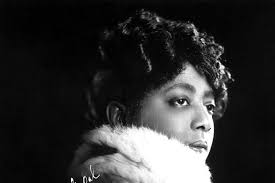
Mamie Smith: The Gateway to the Blues
- Details
- Written by: Simon Godfrey
- Category: Listening Guides
- Hits: 75
Once you have absorbed "Crazy Blues," the next logical step is to hear what Smith sounded like before she had the Jazz Hounds behind her. Her first recording session, from February 1920, produced "That Thing Called Love" and "You Can't Keep a Good Man Down," both Perry Bradford compositions performed with what was likely an all-white studio orchestra. These sides are more conventional than her later work, closer to the popular ballads of the day, but they reveal a singer already in command of her instrument. The 1921 re-recording of "That Thing Called Love" with the Jazz Hounds adds the instrumental heat that the earlier version lacked, and comparing the two provides an immediate lesson in how the presence of Black jazz musicians transformed the blues from popular song into something more urgent and alive.
The early Jazz Hounds recordings represent the next phase of exploration. "It's Right Here for You (If You Don't Get It, 'Taint No Fault of Mine)," recorded at the same August 1920 session as "Crazy Blues," is a raucous, good-time number that showcases the ensemble's cohesion and Smith's ability to sell a lyric with theatrical precision. "Royal Garden Blues," from January 1921, is essentially an instrumental showcase for cornetist Johnny Dunn and the band, with Smith's vocal interjections serving as punctuation rather than narrative. It is valuable for understanding the instrumental prowess of the Jazz Hounds, which included at various times Bubber Miley, Buster Bailey, and the young Coleman Hawkins. "Baby, You Made Me Fall for You" and "U Need Some Loving Blues," both from 1921, demonstrate Smith's range as a romantic vocalist, while "What Have I Done?" reveals the melancholy strain that runs through even her most upbeat material.
By 1922, Smith and the Jazz Hounds were producing records of remarkable variety and confidence. "I Ain't Gonna Give Nobody None o' This Jelly Roll" is a risqué romp that winks at the sexual subtext of jazz-age nightlife, its title referencing both the pastry and the slang term for female sexuality. "Mean Daddy Blues" and "Lonesome Mama Blues" explore the darker emotional territory of abandonment and longing with a directness that was still novel for popular recordings. "You Can Have Him, I Don't Want Him, Didn't Love Him Anyhow Blues" delivers its kiss-off with a swagger that would influence generations of female vocalists. And "New Orleans," from the same year, captures the city's musical spirit with an exuberance that transcends its simple structure.
The 1923 recordings with the Harlem Trio, including "Kansas City Man Blues" and "Lady Luck Blues," show Smith adapting to smaller ensemble settings with equal facility. These sides are less frenetic than the Jazz Hounds recordings, allowing her voice more space to breathe and her phrasing more room to stretch. They are transitional works, pointing toward the more refined approach she would take in her final sessions.
Those final sessions, made for Victor Records in 1931, produced some of her finest work and represent an essential stop for any serious listener. "Don't You Advertise Your Man" is a masterclass in vocal control and dramatic interpretation, with the band providing tight, responsive accompaniment. "Jenny's Ball," her only record released in Britain, captures the call-and-response energy of Harlem cabaret with cornet commentary and piano figures that finally emerge clearly from the acoustic recording process. "Golfing Papa" and "Keep a Song in Your Soul" demonstrate that even after eleven years of recording, Smith remained an artist of consequence, her voice matured and her interpretive instincts sharpened by a lifetime on the stage.
For the newcomer who wants a single collection, the Document Records series "Mamie Smith: Complete Recorded Works" gathers everything in chronological order, and while the sheer volume can be daunting, the journey from the tentative 1920 sides to the assured 1931 masters traces the arc of an artist who grew with the medium she helped create. Alternatively, any compilation that includes "Crazy Blues," "Don't You Advertise Your Man," and "Jenny's Ball" will provide a representative sample of her range.